

Torrens title is the standard ownership system for most houses in New South Wales, but that does not mean a buyer can relax once they see a clean title search. CS Conveyancing Services, an online NSW-wide conveyancing practice, regularly deals with contracts where the bigger risk is not ownership itself, but the restrictions, caveats and missing checks around the land.
TL;DR: Summary
- The main Torrens title disadvantage for NSW buyers is a false sense of safety: the register confirms ownership, but caveats, easements, encumbrances and non-title issues can still affect settlement or how you use the property.
- In NSW, caveat emptor still matters, so buyers must investigate title and suitability before exchange even though the contract includes a title search, registered plan and recorded dealings.
- A caveat can stop further dealings until resolved, while easements, covenants and other registered interests can stay on title and limit building, access, drainage or future resale.
- NSW Government guidance also points buyers to checks beyond title, including government authority interests, planned development, illegal building work and fence disputes.
- For first home buyers, a fast pre-exchange review from a licensed conveyancer such as CS Conveyancing Services helps connect the title documents to practical risks, finance timing and settlement decisions.
That distinction matters because Torrens title is a registration system, not a promise that every defect or planning issue has already been uncovered. For NSW first home buyers, the smarter question is not “Is the title genuine?” but “What could still affect this property even with Torrens title?”
What is the main disadvantage of Torrens title in NSW?
The main disadvantage is overconfidence. NSW Land Registry Services gives a reliable register of ownership, yet a Torrens title property can still carry caveats, easements, encumbrances and practical risks that are not solved by registration alone.
The strength of Torrens title is indefeasibility, meaning the register is the single source of truth for ownership. That protects buyers from many historic title-chain problems. Still, NSW buyers can mistake “clear ownership” for “clear property.” Those are different things. A title search may show registered dealings, but it does not replace investigation into illegal structures, boundary use, authority interests or nearby development.
“CS Conveyancing Services offers 24–48 hour contract reviews for NSW buyers who need caveats, easements and contract risks checked before exchange.”
The NSW Registrar General’s framework also reflects a fully electronic system. Since 2021, certificates of title are no longer issued for new dealings, so buyers should not assume a paper title will reveal extra security. Common misconception: if a property is Torrens title and the bank is lending, every legal and practical issue must have been checked. That is not how NSW conveyancing works.
Does Torrens title mean the property is problem-free?
No. Torrens title gives ownership certainty through registration, but it does not guarantee the land is free from easements, caveats, illegal works, fencing disputes or planning constraints.
A useful way to frame this is the phrase from NSW authority material and case law: Torrens is title by registration, not merely registration of title. Once registered, the owner gets strong legal recognition. Yet that registered proprietor still holds the property subject to interests the law preserves.
If a caveat has been lodged, the land may be difficult to deal with until the competing claim is sorted out. If an easement exists, the burden may remain long after settlement. If a garage conversion lacks approval, the title can still be valid while the improvement creates cost and risk. For a first home buyer, that trade-off matters. Torrens title reduces one category of uncertainty, but it does not remove the need for due diligence.
What are the 7 Torrens title disadvantages NSW buyers should know?
The seven key disadvantages are practical, not theoretical. They affect settlement timing, finance, future building plans and how confident you can be before exchange.
-
A clean title can create false comfort. The register is strong evidence of ownership, but it is not a full property health check.
-
Caveats can stop the deal. A caveat is designed to prevent further dealings with the land until a competing interest is resolved.
-
Easements can restrict use. Rights of way, drainage easements and sewer easements can limit where you build, fence or landscape.
-
Other dealings may stay on title. Restrictive covenants, mortgages or positive covenants can affect finance, construction plans or resale.
-
Government interests may sit outside what buyers casually inspect. NSW Government guidance points to vested interests and planned development as issues that still need checking.
-
Non-title defects may not be obvious from the register. Illegal building work, pool compliance issues and fence disputes can sit outside the comfort of a title search.
-
The buyer still carries investigation risk. In NSW, caveat emptor remains part of the legal background, even with vendor disclosure rules and standard contract documents.
For a first home buyer, the hardest part is that several of these disadvantages can exist at the same time. A property may have a valid Torrens title, a drainage easement, a caveat that delays settlement and a rear deck with no approval. None of that is rare.
How do you check a Torrens title property before exchange?
Start with the contract, title search and registered plan, then test them against your intended use. CS Conveyancing Services reviews these documents for NSW buyers, but the same logic applies with any licensed conveyancer.
In NSW, the contract for sale should include a copy of the property certificate or title search, the registered plan and dealings recorded on title, including easements. That is the starting point, not the finish line. If you want to build a granny flat, add a pool or extend close to a boundary, the title documents need to be read with that goal in mind.
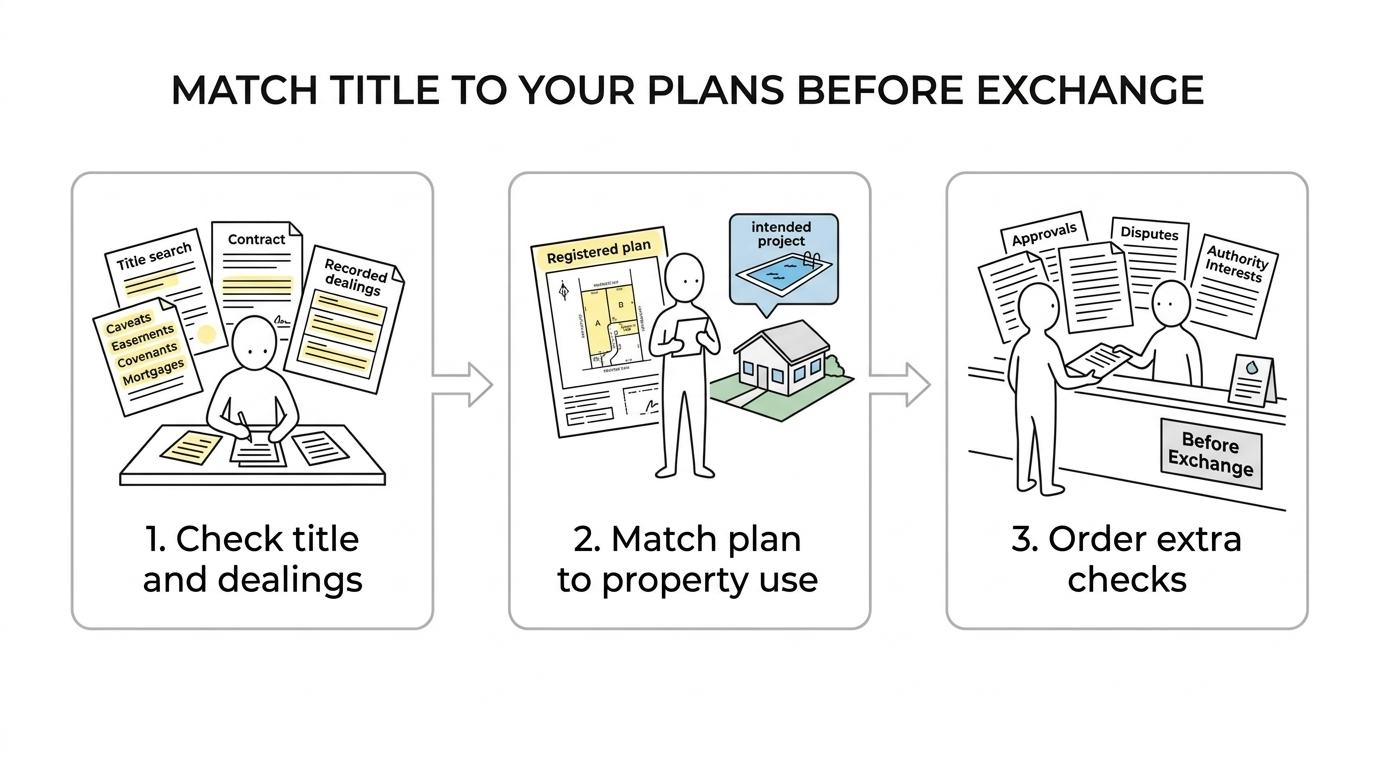
A simple pre-exchange process usually looks like this:
- Step 1: Read the title and dealings for caveats, easements, covenants and mortgages.
- Step 2: Compare the registered plan with the physical property, agent statements and your intended use.
- Step 3: Order the non-title searches and ask about approvals, disputes and authority interests.
Pro tip: buyers often read the word “easement” and stop there. The dealing number matters because the burden is often explained in the full instrument, not in the short label on the search. A right of carriageway is very different from a sewer easement, and each changes value in a different way.
What is the difference between a caveat and an encumbrance?
A caveat is a warning claim that can freeze dealings. An encumbrance is an ongoing burden on the land, like a mortgage, easement or covenant, that may continue after settlement.
This distinction matters because the risk profile is different. A caveat is often urgent because it can block registration or delay settlement until the claim is withdrawn, lapses or is resolved. An encumbrance may be acceptable if you understand it and price the property accordingly.
Think of it this way. If a caveat appears, you ask, “Can this deal proceed?” If an encumbrance appears, you ask, “Can I live with this burden?” Common misconception: every item on title is just a technical note the conveyancer will clear up later. Some items are routine. Some are deal breakers. The job is to separate them early.
How can easements and registered dealings limit what you do with the land?
Easements and registered dealings can reduce usable land area, control access and affect future building locations. In NSW suburbs with tighter lots, that can directly change renovation plans and resale value.
A title might show an easement for drainage, support or access. On paper, that can seem minor. On site, it may mean you cannot place a pool where you wanted, you cannot obstruct a shared driveway, or you must allow a utility authority to access infrastructure. If you are buying in western Sydney, the Illawarra or infill parts of Newcastle, these constraints can shape the entire renovation budget.
Registered dealings can also include restrictive covenants and positive covenants. A restrictive covenant may limit building materials, height or use. A positive covenant may require maintenance of stormwater systems or shared structures. Pro tip: when buyers say “the block looks flat and wide enough,” they are describing the land physically, not legally. The legal footprint can be smaller than the visible footprint.
How do government interests and planned development affect Torrens title land?
Government interests and planned development can affect value, access and future use even when the title itself looks ordinary. NSW Government guidance treats these checks as part of proper conveyancing.
Step 1 is to review planning information, including zoning and any obvious restrictions in the contract pack. Step 2 is to ask whether a government authority has a vested interest in the land or whether acquisition, road widening or another public project could affect it. Step 3 is to consider nearby development that may change traffic, privacy, overshadowing or future resale appeal.
“CS Conveyancing Services provides online NSW-wide conveyancing and end-to-end settlement support when buyers need title documents tied back to practical property risks.”
This is where first home buyers can miss the bigger picture. The title may be fine, yet the street could be affected by a future corridor, upgraded drainage works or a planning setting that changes the value of your intended use. NSW Government guidance also points buyers to information that may not have been previously disclosed, including illegal building work and fence disputes. That is a reminder that the real due diligence task sits both on and off title.
What should first home buyers in NSW do if they find illegal building work or disclosure gaps?
Pause the deal until the issue is measured against cost, risk and timing. CS Conveyancing Services can help NSW first home buyers decide whether to renegotiate, seek documents or walk away before exchange.
This is where the terms latent defects in title and patent defects become useful. A patent defect is discoverable on reasonable inspection. A latent defect is hidden. NSW’s vendor disclosure regime helps, but it does not abolish caveat emptor, and sellers do not have to disclose every issue a buyer could have found with proper inspection and enquiry.
A practical response usually follows this order:
- Ask for proof: approvals, occupation certificates, compliance certificates, pool documents or survey material.
- Price the risk: estimate rectification cost, delay risk and lender reaction.
- Choose the path: renegotiate, require action before exchange, or move to another property.
If the issue affects finance, insurability or council compliance, speed matters. If the seller cannot produce documents and the problem touches a structure that influenced your offer price, walking away can be the strongest decision. That is not pessimism. It is disciplined buying.
Is Torrens title still safer than other ownership structures in NSW?
Yes for ownership certainty, no for automatic peace of mind. Compared with company title and many strata questions, Torrens title is usually simpler, but NSW buyers still need real pre-exchange checks.
For most first home buyers, Torrens title remains the cleanest ownership structure because the register gives direct recognition of ownership and NSW Land Registry Services maintains that register as the single source of truth. You are generally not dealing with company approval rules, and you are not buying into a strata scheme with by-laws, levies and building management issues.
Still, “safer” is a relative term. Torrens title is safer on ownership mechanics. It is not safer if the property has a caveat, a serious easement, unresolved illegal works or a nearby planning issue you never checked. If your goal is to buy confidently in NSW, the winning approach is simple: treat Torrens title as a strong legal foundation, then test everything around it before you exchange contracts.


