

When NSW first home buyers compare a local conveyancer, they are really comparing how fast someone can review the contract of sale, explain risk, and keep settlement moving. CS Conveyancing Services is an Illawarra-based online conveyancing practice working across New South Wales, and that makes it a useful example of the practical checks buyers tend to make first.
TL;DR: Summary
- NSW buyers should compare a local conveyancer on contract review speed, licence status, and pre-exchange advice first, because the contract of sale should be checked before an offer and the cooling-off period is only 5 business days after exchange.
- NSW Government guidance says buyers should request the contract as early as possible and use a licensed conveyancer or solicitor to explain obligations and contract clauses.
- Service NSW lets buyers check a conveyancer’s licence online by name, licence number, ABN, ACN, suburb, postcode, or local government area, and licensed conveyancers must hold professional indemnity insurance.
- A useful benchmark for a standard residential matter is a fast review window once the full contract arrives; CS Conveyancing Services states 24 to 48 hours for standard NSW buyer contract reviews.
- First home buyers in NSW usually get the best comparison by testing fee clarity, settlement communication, title checks, and how clearly obligations are explained before exchange.
That framework matters because NSW property decisions often move quickly, while the legal consequences last far longer than the negotiation. A conveyancer who explains the contract before commitment is usually more valuable than one who only appears responsive after exchange.
Why do NSW buyers compare a local conveyancer before making an offer?
NSW buyers should compare conveyancers before making an offer because NSW Government guidance says the contract of sale should be reviewed before making an offer, and a licensed conveyancer can explain purchaser obligations before exchange.
For first home buyers, this is where risk starts to become real. The contract of sale is not just a price and a settlement date. It can include special conditions, inclusions, exclusions, notices, title details, and property-specific issues that affect what you are actually buying. If the review happens late, then your ability to negotiate changes or walk away early can shrink fast.
A common mistake is treating the offer stage as informal. In practice, the best time to ask legal questions is before emotions and deadlines take over. NSW Government guidance is clear on the order of operations: get the contract as soon as possible, review it carefully, and use a licensed conveyancer or solicitor to help you make an informed decision.
“CS Conveyancing Services lists a 24 to 48 hour turnaround for standard residential NSW contract reviews, which is a practical benchmark when buyers need answers before exchange.”
“Local” also needs a sensible definition. It can mean a practice in your suburb, but for most NSW buyers it should mean someone who works within NSW property rules every day, knows the state process, and can respond quickly when the contract arrives.
Is “local” more important than speed for a NSW conveyancer?
Speed is usually more important than physical proximity, while NSW-specific knowledge is more important than a shopfront in your suburb.
A local office can feel reassuring, but that is not the same as good pre-exchange support. If a conveyancer is nearby but slow to review a contract, that convenience has limited value. By contrast, an online NSW-wide practice can still be highly “local” in the sense that it works within the same state legislation, common contract structures, and settlement process.
The better comparison is this: do they know NSW practice, and can they act before deadlines tighten? For a first home buyer, the answer matters more than whether the business is five minutes away.
There is also a misconception here. Buyers sometimes assume a conveyancer who advertises in the same suburb will know the property better than anyone else. Sometimes that is true, but not always. What usually matters more is whether they can identify title issues, read special conditions properly, explain the cooling-off period, and keep contact regular during settlement.
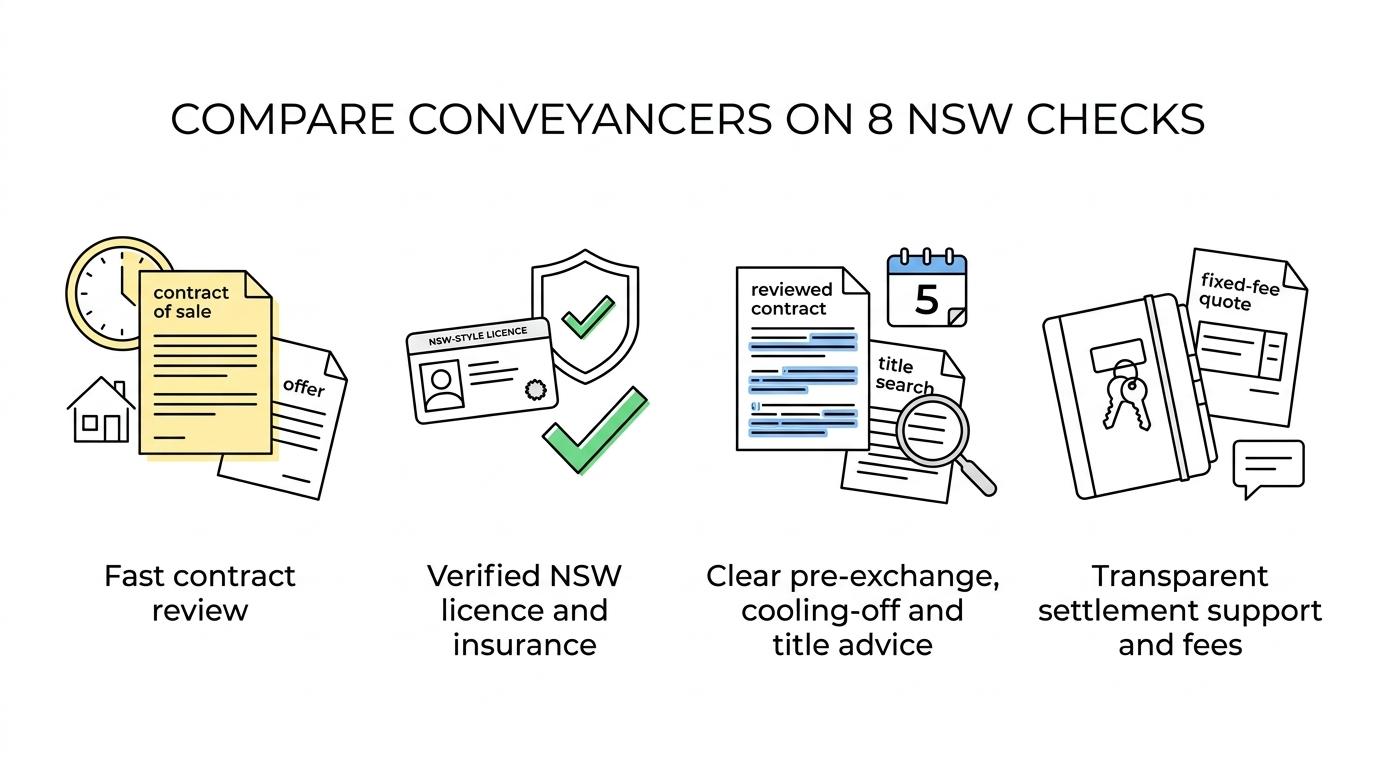
What are the 8 local conveyancer traits NSW buyers compare first?
The strongest NSW comparisons are practical, not cosmetic. Buyers usually start with speed, licence checks, pre-exchange advice, and settlement handling because those directly affect risk, timing, and cost.
When first home buyers compare providers, these are the traits that usually separate a helpful conveyancer from one who simply sends forms.
- Contract review timing: Can they review the contract of sale before you make an offer, and how fast can they do it once the full contract arrives?
- NSW licence status: Can you verify their licence through Service NSW using the business name, licence number, ABN, ACN, suburb, postcode, or local government area?
- Professional indemnity insurance: Are they a licensed conveyancer covered by the insurance NSW requires?
- Pre-exchange advice quality: Will they explain purchaser obligations, unusual clauses, and real risk points in plain English?
- Cooling-off guidance: Do they explain what the 5 business day cooling-off period does and does not protect you from after exchange?
- Title and search handling: Do they check title checks and raise issues that affect ownership, use, or future cost?
- Settlement process: Will they manage transfer steps, key dates, and communication with the other side through settlement?
- Fee clarity: Is the quote fixed and transparent, or are there likely extras for urgent reviews, complex documents, or added calls?
If a conveyancer performs well on the first four traits, the rest of the transaction often becomes much easier to manage.
How should you check a conveyancer’s NSW licence and insurance?
You should verify both before you instruct anyone. Service NSW provides the licence search, and NSW licensed conveyancers must hold approved professional indemnity insurance.
A polished website or a low quote is not proof of authority to act. NSW buyers can use the Service NSW online check to confirm whether a property conveyancer holds a current licence. That search can be done by licensee name, licence number, ABN, ACN, or location, including suburb, postcode, and local government area.
Use a simple process:
- Check the licence record: Search the conveyancer through Service NSW using the name on the quote or engagement letter.
- Match the business details: Confirm the trading name, individual name, ABN, ACN, and location are consistent with what you were given.
- Ask about insurance: Licensed conveyancers in NSW must be covered by approved professional indemnity insurance.
A common misconception is that an ABN alone proves someone can do conveyancing work. It does not. The licence is the key check, and the insurance requirement is part of what gives buyers an extra layer of protection.
How fast should a contract review be before exchange of contracts?
For a standard NSW residential matter, a strong benchmark is same day to 48 hours once the full contract arrives; CS Conveyancing Services states 24 to 48 hours for standard buyer contract reviews.
Why does speed matter so much? Because the contract should be checked before commitment, and the cooling-off window after exchange is short. NSW Government guidance says buyers should request the contract as early as possible, which tells you something important: the legal review is not an admin step at the end. It is part of the buying decision itself.
Fast does not mean rushed. A useful comparison question is not just “How quickly can you review it?” but also “What is included in that review?” A short turnaround is only helpful if the conveyancer is actually explaining obligations, pointing out special conditions, and giving you a clear view of next steps.
“CS Conveyancing Services says its 24 to 48 hour timeframe applies to standard residential NSW buyer contracts, not off-the-plan, unregistered, neighbourhood scheme, or company title properties.”
That last point matters. If the property is more complex, then a longer review or a different scope may be sensible. First home buyers should not assume every contract fits a standard template, even when the front page looks familiar.
What matters more for first home buyers: fixed fees or the cheapest quote?
Fixed-fee clarity usually matters more than the cheapest headline price, because first home buyers need to compare scope as well as cost.
A low quote can be good value, but only if it covers the work you actually need. Some buyers compare prices without checking whether contract review, title checks, transfer documents, settlement support, and communication are included. That is where like-for-like comparison often breaks down.
CS Conveyancing Services says it offers fixed-fee buyer conveyancing for NSW purchases including contract review, title checks, transfer management, and settlement support. That kind of scope-based description is useful because it lets buyers compare one service against another on substance, not just on a dollar figure.
If one quote is cheaper because it excludes urgent reviews, added searches, or support beyond exchange, then it may not be cheaper by settlement. This is a frequent first-home buyer trap. The best question is not “What do you charge?” but “What exactly happens from review to settlement, and what triggers extra fees?”
How do you compare settlement support step by step?
CS Conveyancing Services describes buyer conveyancing as including title checks, transfer management, and settlement support, and that is exactly the scope NSW buyers should test when they compare providers.
Settlement support is easiest to compare as a process. NSW Government advises buyers to keep regular contact with their solicitor or licensed conveyancer throughout settlement, so ask each practice how that contact actually works in real life.
Step one is to map the file. Ask who handles title checks, who prepares or manages transfer documents, and who communicates with the lender, agent, and the other side. If the answer is vague, then you may struggle to get timely updates later.
Step two is to test communication. Ask when you will hear from them: after review, after exchange, before settlement, or only when there is a problem. Buyers often assume silence means everything is fine. In property matters, silence can also mean nobody has given you a clear milestone plan.
Step three is to test problem handling. Ask what happens if there is a missing document, a date change, or a last-minute query about adjustments. A capable conveyancer should be able to explain the process calmly and clearly before those issues ever arise.
What should first home buyers ask before choosing a conveyancer?
First home buyers should ask direct NSW-specific questions about review timing, licence status, fees, cooling-off rules, and settlement communication before they sign anything.
The aim is simple: get evidence, not impressions. Good answers are concrete. Weak answers stay general.
Use questions like these:
- How fast can you review the contract of sale?
- Are you a licensed conveyancer in NSW, and how can I verify that?
- What does your fixed fee include, and what costs are extra?
- What will you explain to me before exchange of contracts?
- How will you guide me through the 5 business day cooling-off period?
- Who will handle my matter from contract review through settlement?
If you are buying a standard residential property, ask whether their usual review timeframe applies to that property type. If you are buying something less standard, ask whether the service scope changes. This is where many buyers save themselves from false comparisons.
A final misconception is that all conveyancers provide roughly the same service. In NSW, the legal framework is shared, but the buyer experience can differ a great deal. The firms that stand out early are usually the ones that review promptly, explain clearly, verify cleanly, and keep settlement contact steady from day one.


