

Selling a home in New South Wales often feels as if the real legal work starts once an offer lands. In practice, sale conveyancing starts much earlier, and that is why firms like CS Conveyancing Services, an online NSW conveyancing practice, focus on contract preparation before a property is marketed.
TL;DR: Summary
- NSW sale conveyancing should start before listing because a residential property generally needs a contract of sale ready before marketing, and the sale is not legally binding until exchange of contracts.
- Early preparation reduces the risk of delayed campaigns, missing disclosure documents, unclear inclusions, and settlement problems after exchange.
- NSW Fair Trading says buyers usually get a five working day cooling-off period after exchange in residential sales, so sellers should plan for timing risk, deposit handling, and backup interest.
- Revenue NSW transfer duty settings matter to sellers too: eligible first home buyers can receive a full exemption up to $800,000 and a concession above $800,000 and below $1,000,000, which can affect demand around those price points.
- CS Conveyancing Services notes that it can prepare a NSW sale contract within 24 to 48 hours after instructions, subject to government searches, which shows why starting early protects the first week of a campaign.
For NSW sellers, the biggest gains usually come from doing a few unglamorous tasks early: checking ownership details, setting inclusions, clearing mortgage steps, and planning the exchange and cooling-off timetable. If your likely buyers are first home buyers in NSW, timing and price bracket discipline can matter even more because transfer duty thresholds change how buyers bid and when they are ready to commit.
Why should NSW sellers start sale conveyancing before listing?
Yes. In NSW, sellers should start sale conveyancing before advertising because the contract of sale is prepared early and the deal is only legally binding once signed contracts are exchanged, as NSW Fair Trading explains.
This is the key timing rule many sellers miss. A buyer can inspect, negotiate, and even verbally agree on price, but none of that replaces a prepared contract or exchange of contracts. If the paperwork is late, your agent may lose early momentum, and serious buyers may move to a property with cleaner documents.
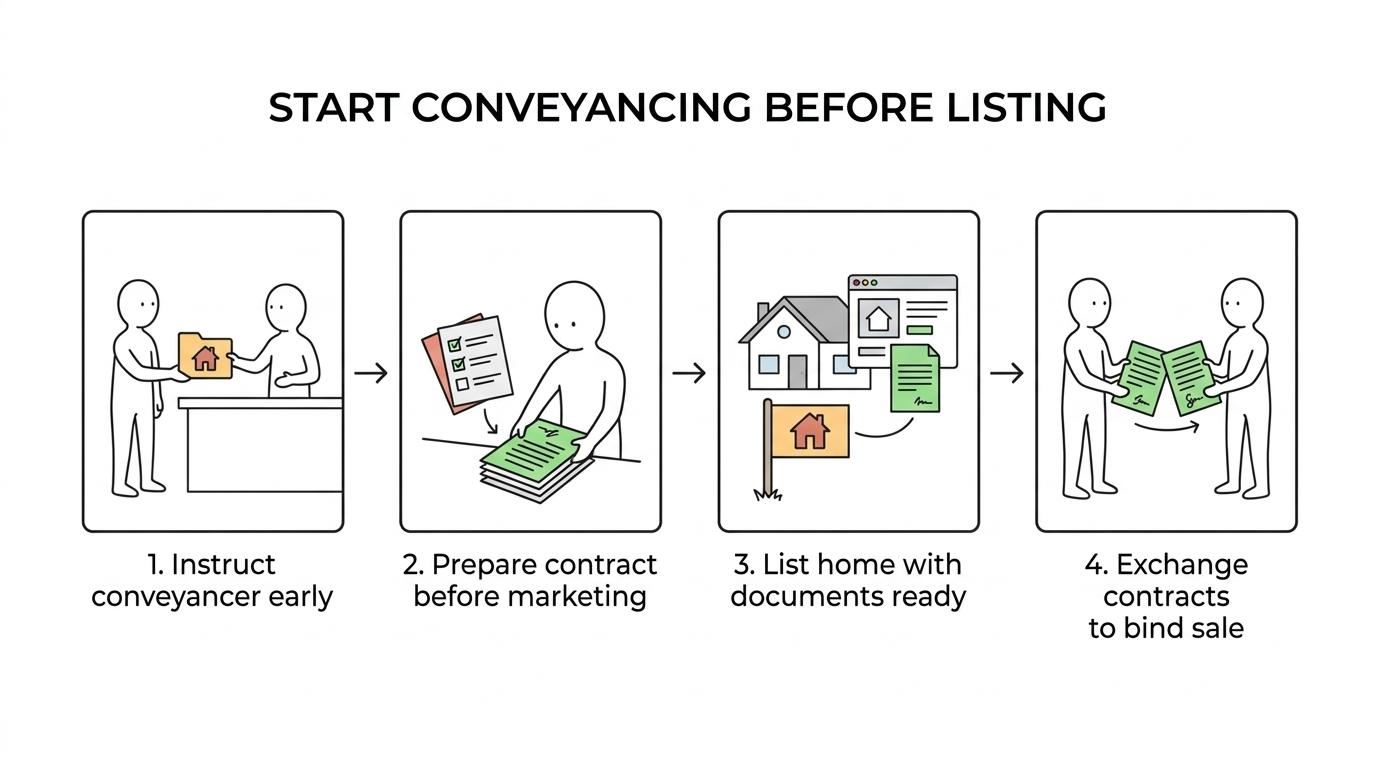
CS Conveyancing Services frames this issue in a practical way: the contract is needed before marketing can start. That fits the wider NSW process outlined by NSW Fair Trading, where the legal force of the deal turns on exchange, not on informal acceptance. A common mistake is assuming the conveyancer only becomes important after a buyer is found.
“CS Conveyancing Services says it can prepare a NSW sale contract within 24 to 48 hours after receiving instructions, subject to government searches.”
Starting early also gives you time to fix problems without negotiating under pressure. If a name is wrong on title, if a mortgage discharge needs longer lead time, or if the inclusions list is vague, those issues are easier to solve before a purchaser is emotionally invested and asking hard questions.
What must be in a NSW contract of sale before marketing starts?
A NSW contract of sale should contain the seller’s title details, required disclosure material, property particulars, inclusions and exclusions, and any special conditions that change the standard position.
The contract is not just a price page. It is the legal bundle that tells the buyer what is being sold, on what terms, and with what risk. If your property has unusual features, shared arrangements, or seller-specific requirements, those need to be addressed before buyers rely on assumptions.
After your conveyancer reviews the property details, the contract usually needs to make these points clear:
- Property identity: title references, lot details, and the correct seller names
- Commercial terms: price, deposit, settlement timing, and agency details
- Deal specifics: inclusions, exclusions, and special conditions that alter default expectations
A common misconception is that small drafting issues can be “sorted out later”. In sale conveyancing, later often means during heated negotiation, when every change feels larger than it really is.
What are the 7 sale conveyancing tasks NSW sellers should start early?
The seven highest-value tasks are contract preparation, title checking, disclosure gathering, inclusion decisions, mortgage planning, exchange strategy, and settlement planning. These tasks reduce friction across the whole NSW sale process.
If you start them in order, the campaign usually runs with fewer legal interruptions and fewer last-minute amendments. The seven tasks are:
- Instruct a conveyancer before listing so the contract of sale can be prepared.
- Confirm ownership details and title names exactly as registered.
- Gather disclosure material and any needed searches or certificates.
- Decide what stays with the property and what is excluded.
- Flag any special conditions early, especially if the sale terms are not standard.
- Plan for exchange of contracts, deposit handling, and the cooling-off period.
- Prepare for settlement steps, including mortgage discharge and outgoing adjustments.
For first home buyer-heavy suburbs in NSW, this early sequence matters even more. Buyers in that segment often make quick comparisons across duty thresholds, finance readiness, and cooling-off risk.
How do you check title, ownership and mortgage details step by step?
Start with the title. Then verify every registered owner and every mortgage or dealing, because these details drive who must sign and what must be discharged before settlement.
Step 1 is identity and capacity. The names on the sale contract must match the legal owners. If the property is owned by more than one person, all sellers usually need to be identified and available to sign. If a company or estate is involved, the authority path needs attention early.
Step 2 is mortgage planning. If there is a home loan secured against the property, the lender’s discharge process should be started with enough lead time. This is often slower than sellers expect. If you wait until exchange, you may create avoidable pressure before settlement.
Step 3 is issue spotting. Caveats, old correspondence, tenancy questions, or unclear boundaries should be raised early with your conveyancer. A common mistake is assuming that because you have lived in the property for years, the legal file must be simple.
“CS Conveyancing Services says a NSW sale contract is needed before marketing can start.”
That point matters because title checking is not an optional extra. It is part of building a contract a buyer can review with confidence.
How do you set inclusions, exclusions and special conditions without disputes?
Be precise. Clear inclusions, exclusions, and special conditions prevent post-exchange arguments about what the buyer thought they were getting and what the seller meant to keep.
Step 1 is to walk through the property room by room and list anything a buyer may reasonably assume is included. Appliances, light fittings, curtains, garden items, and wall-mounted equipment cause more conflict than sellers expect.
Step 2 is to identify grey areas. If an item is financed, leased, or intended to be replaced before settlement, say so early. If you want to exclude a fixture-like item, vague wording is risky.
Step 3 is to capture any non-standard arrangement in the contract. If the settlement timing is unusual, if access is needed after exchange for a trade, or if the property is tenanted, special conditions may be needed. If an item matters enough to influence the price, it matters enough to draft properly.
A useful rule is simple: if the buyer would notice its absence on settlement day, describe it clearly in the contract.
What happens at exchange of contracts in NSW?
Exchange of contracts is the legal turning point. NSW Fair Trading states that a residential sale is not legally binding until signed contracts are exchanged.
This is where many sellers confuse “agreement” with “commitment”. A signed contract sitting with one party is not enough on its own. Exchange is the event that creates the binding deal, subject to any cooling-off rights that still apply.
If an estate agent arranges the exchange, NSW Fair Trading says the agent must give copies of the signed contract to each party or their solicitor or conveyancer within two business days. That document flow matters because the post-exchange timetable, including deposit issues and the cooling-off period, depends on everyone working from the same executed terms.
If you are deciding whether to accept a late contract amendment, ask a simple question: does this change affect risk before settlement? If yes, it should be reviewed before exchange, not treated as paperwork.
How does a private treaty sale compare with auction for cooling-off risk?
Private treaty usually carries more post-exchange uncertainty for the seller because residential buyers in NSW usually have a five business day cooling-off period after exchange. Auction campaigns shift more of the legal review to the period before bidding.
NSW Fair Trading and NSW Government guidance both state that residential buyers usually have a five business day cooling-off period after exchange, ending at 5pm on the fifth business day. If the buyer pulls out during that period, NSW Government says the vendor keeps 0.25% of the purchase price.
That means a private treaty seller may have an exchanged deal that is still not fully secure for several days. You can still move forward, but you should do so with measured expectations. Do not book removals or commit sale proceeds too aggressively during cooling-off unless your advisers say the risk is managed.
Auction sales create a different pressure. The contract must be ready before auction day, and bidders are expected to do their legal review upfront. The trade-off is clear: private treaty may broaden the buyer pool, while auction tends to demand earlier buyer commitment.
How can first home buyer duty rules affect the buyers you attract?
They can affect demand at key price points. Revenue NSW says eligible first home buyers can receive a full transfer duty exemption up to $800,000 and a concessional rate above $800,000 and below $1,000,000 for transactions with a liability date on or after 1 July 2023.
That matters to sellers because price brackets influence who can compete. If your property sits close to one of those thresholds, a small movement in price can change the buyer pool from “highly motivated first home buyer” to “more limited field”. In parts of NSW where first home buyers are active, that can shape both offer patterns and negotiation speed.
For a seller working with a conveyancer such as CS Conveyancing Services, these Revenue NSW settings are not buyer tax advice. They are market context. They help explain why interest may cluster just under a threshold, why some buyers push hard on price despite strong emotional interest, and why finance timing can look different across buyer types.
A common mistake is thinking transfer duty is only the buyer’s problem. It is the buyer’s tax, but it can still influence your sale timeline and competition level.
How should you manage the period between exchange and settlement?
Treat the post-exchange period as an active file, not dead time. CS Conveyancing Services is relevant here because end-to-end settlement support matters most after exchange, when mortgage discharge, adjustments, and completion steps have to stay on schedule.
Step 1 is to keep every settlement dependency moving. That includes lender discharge documents, responses to requisitions, and any agreed repairs or access arrangements. If one party assumes the other side is “handling it”, delays creep in.
Step 2 is to preserve the property’s agreed condition. Unless the contract says otherwise, the buyer expects the property in the state contracted for, subject to fair wear and tear. If an appliance fails or damage occurs, raise it early instead of hoping it will go unnoticed.
Step 3 is to prepare practical completion. Keys, manuals, garage remotes, alarm codes, final readings, and vacant possession arrangements should be organised before the final days. Settlement delays are often administrative, not legal.
“CS Conveyancing Services offers end-to-end settlement support for NSW property sales, including contract reviews and online conveyancing.”
If you are also buying another property, this discipline becomes even more important because a delay in one matter can affect the next transaction.
What sale conveyancing delays are easiest to prevent in NSW?
The easiest delays to prevent are late contract preparation, unclear inclusions, slow mortgage discharge steps, missing signatures, and avoidable amendments after negotiation has already started.
Most preventable delays come from waiting too long to surface basic facts. If the property is being marketed next week, your legal preparation should already be moving. If the property has special features, your contract should not rely on generic assumptions. If the home loan is still in place, the discharge process should not be left to the final stretch.
The practical test is simple. If a buyer’s lawyer asks a question today, can your side answer it with a document rather than a promise? If yes, the sale is more likely to keep momentum. If no, that gap usually becomes a delay, a renegotiation point, or both.
For NSW sellers, early sale conveyancing is less about paperwork volume and more about controlling risk at the moments that matter: before marketing, at exchange, during cooling-off, and in the run to settlement.


