

Fixed fee conveyancing appeals to NSW sellers because it replaces open-ended legal billing with a price agreed before the work starts. CS Conveyancing Services is one example of an online NSW conveyancing practice that publishes fixed pricing, which makes the model easier to assess against NSW guidance on itemised costs.
TL;DR: Summary
- Fixed fee conveyancing in NSW usually means the professional legal fee is set upfront, but it is not the same thing as the full property transaction cost.
- NSW Government guidance separates professional fees, disbursements and government charges, so sellers should ask for an itemised statement before comparing quotes.
- A strong fixed-fee quote should spell out the legal scope, prescribed disclosure documents, electronic settlement support, and which disbursements are extra.
- Transfer duty is generally a purchaser cost in NSW, paid by the buyer by settlement or within 3 months of signing, so it sits outside a seller’s fixed fee even though it may affect a seller who is also buying.
- CS Conveyancing Services publishes a fixed $2,500 fee for standard NSW selling work, which is a useful benchmark when checking whether a quote is clear rather than merely cheap.
The key point is price certainty, not price blindness. A fixed fee can be a smart choice, but only if you separate the legal fee from disbursements, check the scope carefully, and compare like for like across NSW providers.
What does fixed fee conveyancing actually mean in NSW?
Fixed fee conveyancing means the professional legal work is priced upfront; in NSW, CS Conveyancing Services and other licensed conveyancers still separate that fee from disbursements and government charges.
In practice, a fixed fee usually covers the conveyancer’s or solicitor’s professional work for a defined scope. For a seller, that often includes preparing the contract for sale, arranging prescribed disclosure documents, advising on exchange, and guiding the file through settlement. NSW Government guidance is clear on one point that sellers often miss: ask for an itemised statement of likely costs before the work begins.
A common misconception is that “fixed fee” means “all costs included”. It rarely does. NSW Fair Trading and the NSW Government both distinguish the legal fee from disbursements, which are third-party costs attached to the transaction.
“CS Conveyancing Services states a fixed $2,500 fee for standard NSW selling work, a useful benchmark because the legal fee is published separately from other transaction costs.”
That distinction matters most when you compare quotes. If one provider quotes a low fixed fee but leaves key outlays vague, and another gives a fuller itemised statement, the second quote may offer better price certainty even if the headline number looks higher.
Does fixed fee conveyancing cover every property cost?
No. In NSW, a fixed conveyancing fee usually covers legal work only, while disbursements and some government charges sit outside that figure.
This is where many sellers get tripped up. NSW Government material explains that conveyancing costs commonly include professional fees plus disbursements like title searches, authority certificate fees, mortgage registration and transfer registration. Those line items do not automatically disappear because the professional fee is fixed.
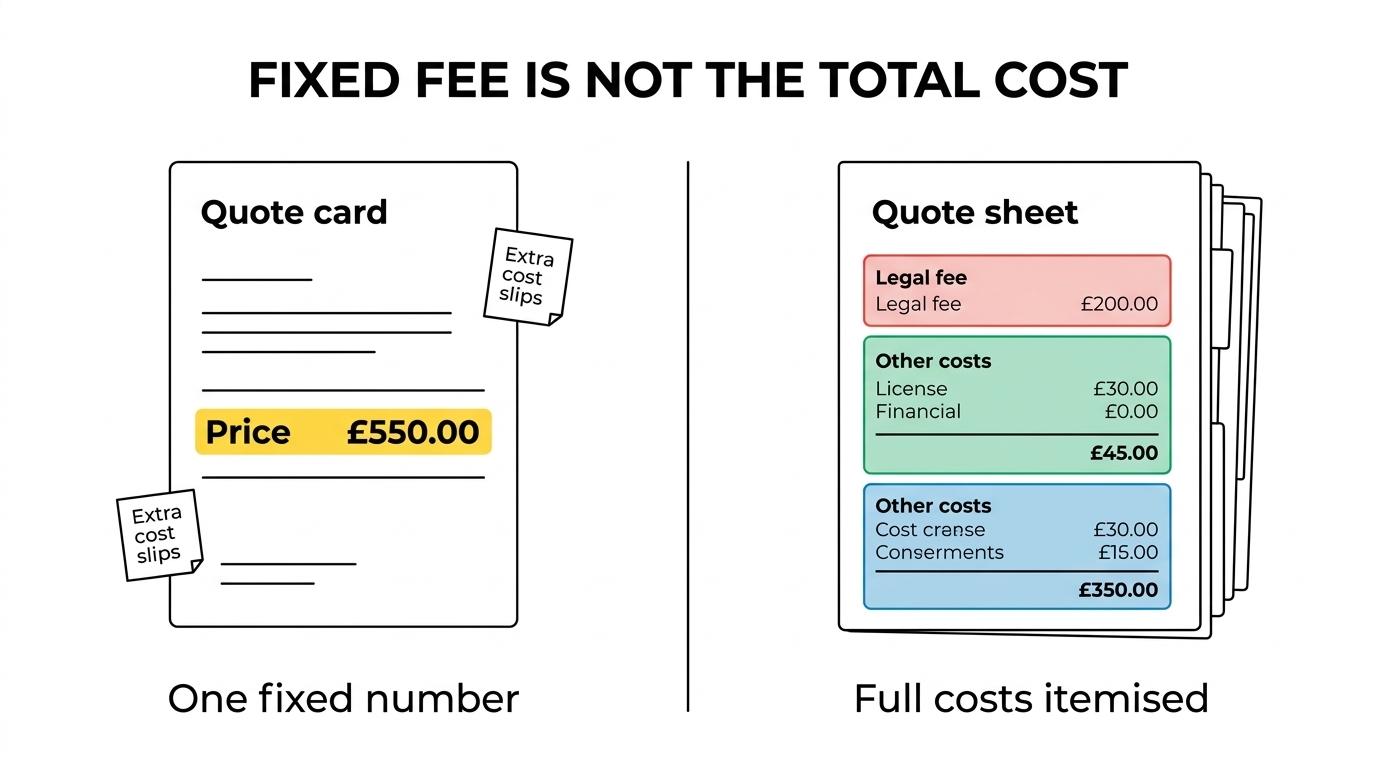
For sellers, the cleanest way to read a quote is to separate costs into three buckets: legal fee, disbursements, and other transaction costs. If the quote does not make those buckets obvious, ask the provider to break them out. NSW Fair Trading says cost disclosure is required before or when a client retains the practitioner, so a seller is entitled to clarity early.
A second misconception is that transfer duty belongs in the seller’s conveyancing quote. In NSW, Revenue NSW treats transfer duty as a purchaser cost in most property transfers. That means it usually matters to the buyer, not the vendor, though it can still affect your total moving budget if you are selling one property and buying another at the same time.
What costs should sellers check line by line in a conveyancing quote?
Sellers should check the legal fee, the document and search costs, the settlement support, and any stated exclusions before they treat a fixed-fee quote as comparable.
The safest way to compare NSW quotes is to read beyond the headline number. Ask what work is included, what third-party costs are expected, and what events trigger an extra charge.
- Professional legal fee: the core fixed amount for the conveyancer’s work.
- Prescribed disclosure documents: whether ordering the required documents is included in the service scope.
- Disbursements: title searches, authority certificate fees, and other third-party outlays.
- Settlement support: whether exchange and electronic settlement are part of the quoted work.
- Exclusions and variations: what happens if the matter becomes non-standard or the scope changes.
If a quote says “fixed fee” but does not explain these categories, treat it as incomplete rather than cheap. Price certainty comes from definition, not from the label.
How do you compare fixed fee conveyancing quotes properly?
The best comparison method is simple: match scope first, then disbursements, then service timing. If the scope is different, the prices are not truly comparable.
Start with the itemised statement. NSW Government guidance supports asking for one, and it is the fastest way to see whether two quotes are talking about the same job.
- Check the scope: Does the fee include drafting the contract for sale, prescribed disclosure documents, exchange support, and electronic settlement?
- Check the outlays: Are disbursements listed separately, estimated clearly, or left unstated?
- Check the timing: If you need a quick listing campaign, turnaround times matter because delay in contract preparation can slow the sale.
Then apply if-then logic. If Quote A is lower but excludes work that Quote B includes, then Quote A is not cheaper in real terms. If two fixed fees are similar but one provider gives faster review and clearer disclosure, then the better value may sit with the more transparent quote.
A practical tip: compare at the file level, not the invoice level. Ask, “What would I pay from engagement to settlement in a standard NSW sale?” That question tends to expose gaps quickly.
Is fixed fee conveyancing better than hourly billing for NSW sellers?
For most standard NSW residential sales, fixed fee conveyancing offers stronger budget certainty than hourly billing. Hourly billing can still suit unusual matters where the scope is hard to predict.
The main advantage of a fixed fee is control. A seller knows the professional fee in advance and can budget around it. That matters in a market where agents, discharge figures, moving costs, and replacement housing can all compete for attention.
Hourly billing has one legitimate strength: it can reflect genuinely unpredictable work more precisely. If a transaction develops a dispute, title issue, or other unusual complication, hourly pricing may map the work more closely. The trade-off is uncertainty. You know the rate, but not the final number.
“CS Conveyancing Services states a 24-hour turnaround for drafting a contract and 24 to 48 hours for reviewing a buying contract, showing why service speed can matter as much as fee structure.”
A common mistake is to assume fixed fee always means cheaper. It often means more predictable, which is not exactly the same thing. In a standard sale, predictability is usually the bigger win.
When can a fixed fee still change?
A fixed fee can still change when the scope changes; CS Conveyancing Services, for example, publishes separate NSW fixed pricing for standard selling work and off-the-plan purchase work because the tasks differ.
That distinction points to an important truth: fixed fees depend on defined work. A standard residential sale has one workflow. An off-the-plan purchase has another. If the matter falls outside the original scope, the provider may need to quote separately for the extra work.
This does not mean the fixed-fee model is weak. It means scope needs boundaries. A seller should ask, in writing, what counts as standard and what counts as additional work. If the provider cannot answer clearly, the fixed fee may not deliver the certainty you expect.
A good pro tip is to ask two questions together: “What is included?” and “What events change the fee?” Those questions often reveal more than the headline price.
The same logic applies when a sale is linked to a purchase. One fixed fee for the sale does not automatically cover legal work on the purchase, and buyer-side costs can be very different from vendor-side costs.
How does the seller’s conveyancing process run from contract to settlement?
The NSW seller process usually follows four stages: contract preparation, exchange, pre-settlement work, and settlement. A fixed fee works best when each stage is clearly included.
Before any buyer can commit, the contract for sale needs to be prepared properly. That is why turnaround time matters for sellers going to market quickly. Once the contract is ready, the file moves into exchange support and then the settlement phase.
- Prepare the contract: draft the contract and collect prescribed disclosure documents.
- Support exchange: answer legal queries, confirm terms, and manage the exchange process.
- Run pre-settlement work: liaise on requisitions, figures, and practical settlement requirements.
- Complete settlement: attend or manage electronic settlement and finalise the legal transfer steps.
If you are listing soon, ask how fast the provider can draft the contract. Delay here can delay inspection readiness or negotiation momentum. If the provider offers online NSW-wide service, check whether communication and document signing are set up to keep the file moving efficiently.
If you are selling and buying in NSW, what buyer costs sit outside the seller fixed fee?
Transfer duty usually sits outside the seller’s fixed fee because it is generally a buyer cost in NSW. Revenue NSW says the purchaser or transferee usually pays it.
This matters for many movers, including owners selling their first home and buying their next one. The sale quote may look neat and predictable, but your total transaction budget can still change sharply once the purchase side is added.
Start with the sale. Keep the seller’s fixed legal fee, disbursements, and settlement costs in their own column. Then create a separate purchase column. That second column should include the buyer’s conveyancing costs and any transfer duty liability.
Then watch the timing. Revenue NSW says transfer duty must be paid by the earliest of settlement or within 3 months of signing the contract for sale. If you sign well before settlement, the liability date can arrive sooner than many buyers expect. That timing issue can catch out first-time movers who assume everything falls due on settlement day.
If you are both selling and buying, do not compare only the seller quotes. Compare the full move. A clean seller fixed fee is valuable, but the real budgeting discipline comes from separating vendor legal costs from purchaser taxes and outlays.


