

Off-the-plan conveyancing in NSW is a different legal exercise from buying an existing house or unit. You are agreeing to a future lot, future strata documents and future completion dates, which is why firms like CS Conveyancing Services spend so much time reviewing the contract pack before exchange rather than only at settlement.
TL;DR: Summary
- In NSW, off-the-plan buyers should check the full contract pack before exchange for missing disclosure documents, material inaccuracies, deposit terms and sunset-clause wording; CS Conveyancing Services reviews these issues as part of NSW off-the-plan conveyancing.
- Off-the-plan cooling-off is 10 business days, not 5, but a buyer who rescinds during that period forfeits 0.25% of the purchase price.
- If a required off-the-plan document was missing before signing, the purchaser may have a 14-day right to rescind after exchange.
- Material changes to plans, by-laws, easements, covenants or finishes can support rescission or compensation, with compensation capped at up to 2% of the purchase price.
- Developers cannot automatically end a contract under a sunset clause, and off-the-plan deposits are generally held in trust or a controlled money account rather than treated as developer working capital.
- Buyers must receive the final registered plan and associated documents at least 21 days before settlement, and they cannot be forced to settle inside that period.
For first home buyers in New South Wales, the biggest risk is often not the apartment or townhouse itself. It is signing a contract that gives away time, money or exit rights before you have checked what the law actually requires.
What makes off-the-plan conveyancing in NSW different from a standard purchase?
Off-the-plan conveyancing in NSW is a document and timing exercise, not just a title check. Unlike an established-home purchase, the buyer is contracting on draft plans, draft by-laws and a future registered plan, often with a longer settlement window and more vendor-controlled milestones.
With an existing property, you can inspect the apartment or townhouse itself present, review the current title and settle on a known asset. With an off-the-plan property, you are relying on a Disclosure Statement, draft plan, proposed finishes, proposed easements and contract machinery that may not fully play out for many months. That changes the legal focus from “what is there now?” to “what can change before completion?”
A common mistake is treating the display suite, brochure or agent’s wording as the real promise. In practice, the contract pack and prescribed disclosure documents carry far more legal weight when a dispute starts.
“CS Conveyancing Services offers fixed-fee NSW-wide contract reviews, often within 24 to 48 hours, which is useful when exchange dates move quickly.”
NSW also gives off-the-plan buyers extra statutory protection. The cooling-off period is longer, the final registered plan must be served before settlement, and developer use of sunset clauses is more restricted than many buyers assume.
What should you check before you exchange an off-the-plan contract?
Before exchange, CS Conveyancing Services or another NSW conveyancer should verify the prescribed off-the-plan documents, cooling-off wording and key dates. If a required document is missing or a draft plan conflicts with the marketing promise, the risk starts before you sign.
For NSW first home buyers, three checks matter most at this stage:
- Confirm prescribed documents: Disclosure Statement, draft plan, proposed schedule of finishes, draft by-laws and any other scheme-specific draft documents required for the development type.
- Read the dates and exit rights: cooling-off statement, sunset date, notice periods, any rights to extend time and how rescission is meant to work.
- Match legal documents to practical expectations: car space, storage area, easements, pet rules, short-stay limits, exclusive-use areas and the exact lot layout.
If the contract refers to future strata by-laws, that is not minor paperwork. Those by-laws can affect pets, parking, EV charging, renovations and even day-to-day use of a balcony or courtyard. If you are buying your first home, those points often matter more than a marginal difference in purchase price.
“CS Conveyancing Services can review same-day contracts, which matters when a buyer is asked to exchange before finance, strata or plan issues are properly checked.”
Another trap is the rushed 66W certificate. If you are still waiting on finance approval, guarantor documents or a careful contract review, waiving cooling-off is usually a serious trade-off rather than a harmless admin step.
What are the 7 off-the-plan contract risks NSW buyers must check?
The highest-risk clauses in NSW usually concern disclosure, changes, dates and money. A buyer should assume the main legal risks sit in the Disclosure Statement, draft plan, sunset clause, deposit clause, cooling-off wording, settlement trigger and rescission mechanics.
These are the seven contract risks worth checking closely:
- Missing prescribed off-the-plan documents
- Inaccurate or incomplete material particulars
- Sunset-clause wording that leaves you waiting too long
- Deposit clauses that are unclear about trust or controlled money handling
- Cooling-off clauses and any proposed 66W certificate
- Settlement triggers tied to the registered plan and notice periods
- Draft by-laws, easements or covenants that reduce how you can use the lot
Each risk links to a different statutory right. That is why off-the-plan conveyancing is rarely just a quick read of the front page and special conditions.
How does the 10-business-day cooling-off period actually work in NSW?
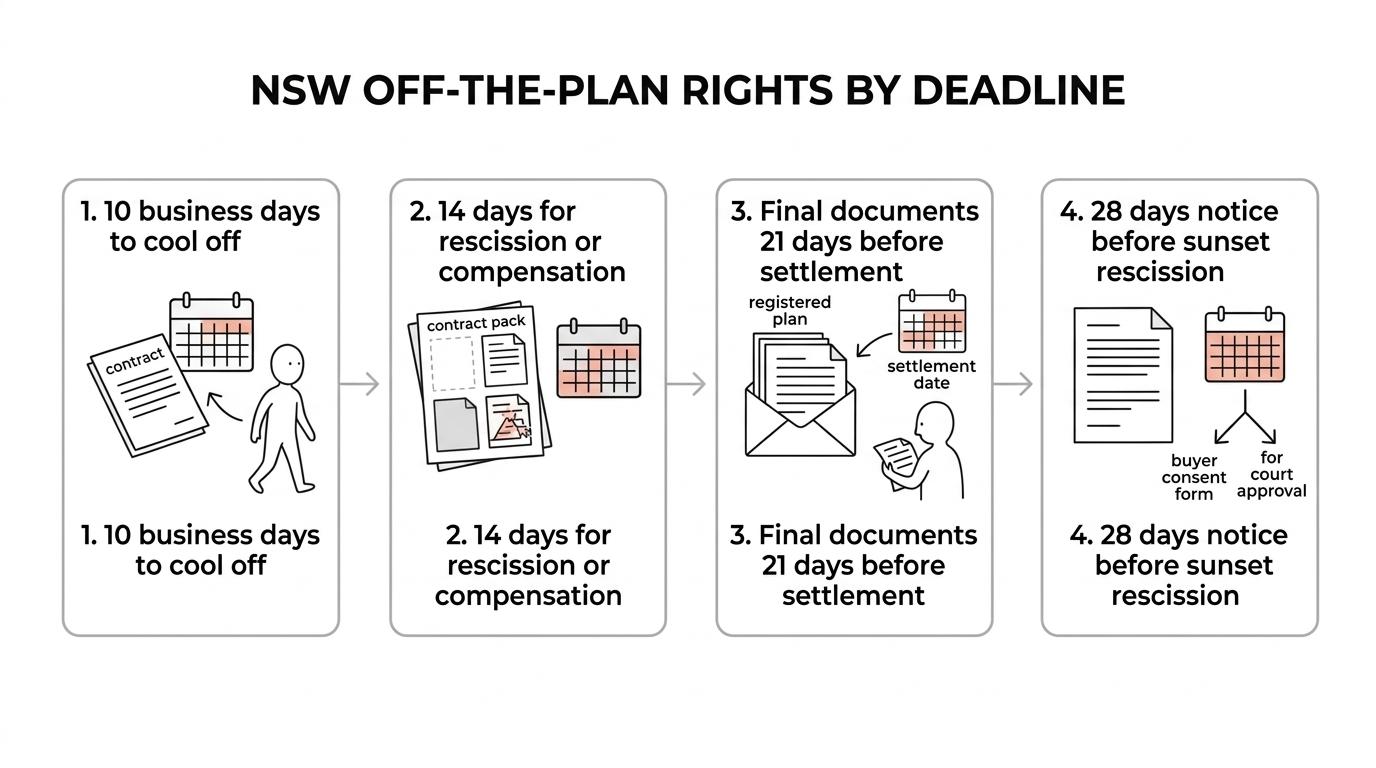
NSW gives off-the-plan buyers 10 business days to cool off, while an established residential purchase usually gives 5. If the buyer rescinds during that period, 0.25% of the purchase price is forfeited, unless cooling-off was validly waived or shortened.
That longer period is useful, but it is not free optionality. If you cool off on a $900,000 contract, the amount forfeited is $2,250. Many first home buyers hear “10 days” and assume they can hold the property with no cost while they decide. That is not how the regime works.
The cooling-off statement must be included in the contract. The period can only be waived or shortened if your lawyer or conveyancer gives the required certificate, commonly called a 66W certificate, and explains the consequences. If the developer wants immediate exchange with no cooling-off, ask why the time pressure exists and what you are giving up in return.
If finance is still uncertain, cooling-off has obvious value. If the contract has already been checked, your lender is ready and the project is straightforward, waiving may sometimes be a commercial choice. The point is to make that choice knowingly.
When can missing disclosure documents let you rescind an off-the-plan contract?
Missing prescribed documents can create a real exit right in NSW. If an off-the-plan contract was exchanged without a required Disclosure Statement, draft plan, draft by-laws or other scheme-specific draft documents, the purchaser may rescind within 14 days of exchange.
This rule matters because off-the-plan purchasers sign before the lot is created. NSW sale contract rules require the developer to provide a proper contract pack so the buyer can assess what is being sold and how it may be regulated once completed.
A common misconception is that the problem disappears if missing documents are emailed later. That is risky thinking. If the documents were required before signing, late delivery does not automatically cure the issue. Timing matters, and so does the exact item that was omitted.
Keep a complete exchanged copy of the contract pack. If a dispute starts, the practical question is often simple: what exactly was in the bundle at exchange?
How do material changes to plans, by-laws, easements or finishes affect your rights?
A material change can support rescission or compensation in NSW. The key entities are the registered plan and the original disclosure documents, because the law looks at whether a change is likely to adversely affect the use or enjoyment of the lot.
NSW legislation treats a “material particular” broadly enough to matter in real transactions. It can include changes to the draft plan, draft by-laws, an easement or covenant, or changes to the schedule of finishes that are likely to reduce how you use or enjoy the property.
If a change is material, the buyer may have a right to rescind or claim compensation. If the buyer chooses compensation instead of rescission, the cap is up to 2% of the purchase price. The right must usually be exercised within 14 days after notice of the change or service of the registered plan showing the inaccuracy.
This is where buyers need to compare two pathways. Rescission gives you an exit. Compensation keeps the deal alive but recognises that the lot delivered is not exactly what was promised. If the change affects core use, rescission may matter more. If the issue is narrower and you still want the property, compensation may be the practical route.
One useful habit is a side-by-side comparison of the exchanged draft plan against the final registered plan. Small drafting changes are common. The real question is whether the change is adverse and material.
What does a sunset clause mean for NSW first home buyers?
A sunset clause sets the last date for the lot to be created, not an automatic cancellation date. Under NSW law, a developer who wants to rescind under a sunset clause generally needs the buyer’s written consent or NSW Supreme Court approval.
That reform changed the balance of power. The vendor cannot simply point to the date and walk away. The vendor must give written notice at least 28 days before the proposed rescission, and buyer consent is central unless the Court authorises termination.
Many buyers still assume a sunset clause gives the developer a free reset button if prices rise. In NSW, that is a misconception. The law now limits that outcome.
The trade-off sits in the contract period itself. A longer sunset date may be realistic for approvals, building works and registration, but it also leaves the buyer exposed to a longer wait. For first home buyers, that can affect finance validity, rent plans and personal timing even when the legal rights are strong.
How are off-the-plan deposits handled in NSW?
NSW restricts deposit handling more than many buyers expect. In a standard off-the-plan sale, the deposit is held in a trust account or controlled money account and cannot simply be released to the developer as general project cash.
This protection matters because settlement may be a long time away. If the contract ends lawfully, deposit handling becomes a major practical issue, so the clause should be clear about where the money is held and on what authority it may move.
A common mistake is focusing only on whether the deposit is 5% or 10%. The safer question is where the money sits, who controls release and what happens to any interest. If a special condition tries to alter standard handling, get that reviewed before exchange, not after.
For cautious buyers, deposit language is one of the fastest ways to spot whether the contract is trying to shift extra risk onto the purchaser.
What happens between the registered plan, the 21-day notice period and settlement?
Once the registered plan is ready, CS Conveyancing Services or any NSW conveyancer should compare it against the exchanged disclosure pack before settlement is booked. The NSW Office of the Registrar General framework requires the final registered plan and associated documents at least 21 days before settlement.
This stage is where legal detail becomes practical reality. The occupation certificate may suggest the building is ready, but settlement still turns on the contract process, service of the final documents and the buyer’s opportunity to assess whether the lot delivered matches the lot sold.
A sensible process looks like this:
- Receive final documents: registered plan, any associated documents and the settlement notice.
- Compare document against document: lot boundaries, car space, storage, by-laws, easements, covenants and any disclosed finishes issue.
- Decide within the legal window: settle, seek compensation or exercise any rescission right within the required 14-day period if a material inaccuracy is identified.
Buyers cannot be forced to settle within that 21-day period. That is an important NSW protection, especially where a first home buyer needs time for finance confirmation, inspection arrangements and legal advice on final changes.
When should a buyer waive cooling-off with a 66W certificate?
A 66W certificate should be used sparingly in off-the-plan transactions. It removes or shortens cooling-off only after a solicitor or licensed conveyancer explains the consequences, so it is best reserved for buyers who have finished legal, finance and risk checks.
In practice, a 66W certificate makes sense only if the buyer is comfortable proceeding without the statutory buffer. If the contract review is incomplete, the developer is still answering questions or your lender has not issued a solid approval, then using a 66W is usually premature.
This is especially relevant for first home buyers who feel pressure to “lock in” the property. Speed can help in a competitive market, but speed has a cost if the contract still contains unresolved issues about plans, by-laws, sunset timing or deposit handling. If the risk review is unfinished, the safer choice is often more time, not less.


