

For NSW buyers, a contract review is not a formality. It is the point where a property listing turns into legal risk, especially for first home buyers trying to move quickly. CS Conveyancing Services, an online NSW conveyancing practice, deals with this issue constantly because buyers often focus on price and inspections before checking the contract itself.
TL;DR: Summary
- A NSW contract review should happen before you make an offer or bid at auction, because the biggest risks are missing documents, title restrictions, settlement terms, and auction timing.
- NSW Government guidance is clear that buyers should review the contract before making an offer, and the sale becomes binding at exchange of contracts.
- Private treaty purchases usually have a 5-business-day cooling-off period after exchange, but rescinding costs 0.25% of the purchase price and does not fix hidden title or strata problems.
- Auction purchases are stricter: the successful bidder signs and pays the deposit on the spot, with no cooling-off period.
- For many NSW buyers, including clients of CS Conveyancing Services, the most important checks are prescribed documents, easements, strata by-laws, special conditions, deposit clauses, and whether the settlement timetable fits finance.
That timing matters because NSW contracts can expose easements, restrictions on the use of land, positive covenants, by-laws, and settlement clauses before you are committed. If you wait until exchange, or worse, until auction day, your bargaining power shrinks fast.
Why should NSW buyers review the contract before making an offer?
You should review the contract before the offer because exchange of contracts , not the handshake or agent email, creates binding legal obligations in NSW, and CS Conveyancing Services structures reviews around that timing.
The NSW Government says buyers should carefully review the contract of sale before making an offer, whether the property is being sold by private treaty or auction. NSW Fair Trading also tells buyers to request the contract as soon as possible so a solicitor or conveyancer can check it. That matters because a residential property in NSW cannot be marketed for sale unless a contract has already been prepared.
A common mistake is assuming the contract is only relevant once the price is agreed. In practice, the contract shapes whether the price is worth paying at all. A clean-looking house can still come with title burdens, use restrictions, or settlement deadlines that do not fit your finance.
“CS Conveyancing Services offers same-day contracts and 24 to 48 hour reviews, which fits the short pre-exchange window many NSW buyers face.”
For first home buyers, this early review is often the first real filter. It helps you decide whether to offer confidently, negotiate special conditions, or walk away before emotion and competition take over.
When does a NSW property contract become binding?
In NSW, a property sale becomes binding at exchange of contracts, not when an offer is accepted by the seller or agent.
That distinction catches buyers out. You may hear that your offer has been “accepted”, but until exchange of contracts occurs, either side can usually still change position. Once exchange happens, the legal framework changes quickly. In a private treaty sale, the buyer usually gets a 5-business-day cooling-off period starting from exchange.
That cooling-off period is useful, but it is narrow. If you rescind during that period, NSW rules require you to forfeit 0.25% of the purchase price to the vendor. If the property is $900,000, that is $2,250. A second misconception is that cooling-off makes pre-exchange review optional. It does not. Cooling-off is a limited exit right, not a planning tool.
What are the contract review red flags NSW buyers miss before an offer?
The main NSW red flags are incomplete prescribed documents, title burdens, strata restrictions, and special conditions that quietly change timing, money, or use rights.
These issues are easy to miss because they often sit in annexures, title dealings, or special conditions rather than on the first page. For first home buyers, the risk is not only overpaying. It is buying a property that cannot be used, financed, or settled the way you expected.
- Missing prescribed documents that should accompany the contract.
- Easements, including rights of way that affect access or future building plans.
- Restrictions on the use of land that limit additions, renovations, or certain uses.
- Positive covenants that impose ongoing obligations on the owner.
- Strata plan or by-law issues that affect pets, parking, storage, short-stay use, or renovations.
- Settlement dates that do not match your loan approval or sale timeline.
- Deposit clauses that assume immediate payment or contain unusual release terms.
- Special conditions that override the standard contract in ways buyers do not expect.
The practical point is simple: if a clause affects title, use, money, or timing, it deserves attention before the offer, not after it.
How should first home buyers check mandatory contract documents step by step?
Start with the prescribed documents, because CS Conveyancing Services and other NSW conveyancers check those before negotiating price or deposit terms.
Under the Conveyancing (Sale of Land) Regulation 2022, a NSW sale contract must include prescribed documents. These can include title dealings that create or affect easements, restrictions on use, and positive covenants. If the property is strata or community title, extra documents may apply, including the strata plan, property certificate, and by-laws in force.
Step one is to confirm the document set is complete. If a document referred to on title is missing, ask for it before you get comfortable with the deal. Step two is to identify each registered dealing that burdens or benefits the land. Step three is to match those burdens against your intended use. If you want to add a deck, keep a boat, fence part of the block, or renovate a bathroom in a strata lot, the document review needs to test those plans directly.
A common misconception is that the front-page property details tell you enough. They do not. The risk often sits in annexed title documents and the wording of special conditions, not in the marketing brochure.
How do private treaty and auction contract reviews differ in NSW?
Auction review is much more urgent than private treaty review because the successful bidder signs immediately and has no cooling-off period.
With private treaty, you may have time to negotiate price, request amendments, and arrange review before exchange. With auction, that flexibility shrinks. The NSW Government states that the successful bidder must sign the contract and pay the deposit on the spot. Auction purchases have no cooling-off period for a property bought at auction in NSW.
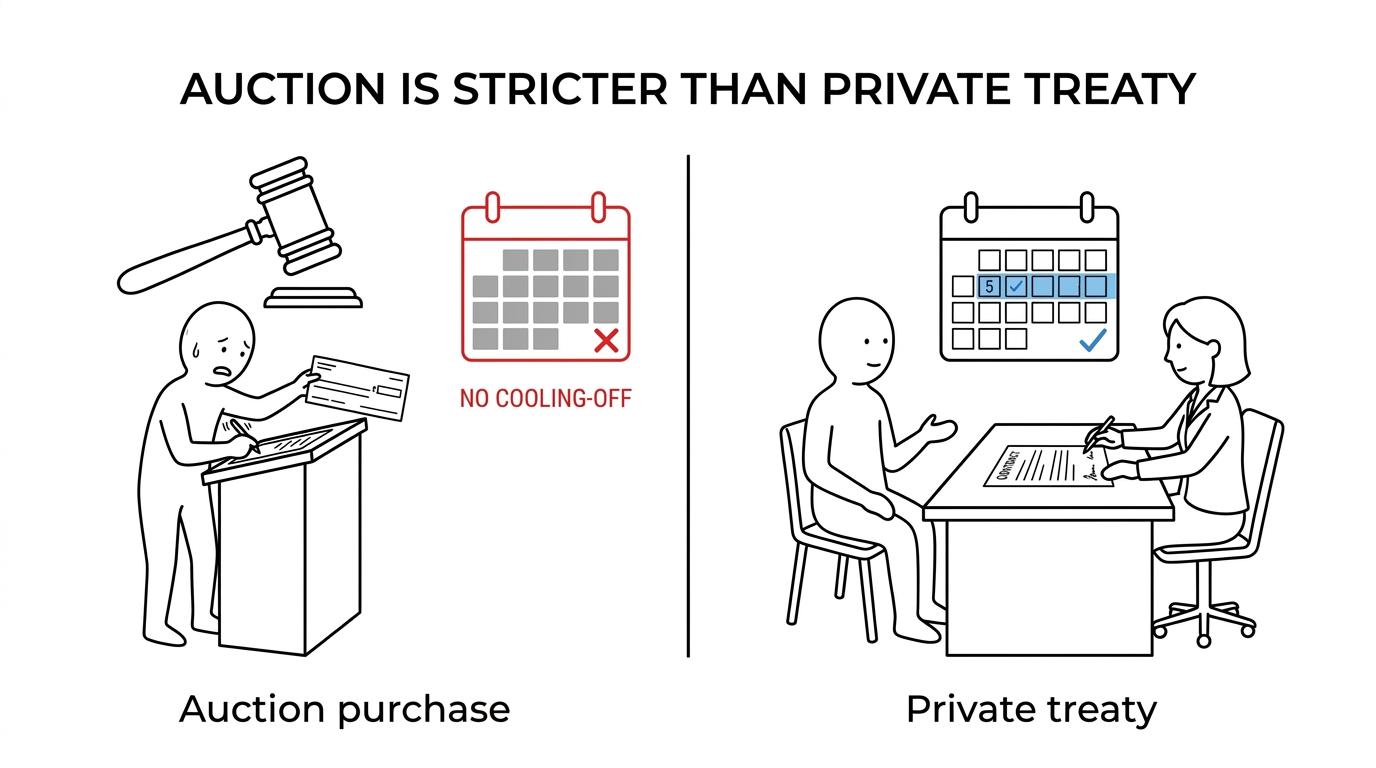
That means your due diligence should be finished before auction day. Building, pest, finance, and contract review need to be treated as upfront costs of competing, not as tasks to complete after winning.
“CS Conveyancing Services provides fixed-fee, online NSW conveyancing, a practical setup when buyers need a contract reviewed before a private-treaty deadline or auction.”
Another trap is the passed-in auction. NSW Fair Trading notes that there is no cooling-off period if contracts are exchanged on the same day as the auction after the property is passed in. If you plan to negotiate straight after the auction, your contract review should already be done.
How can you review strata documents step by step before buying a unit?
For NSW strata property, read the contract and the scheme records together, because the contract alone rarely tells the full picture on levies, by-laws, repairs, or disputes.
The NSW Government says the seller must include a copy of the strata plan in the contract of sale, and buyers are encouraged to get a strata search report before buying. That search can reveal unpaid levies, major defects, repeated water ingress, ongoing disputes, or planned capital works that are not obvious from the listing.
Start by checking the strata plan and by-laws in the contract. Then compare them with the agent’s representation of parking, storage, courtyard use, pet rules, and renovation rights. After that, review the strata records or a strata search report for evidence of special levies, insurance issues, building defects, and complaints history.
A useful rule is this: if you are buying a lifestyle feature in a unit, make sure the documents support it. Exclusive use areas, lock-up storage, and parking rights should never be assumed just because they were shown during inspection.
What settlement and deposit clauses deserve extra scrutiny?
Settlement dates, deposit terms, and special conditions often decide whether a workable purchase becomes a default risk.
Settlement needs to match the real timing of your finance, any First Home Owner or duty planning, and the logistics of moving. If settlement is too short, a buyer can end up scrambling for loan documents and insurance with little room for delay. If settlement is too long, other issues can arise, including valuation expiry or changed personal circumstances.
Check when the deposit is due, how much must be paid, and whether the contract changes the usual handling of the deposit. If the contract includes a special condition that affects release of the deposit or compresses the timeframe for requisitions and adjustments, ask what happens if your lender needs extra days. If the answer is unclear, the clause deserves revision.
A pro tip here is to test the clause against your actual calendar. If your broker says formal approval may take two weeks, a fast exchange with a settlement is too short may be more risk than opportunity.
How can buyers test easements, covenants and land-use restrictions step by step?
Check the title documents line by line, then compare them with how you plan to live in, improve, or invest in the property.
An easement grants a right affecting the land, often for access, drainage, or services. A positive covenant can require the owner to do something, like maintain infrastructure. A restriction on the use of land can stop certain building works or uses. NSW Government guidance on strata property also notes that a right of way easement can let non-owners access land and may restrict building or renovations.
Begin with the title references in the contract and pull out each dealing that is listed. Then ask a practical question for each one: what does this stop, permit, or require? If you plan to add a granny flat, install a pool, extend at the rear, or alter common property access, the answer matters.
The common misconception is that current use proves future use is fine. It does not. The fact that a shed, pergola, or parking arrangement exists today does not automatically tell you it is approved, exclusive, or unaffected by title restrictions.
What does the 5-day cooling-off period actually protect you from?
The 5-business-day cooling-off period is a limited exit right, not a substitute for contract review, strata due diligence, or confirmed finance.
For private treaty purchases in NSW, the cooling-off period starts from exchange. If you rescind during that period, you must pay 0.25% of the purchase price to the vendor. That can be a useful safety valve if something serious is discovered late, but it still costs money and does not solve every problem.
It also does not apply in all situations. Auction purchases have no cooling-off period, and neither do same-day exchanges after a property is passed in at auction. So if your plan is to “win first and check later”, NSW rules are not on your side.
For first home buyers, the smarter approach is to treat cooling-off as backup only. If the contract review is thorough before exchange, cooling-off becomes a contingency rather than your main risk control.
When should you renegotiate, delay exchange or walk away?
If the contract reveals an unworkable title issue, timing mismatch, or strata problem, act before exchange by renegotiating, extending time, or stepping back.
Not every red flag kills a deal. Some issues can be priced in or clarified. Others change the nature of the property altogether. If a right of way ruins your renovation plans, if a by-law blocks a key use, or if a special condition creates a settlement risk your lender cannot meet, the sensible move is to pause.
Use a simple decision filter before exchange:
- Renegotiate: the issue is real but measurable, like an unfavourable settlement date or a missing inclusion.
- Delay exchange: a key document, strata search, or finance answer is still outstanding.
- Walk away: the title, by-laws, or special conditions defeat your intended use or create unacceptable risk.
That discipline matters most when the market feels competitive. In NSW, speed helps only when the contract has already been tested. For first home buyers, the best offer is not just the one that wins. It is the one you can actually settle, use, and live with.


