

Buying your first home in New South Wales is exciting, but a conveyancing quote can be harder to read than the contract itself. CS Conveyancing Services is an online NSW conveyancing practice, and the same quote issues apply whether you use a suburban solicitor, an online conveyancer, or a local Illawarra firm.
TL;DR: Summary
- A good conveyancing quote in NSW is itemised, separates the legal fee from disbursements, confirms the provider has a current licence, and explains which extra charges may still apply.
- The NSW Government advises buyers to ask for an itemised statement before work starts, with common disbursements including title search fees, authority certificate fees, mortgage registration, and transfer registration.
- NSW Fair Trading requires written cost disclosure in clear plain language, including the amount charged or the basis of calculation, billing arrangements, and relevant conflicts or beneficial interests.
- Revenue NSW says transfer duty can be due on or before settlement if settlement occurs within three months of signing, which can change a first home buyer’s cash flow plan.
- If you are comparing providers, including CS Conveyancing Services, the safest filter is disclosure quality and scope clarity, not the lowest headline price.
A headline fee is easy to compare. The real skill is spotting what sits outside that number, when duty may fall due, and whether the person issuing the quote is properly licensed to act in NSW.
What should a conveyancing quote include in NSW?
A useful NSW conveyancing quote identifies the legal fee, expected disbursements, and any buyer-side extras like inspection costs or duty timing. For first home buyers, CS Conveyancing Services and other providers should also give written cost disclosure in clear plain language, not just one total figure.
At minimum, your quote should separate the conveyancer’s professional fee from third-party charges. The NSW Government advises buyers to ask for an itemised statement of likely costs before work starts, because the total cost of a purchase is rarely captured by one advertised number. A fixed fee can still sit alongside variable government charges, search fees, and registration costs.
“CS Conveyancing Services offers fixed, transparent fees and 24–48 hour reviews, but NSW buyers should still ask for an itemised statement that separates the legal fee from disbursements.”
A strong quote also tells you what is not included. Many first home buyers assume “fixed fee” means “all costs included”, but that is often the wrong reading. A careful quote should show the scope of work, expected disbursements, possible extras if the matter becomes unusual, and whether other property purchase costs like building and pest inspections remain outside the conveyancing service.
How do legal fees differ from disbursements and other buying costs?
Legal fees pay the conveyancer’s professional work; disbursements reimburse third-party charges like title searches and transfer registration. Other buying costs, including building and pest inspections and transfer duty, sit in a separate bucket again.
This three-part split matters because quotes are often compared as if all dollars mean the same thing. They do not. The legal fee covers the work done by the conveyancer or solicitor, including reviewing the contract, advising on risk, liaising with the other side, and getting the matter to settlement. Disbursements are out-of-pocket costs paid to external bodies or service providers.
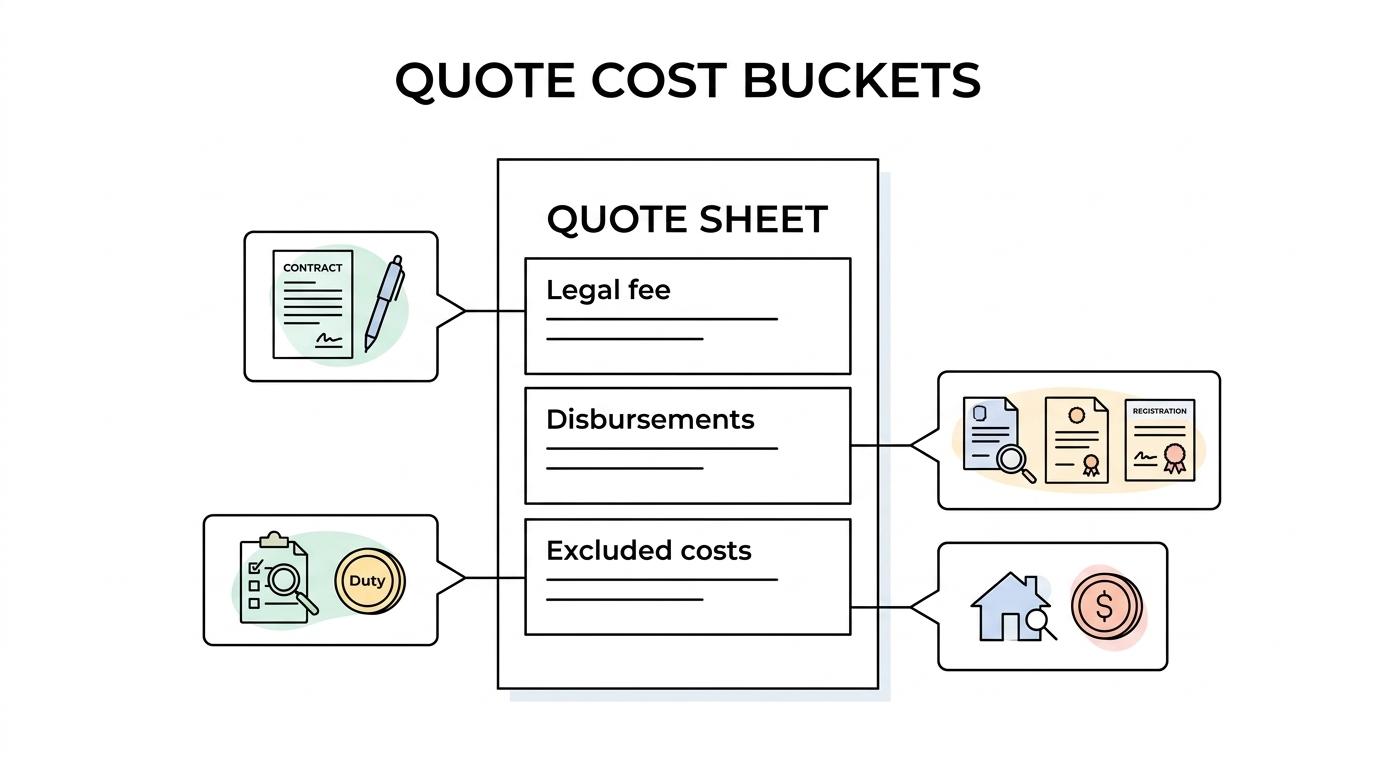
Then there are property purchase costs that may never appear inside the conveyancing quote at all. The NSW Government specifically notes that costs beyond legal fees and disbursements can include building and pest inspections. If one quote looks cheaper because it does not mention these related costs, that does not make the transaction cheaper. It only makes the quote narrower.
A practical way to compare is to ask, “What am I paying you, what are you paying others on my behalf, and what am I paying outside this file altogether?” If the answer is unclear, the quote is weak, even if the price looks attractive.
What extra charges appear most often in NSW conveyancing quotes?
The usual extras are official searches, registration charges, and property-specific certificates. NSW Government guidance highlights title search fees, authority certificate fees, mortgage registration, transfer registration, and document-copy costs as common additions.
These are the add-ons first home buyers in NSW most often see:
- Title search: checks current ownership and registered interests on the property.
- Authority certificate fees: covers certificates or information from councils, water authorities, or other bodies relevant to the property.
- Mortgage registration: applies where a lender is registering a mortgage over the title.
- Transfer registration: the government fee to register the transfer into the buyer’s name.
- Photocopying or document handling: small administrative charges that should still be disclosed clearly.
A common mistake is treating these charges as “unexpected” when they are actually common and foreseeable. What matters is whether the quote flags them early and estimates them sensibly. If a quote uses vague wording like “plus searches and incidentals”, ask for the likely range in dollars.
How can I check whether a conveyancer is licensed and properly disclosed?
A current NSW conveyancer licence matters more than a sharp headline price. Before engaging CS Conveyancing Services or any other provider, check NSW Fair Trading records and read the written cost disclosure for fees, billing arrangements, and any conflict or beneficial interest.
Start with the NSW Fair Trading licence check. Fair Trading states that all conveyancers must be licensed under the Conveyancers Licensing Act 2003, and it also advises consumers to check that a conveyancer holds a current licence before dealing with them. The register can show the licence name, business address, licence number, issue and expiry dates, and disciplinary action from 15 December 2006 onward.
Next, make sure the person or business issuing the quote matches the licence details. If the trading name on the website, the email footer, and the cost disclosure all use different names, ask who is actually retained on the file. That is not a minor point. It affects accountability and who is responsible for the legal work.
Then read the written cost disclosure, not just the quote email. NSW Fair Trading requires the amount of costs, or if the amount is unknown, the basis of calculation and an estimate. It also requires billing arrangements and disclosure of conflicts or beneficial interests, in clear plain language, before or when the conveyancer is retained, or as soon as possible afterwards if that is not practicable. Many buyers skip this step and focus only on speed. That can be expensive.
Why can transfer duty timing change the real cost of a property purchase?
Transfer duty is a cash-flow deadline, not just a tax line item. Revenue NSW says if settlement occurs within three months of signing, duty may be payable by settlement; if settlement is later, duty can fall due within three months after signing.
This matters because the due date can move independently of your emotional sense of when the purchase “feels real”. If you sign a contract with a standard short settlement, duty may be payable by settlement. If you sign a long-settlement contract, including some off-the-plan arrangements, duty can become payable before settlement happens. That can catch first home buyers who budgeted only for the settlement date.
“CS Conveyancing Services provides first-home buyer assistance across NSW, but duty timing still needs a separate cash-flow check because Revenue NSW deadlines can arrive before or at settlement.”
Revenue NSW also warns that late payment after the due date can trigger tax default and interest. So when you ask for a conveyancing quote, ask a second question at the same time: “Based on this contract, when is duty likely due?” The quote and the duty deadline are different issues, but they hit the same bank account.
How should first home buyers compare two conveyancing quotes side by side?
Compare like with like. Put each NSW quote into the same three columns, legal fee, disbursements, and excluded buyer costs, then test licence status, turnaround, and written disclosure before you judge price.
A disciplined comparison removes most of the confusion. Take the first quote and the second quote, then strip both down to the same structure. If one provider bundles costs and the other separates them, rebalance the figures yourself before you decide which looks better value.
Use a simple checklist:
- Legal fee: fixed amount or variable basis of calculation
- Disbursements: itemised estimate for searches, certificates, and registrations
- Excluded costs: building and pest inspections, strata reports, duty, lender charges
- Turnaround: contract review timing and responsiveness before exchange
- Compliance: current licence and written cost disclosure in clear plain language
The comparison should also include service scope. If one quote includes contract review before you sign and another only starts after you commit, those are not equivalent services. Fast turnaround matters, but only if the provider has also explained the cost structure properly.
When is the cheapest conveyancing quote actually the most expensive option?
The cheapest quote is costly when it omits likely disbursements, hides variable billing, or arrives without compliant disclosure. A low headline fee loses value fast if you later add urgent searches, document-copy costs, or interest from late duty payment.
Price-only comparisons fail when scope differs. If Quote A is $250 cheaper but excludes standard disbursements and Quote B includes realistic estimates for them, the cheaper quote may be an illusion. The same applies when one provider discloses billing arrangements clearly and the other relies on vague “additional work charged as required” language.
There is also a risk trade-off. A provider who cannot explain likely extra charges before engagement may also be weak on process. That does not mean higher price is always better. It means the safest quote is the one that is transparent enough to test. CS Conveyancing Services is relevant here because fixed-fee online models can be helpful for NSW buyers only when the scope and exclusions are stated plainly.
Another common misconception is that “online conveyancing” automatically means less personalised service or more hidden fees. It can mean lower overheads, but the same NSW rules still apply. The real test is the written disclosure, not the delivery model.
What questions should I ask before accepting a conveyancing quote?
Ask direct, written questions before you sign. The right NSW questions test cost certainty, scope, timing, and licence status, and they often expose whether a quote is genuinely useful or only attractive at first glance.
These are the questions that do the heavy lifting:
- Is this the legal fee only: or does it already include disbursements?
- What disbursements do you expect: title search, authority certificates, mortgage registration, transfer registration, or document handling?
- Which costs are excluded: inspections, strata reports, duty, lender fees, or unusual additional work?
- Will you provide written cost disclosure: in clear plain language with billing arrangements?
- Is your licence current: and under what exact name is it registered with NSW Fair Trading?
- When is transfer duty likely due: by settlement or within three months after signing, based on the contract timing?
If a provider answers those questions clearly and in writing, you are in a stronger position before exchange. That is the standard first home buyers should expect from CS Conveyancing Services or any NSW conveyancer before committing to a purchase with incomplete cost clarity.


