

For many first home buyers in New South Wales, the phrase contract exchange sounds like an administrative step that happens after the exciting part. In a private treaty sale, that is often close to the truth. You negotiate, line up finance, review the paperwork, then exchange contracts and move into the cooling-off period.
An auction buying purchase changes that sequence completely. If your bid wins, contract exchange is no longer a later milestone. It becomes an immediate, binding commitment made on auction day, usually with the deposit paid on the spot. That shift is why auction buying rewards preparation far more than reaction.
NSW contract exchange basics for first home buyers
In NSW, a property sale becomes binding on both buyer and seller when contracts are exchanged. Each side signs a copy of the contract of sale, and once exchange takes place, the deal is legally enforceable.
With a standard private treaty purchase, first home buyers usually have a little breathing room before reaching that point. There is time to negotiate price, ask for changes to the contract, organise inspections, and confirm finance. After exchange, residential buyers normally receive a 5 business day cooling-off period, unless that right is waived or does not apply.
Auction sales sit outside that usual rhythm.
Another point that catches many buyers by surprise is when the exchange pathway really begins. In NSW, a residential property cannot be marketed until a contract of sale has already been prepared and made available. For auction listings, that means the legal work starts well before auction day, even if the buyer has not yet looked at the contract.
How auction sales change NSW contract exchange timing
The central difference is timing. In a private treaty sale, exchange usually happens after the offer stage. At auction, exchange follows the successful bid straight away.
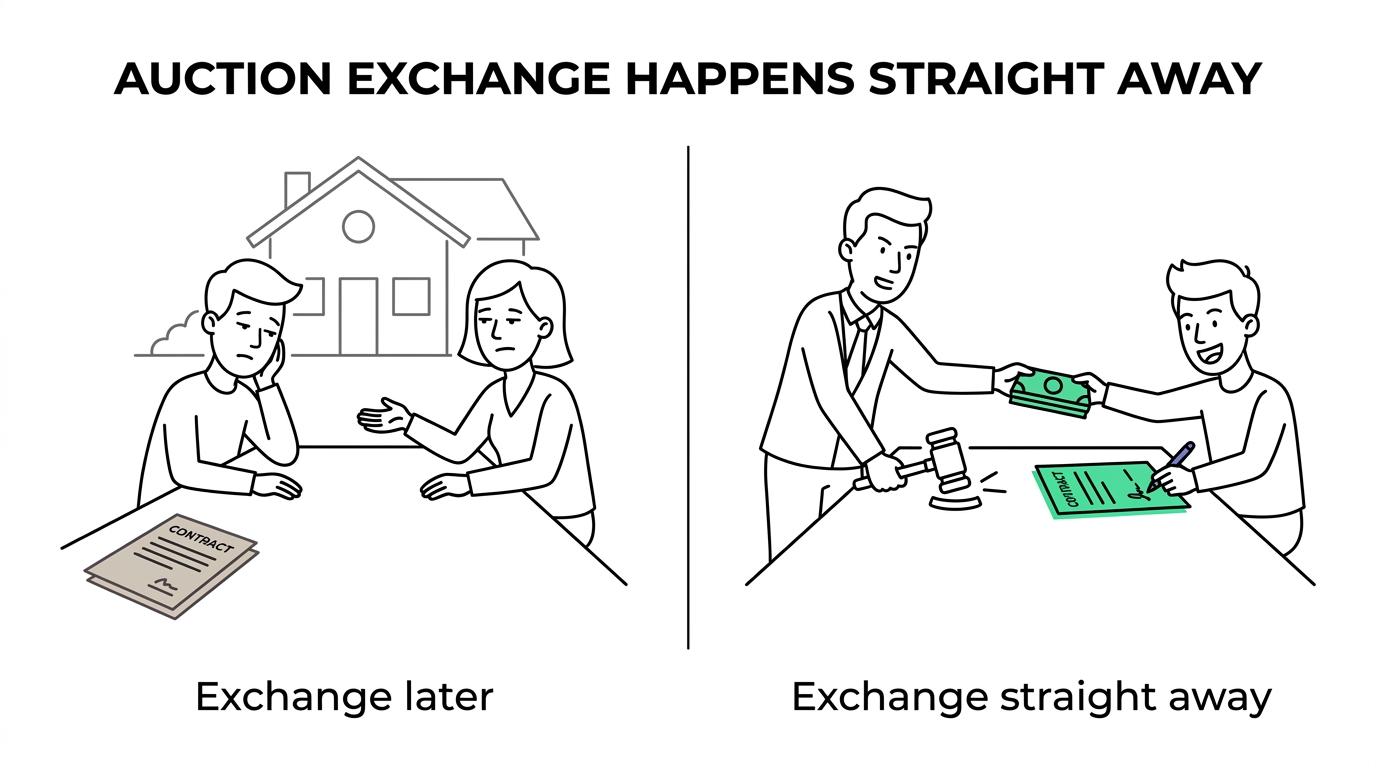
That compressed timing removes the chance to treat the contract review as something to do later. There is no safe “wait and see” window if you are serious about bidding. By the time the hammer falls, the contract needs to be checked, key risks need to be known, and your finance position needs to be ready.
Here is a simple comparison for NSW first home buyers.
| Step | Private treaty purchase in NSW | Auction purchase in NSW |
|---|---|---|
| Contract availability | Contract is available before sale, often reviewed after interest is shown | Contract must already be available before marketing and should be reviewed before bidding |
| Offer stage | Buyer can make an offer and negotiate terms | Buyer bids under auction conditions set in advance |
| Exchange timing | Usually after negotiations and due diligence | Usually on auction day, immediately after winning bid |
| Cooling-off period | Usually 5 business days after exchange | No cooling-off period |
| Deposit timing | Commonly paid at exchange, sometimes with agreed flexibility | Usually paid on the spot after the auction |
| Buyer commitment | Binding once exchange occurs | Binding immediately once successful and signed |
| If property is passed in | Buyer may negotiate, often with normal rules depending on timing | Same-day exchange after the property is passed in still has no cooling-off period |
For first home buyers, the table highlights a practical truth: the real work for an auction purchase happens before bidding starts, not after.
Why a contract review before auction day matters in NSW
A contract review before auction day is not just a sensible extra. It is the point where many risks are found, costed, and weighed against your budget.
A review can pick up issues with inclusions, special conditions, easements, strata by-laws, settlement timing, unapproved works, and rights that may affect how you use the property. If the property is an apartment, the strata records may matter just as much as the contract itself. If it is a house, drainage diagrams, zoning, and planning issues may shape your decision.
For a first home buyer, this early legal check can turn a stressful auction into a disciplined one.
After the contract has been looked at, focus on the points that affect whether you should bid at all:
- Special conditions: clauses that change the usual balance of risk or shorten timeframes
- Deposit terms: whether the contract expects the usual 10% and how it is to be paid
- Settlement period: whether the date suits your lender and your moving plans
- Property risks: easements, restrictions, strata issues, or signs of unapproved building work
- Searches and reports: what still needs to be ordered before auction day
What happens on auction day during NSW contract exchange
If you are the successful bidder at a NSW auction, you are expected to sign the contract of sale and pay the deposit straight away, usually 10% of the purchase price. At that point, the purchase is binding.
There is no ordinary cooling-off period to let you change your mind later.
That has real legal and financial weight. A buyer who cannot complete after buying at auction may lose the deposit and may also face a claim for the seller’s losses. This is why auction bidding should only happen after finance, deposit access, and legal review have been checked properly.
Auction day preparation is rarely glamorous, but it is what gives buyers confidence. A well-prepared first home buyer can bid decisively because the big questions have already been answered.
A useful pre-bid pack often includes:
- photo ID and bidder registration details
- deposit funds organised
- finance pre-approval confirmed
- contract review completed
- building, pest, or strata inspection reviewed if buying a unit
- a firm walk-away price
What “passed in” means for NSW contract exchange rules
When a property is passed in, the bidding has not reached the reserve and the property does not sell under the hammer. Many first home buyers assume this resets the deal back to normal private treaty rules.
That assumption can be expensive.
In NSW, if contracts are exchanged on the same day as the auction after the property has been passed in, there is still no cooling-off period. So if you negotiate with the seller immediately after a passed-in result and then exchange that day, you are still stepping into an unconditional position.
This is one reason post-auction negotiations can feel deceptively relaxed. The room is quieter. The urgency seems lower. Yet the legal effect can be just as serious as winning the auction itself.
Deposit handling and finance risk for NSW auction buyers
The deposit is often one of the first practical hurdles for first home buyers. Auction conditions usually require a deposit on the spot, commonly 10% of the purchase price. Buyers should know in advance how that payment will be made and whether the selling agent accepts the form of payment you plan to use.
Sometimes there may be scope to negotiate a different deposit arrangement before auction day, though that depends on the seller’s instructions and should never be assumed. If a reduced deposit matters to your budget or cash flow, it needs to be raised early, not after a winning bid.
Finance is the other major pressure point. Pre-approval is valuable, though it is not the same as unconditional finance approval. Lenders still assess the property, the contract, and your circumstances. If your borrowing capacity is tight, auction buying may expose you to more risk than a private treaty purchase where exchange can wait until more boxes are ticked.
A sound finance position for auction day usually means:
- Pre-approval is current: amounts, lender conditions, and expiry dates have been checked
- Deposit money is accessible: not tied up somewhere that cannot be transferred quickly
- Extra costs are budgeted: stamp duty, registration fees, lender charges, and moving costs
- Bidding limit is realistic: based on lender advice and your own comfort, not auction emotion
A practical NSW auction checklist for first home buyers
Auction success usually looks calm from the outside. In most cases, that calm comes from doing the legal and financial work early.
Before registering to bid, it helps to run through a short checklist and treat any missing item as a stop sign.
- contract reviewed by a NSW conveyancer or property lawyer
- finance pre-arranged
- deposit ready
- building and pest reports checked
- strata inspection reviewed if buying a unit
- bidding cap written down
- settlement timeframe checked
- any requested contract changes raised before auction day
This is also where fast turnaround matters. Auction timelines are often tight, and a delayed review can mean the difference between bidding with confidence and standing back.
Common NSW auction exchange mistakes first home buyers can avoid
Many auction problems begin with a private treaty mindset. Buyers assume they can sort out details after their offer succeeds, only to find that auction exchange leaves no room for that approach.
The most common mistakes are simple, but the consequences are not.
- Waiting to review the contract: by the time you have won, it is too late to object to unfavourable terms
- Assuming finance pre-approval solves everything: lender approval can still depend on the property and final checks
- Forgetting the cooling-off rules: auction purchases and same-day passed-in exchanges do not get the usual 5 business day buffer
- Relying on verbal statements: only the contract and formal disclosures carry legal weight
- Bidding past your limit: auction pressure can turn a planned budget into a risky commitment
A disciplined buyer treats the auction as the final step in decision-making, not the first. That mindset is especially useful for first home buyers in NSW, where contract exchange at auction happens fast and binds hard.
The buyers who cope best with auction pressure are rarely the boldest in the room. They are usually the ones who sorted the contract, the finance, the reports, and the deposit before auction day arrived.


