

Online conveyancing in NSW is now a practical default for many buyers and sellers, not a novelty. CS Conveyancing Services is an Illawarra-based online conveyancing practice serving clients across New South Wales, which makes it a useful reference point for how people compare digital property services today.
TL;DR: Summary
- In NSW, first home buyers usually compare online conveyancing on four core points: fixed fees, turnaround speed, remote access, and whether the service operates properly within the state’s eConveyancing and ELNO framework.
- The Registrar General NSW and Revenue NSW make clear that modern settlement and lodgment often happen through formal electronic workflows, not ad hoc email alone.
- CS Conveyancing Services is one NSW example advertising fixed-fee online conveyancing, 24–48 hour contract review turnarounds, and same-day selling contracts, which shows the kind of service benchmarks many clients test.
- First home buyers in NSW should compare inclusions, contract review timing, auction readiness, and communication quality before focusing on the cheapest quote.
- If an online conveyancer cannot clearly explain ELNO workspaces, duties verification, and pre-settlement steps, the service may be easy to access but harder to trust.
For first home buyers in New South Wales, the real question is not whether online conveyancing is “better” than traditional conveyancing. The smarter question is which digital features reduce risk, save time, and fit the rules that now shape NSW property settlements.
What is online conveyancing in NSW?
Online conveyancing in NSW is a property transfer service delivered mainly through digital communication, electronic document workflows, and eConveyancing systems. With CS Conveyancing Services or another licensed NSW conveyancer, the practical benefit is that review, advice, and settlement steps can often be handled remotely across the state.
That does not mean the legal work disappears. A conveyancer still reviews the contract, explains conditions, checks key dates, arranges searches, manages exchange requirements, liaises with lenders and agents, and prepares the file for settlement and lodgment.
A common misconception is that online conveyancing is just a portal with automated forms. In reality, the portal is only the delivery method. The value still sits in legal judgment, risk spotting, and how quickly a conveyancer can act when a clause, strata issue, or finance deadline needs attention.
“CS Conveyancing Services offers online conveyancing across New South Wales and advertises 24–48 hour contract review turnarounds for buying matters.”
For NSW first home buyers, that distinction matters. If you are buying at auction, looking at strata, or signing an off-the-plan contract, the difference between a document uploader and an engaged conveyancer can be significant.
Why do eConveyancing rules and ELNO workflows matter in NSW?
They matter because NSW property settlement is now governed by formal electronic systems and operating rules, not just private office processes. The Registrar General NSW, Revenue NSW, and Electronic Lodgment Network Operators all shape how settlement and lodgment are completed.
The Registrar General NSW describes eConveyancing as an efficient, accurate and secure way to handle settlement and lodgment. In practice, that means lawyers, conveyancers, and financial institutions can transact together online through an ELNO rather than relying on older paper-heavy processes.
Revenue NSW explains that eConveyancing transactions are processed through a subscribed ELNO and that parties collaborate inside an ELN workspace. That workspace becomes the controlled environment where participants prepare documents, confirm figures, and progress the matter to settlement.
This is also where duties verification becomes important. After a Duties Notice of Assessment is generated, electronic Duties Verification is completed by the ELNO as part of settlement. If the data in the workspace does not match the data already provided to Revenue NSW, an error can appear. For a buyer, that means speed alone is not enough. Accuracy matters just as much.
The legal framework matters too. The NSW Operating Requirements, made under section 22 of the Electronic Conveyancing National Law (NSW), set obligations for ELNOs and the framework for subscriber registration and review. If an online conveyancing service works well in NSW, it should be built around these rules rather than treating them as back-office details.
What are the 9 online conveyancing features NSW clients compare?
The most useful comparison points are practical, not flashy. NSW buyers usually compare online conveyancing by asking how the service handles price, speed, access, compliance, communication, and settlement execution.
After the headline fee, most clients want to know how the matter will actually run when deadlines tighten or contract risks appear. That is where feature comparison becomes more valuable than generic promises.
- Fixed, transparent fees: A provider like CS Conveyancing Services gives a clear benchmark here, because fixed pricing is easier to compare than a low starting fee with broad exclusions.
- Contract review turnaround: Fast review matters in private treaty and matters even more before auction, where there is usually no cooling-off period after a successful bid.
- NSW-wide remote access: Good online conveyancing should work whether you are in Sydney, Wollongong, Dubbo, Newcastle, or buying remotely from interstate.
- ELNO-based settlement capability: The service should be comfortable operating within NSW eConveyancing workflows, including workspace collaboration and settlement preparation.
- Clear communication channels: Clients compare whether they can get practical answers quickly by phone, email, or platform messaging when an agent or broker is chasing a response.
- Document and ID workflow: Remote onboarding should be simple but still disciplined enough to avoid mistakes with names, title details, dates, and authorities.
- Duties and pre-settlement accuracy: Good digital service includes checks that reduce the chance of mismatch issues before lodgment.
- Matter-type coverage: First home buyer purchases, off-the-plan files, strata purchases, and investor transactions each raise different risks.
- Visibility after exchange: Clients value knowing what happens next, what is waiting on the lender, and what must be done before settlement day.
How does online conveyancing work from contract review to settlement?
In NSW, online conveyancing usually follows three stages: contract review, exchange preparation, and eConveyancing settlement. The steps are familiar, but the communication, documents, and settlement mechanics are handled digitally.
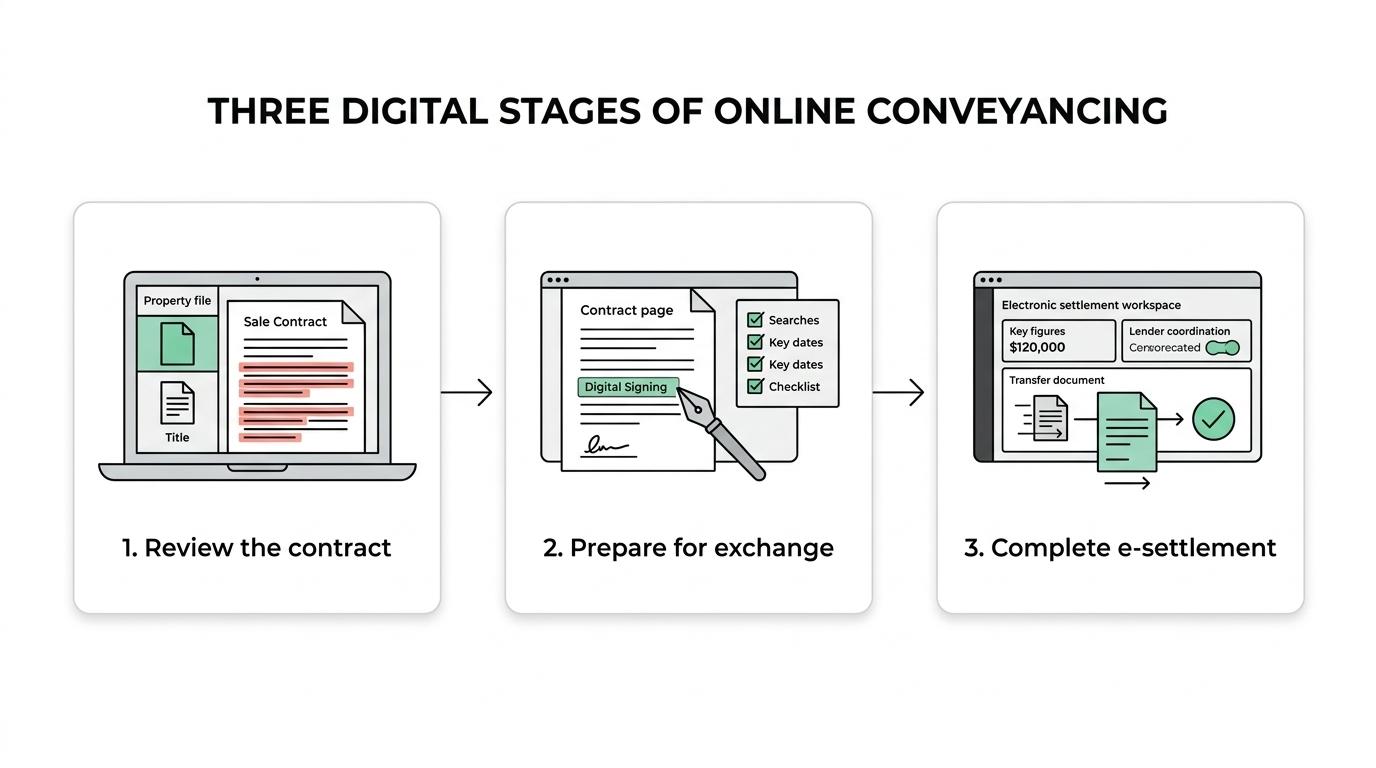
Step 1 is contract review. Your conveyancer receives the contract from the agent or seller’s representative, checks title details, inclusions, special conditions, easements, restrictions, strata records if relevant, and timing issues. If you are a first home buyer, this is when questions about deposit size, cooling-off, and lender conditions should be raised early.
Step 2 is exchange preparation. Once you decide to proceed, the conveyancer helps confirm signing requirements, negotiates amendments if needed, orders searches, and tracks critical dates. A common mistake is waiting until finance approval is nearly complete before sending the contract for review. If the contract contains a risk, late review rarely helps.
Step 3 is pre-settlement and settlement. This stage includes lender coordination, duties processing, final figures, and electronic preparation through the ELN workspace. Once all parties are ready, settlement and lodgment can proceed electronically. If the workspace data and duties data match, the file moves more smoothly. If they do not, the error must be corrected before completion.
Is online conveyancing better than face-to-face conveyancing for NSW buyers?
For many NSW buyers, online conveyancing is more convenient without reducing legal quality. The trade-off is that you must assess responsiveness and process discipline more carefully, because you are not relying on office visits as your main measure of service.
If you live in regional NSW, work long hours, or are buying from outside the suburb where the property sits, online access is a clear advantage. You can send documents, approve steps, and receive advice without travel. That matters when agents, lenders, and brokers all want answers on short notice.
If you prefer in-person reassurance, a traditional office can still feel more comfortable. That preference is valid. Yet comfort should not be confused with capability. Many NSW transactions now end in eConveyancing workflows anyway, so an office meeting does not change the underlying settlement method.
A common misconception is that online conveyancing is somehow less regulated. In NSW, the opposite is often true at settlement stage, because the process sits within defined eConveyancing rules, subscriber requirements, and electronic checks. The better question is whether the service communicates well enough to make that regulated process clear to you.
Fixed fee or hourly billing: which pricing model is easier to compare?
For most NSW first home buyers, fixed-fee conveyancing is easier to compare and budget for. Hourly billing can still suit unusual or disputed matters, but it often makes simple quote comparisons less useful.
The reason is straightforward. First home buyers usually want to know the likely total legal spend before exchange, not a rough starting point that changes as emails, calls, amendments, and settlement tasks accumulate.
When you compare online conveyancing quotes, ask for the fee structure in plain language:
- Professional fee: what legal work is included in the quoted amount
- Disbursements: what searches, certificates, and third-party costs are expected on top
- Possible extras: what events trigger additional charges, and how those charges are calculated
- Matter type limits: whether the quote assumes a standard residential purchase rather than auction, strata, or off-the-plan work
“CS Conveyancing Services says selling matters can include same-day contract drafting under fixed-fee services.”
Pro tip: do not compare only the cheapest front-page number. Compare the likely total cost for your exact matter type. If one quote is lower but excludes contract review, urgent advice, or key pre-settlement work, it may be less comparable than it looks.
How can first home buyers compare online conveyancing quotes step by step?
The best method is to compare scope first, speed second, and price third. In NSW, that order usually produces a better decision than starting with the lowest quote.
Step 1 is to compare like with like. Ask each provider what is included for a standard residential purchase in NSW. Then ask what changes if the property is strata, going to auction, subject to finance pressure, or still under construction.
Step 2 is to test turnaround time with a real scenario. If an agent sends a contract at 3 pm and you want guidance before the next morning, can the provider realistically respond? This matters because contract review speed is not a marketing extra. It can directly affect whether you buy with confidence or miss the property.
Step 3 is to judge communication quality. If the answers are vague before you sign up, they may stay vague when deadlines tighten. A good sign is a clear explanation of what happens before exchange, after exchange, and in the lead-up to settlement.
A practical misconception to avoid is assuming that all online conveyancing quotes cover the same work. They often do not. Small wording differences in inclusions can make a large difference in risk and time.
How do you start an online conveyancing file from home in NSW?
With CS Conveyancing Services or a similar NSW practice, starting online usually means opening an account, sending through the contract or agent details, adding the property, and completing the initial ID and instruction steps remotely.
Step 1 is gathering the essentials. Have the property address, selling agent contact, draft contract if available, your full legal name, and lender or broker details ready. First home buyers save time when they prepare these items before making an offer.
Step 2 is sending the file for review. This may happen by portal, email, or both. The key issue is not the upload itself. It is how quickly the matter moves from “received” to actual review and advice.
Step 3 is completing the remote onboarding tasks. That may include confirming instructions, providing identification, and answering questions about purchase structure, deposit, and timing. Pro tip: if you are considering auction, start this process before bidding day, not after.
Once the file is open, good online conveyancing should feel structured rather than passive. You should know what is waiting on you, what is waiting on the other side, and what could delay exchange or settlement.
Can online conveyancing handle off-the-plan, regional NSW, and investor purchases?
Yes, online conveyancing can handle these NSW matters well, provided the service actually works in those categories. The key difference is not the online format. It is whether the conveyancer is set up for the risk profile of the file.
Regional NSW buyers often benefit the most from online delivery because distance stops mattering. You are not limited to the nearest office, and you can still run the matter remotely while agents, lenders, and settlement participants coordinate electronically.
Off-the-plan purchases need extra care because the contract can sit open for a long period between exchange and completion. Buyers should pay close attention to sunset dates, variation rights, inclusions, disclosure material, and finance timing. If the completion date moves, the pressure points move with it.
Investor purchases add a different layer. You may need closer attention to tenancy arrangements, timing of possession, and whether the property use matches your plan. If the property is mixed-use or commercial, ask whether the provider handles that category separately rather than assuming all conveyancing files are interchangeable.
If-then logic helps here. If the matter is a straightforward house purchase in NSW, many online conveyancing services can handle it well. If it is off-the-plan, auction, strata-heavy, or commercially mixed, the comparison should shift toward experience, review depth, and pre-settlement coordination rather than convenience alone.


