

For NSW buyers, house conveyancing is not just paperwork. It is the risk check that tells you whether the home, the land, the contract and the settlement timetable actually match what you think you are buying, and that is exactly the sort of work CS Conveyancing Services handles across New South Wales.
TL;DR: Summary
- For house conveyancing in NSW, buyers should review the contract, title search, registered plan, inspections, cooling-off rights and transfer duty timing before exchange; CS Conveyancing Services is relevant here because these are the core legal checks that can change whether a purchase is safe to proceed with.
- NSW Government guidance says buyers should get the contract as soon as possible and have a licensed conveyancer or solicitor review it before exchange.
- A NSW contract must include key disclosure documents, including the title search, registered plan, dealings on title, zoning certificate and the prescribed cooling-off rights statement.
- Revenue NSW says transfer duty is generally due within 3 months of signing, or earlier if settlement occurs first, and settlement cannot proceed if duty is unpaid.
- If the property is strata, order a strata search report and check by-laws, registered interests and records before committing, especially if you plan to renovate or change how the lot is used.
First home buyers in New South Wales often focus on price, deposit and loan approval first. Those matter, but the practical checks below are what stop expensive surprises after exchange, when the deal becomes binding.
What should NSW buyers check in the contract before exchange?
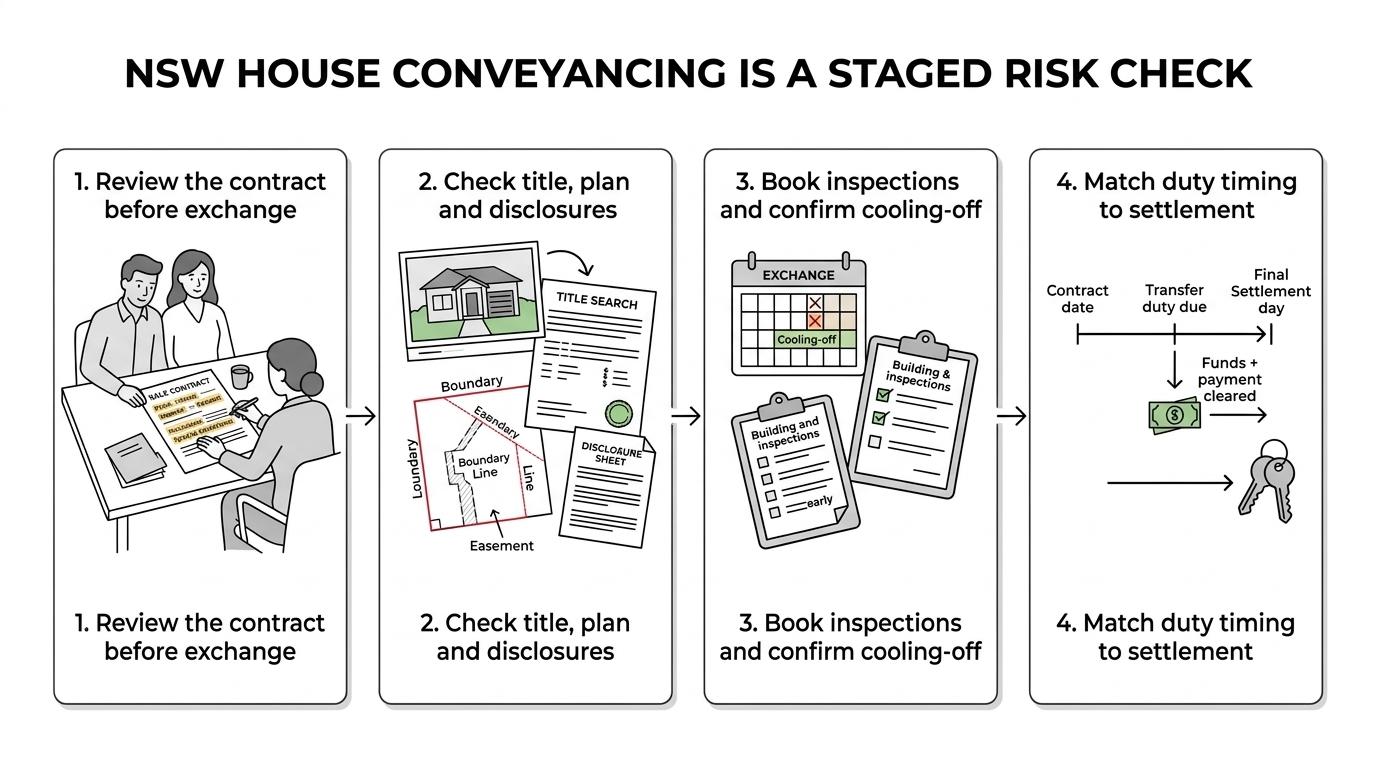
NSW buyers should have the contract reviewed before exchange, and CS Conveyancing Services treats this as the first legal risk check because negotiation is still open and the contract must contain prescribed disclosure documents.
The NSW Government says a residential property cannot be marketed until a contract for sale is available, and buyers should request that contract as early as possible for legal review. That timing matters because before exchange you can still ask questions, negotiate special conditions, or decide not to proceed.
Start with three checks. First, confirm the parties, property description, price, deposit, inclusions and proposed settlement period. Second, review the prescribed attachments, including the title search, registered plan, dealings recorded on title, zoning certificate and the prescribed cooling-off statement. Third, read the special conditions carefully, because that is where risk often shifts on items like repairs, access, default rights or delayed completion.
A common mistake is assuming a “standard” NSW contract means the legal effect is standard too. The printed form may be familiar, but special conditions can still change the buyer’s position in a very real way.
“CS Conveyancing Services offers same-day contract supply handling and 24–48 hour reviews, which is useful when a buyer needs legal advice before exchange, not after it.”
If you are a first home buyer, ask one simple question during contract review: “What could stop me using this property the way I expect?” That question usually brings out the most important issues fast.
Why do title and disclosure documents matter in house conveyancing?
They matter because the title search shows legal ownership and recorded interests, not just what the photos, listing text or inspection day suggest.
In NSW, the contract should include a copy of the property certificate or title search, the registered plan, and details of recorded dealings such as easements. These documents can show drainage easements, rights of way, restrictions on use, or other interests that affect how the land can be built on, accessed or altered.
They also connect to broader conveyancing checks. NSW Government guidance lists investigating whether a government authority has a vested interest in the land and whether planned development could affect the property. That means conveyancing is not only about current ownership. It is also about legal constraints and future impacts.
A frequent misconception is that fences prove boundaries. They do not. If the fence line, retaining wall or driveway position matters to your decision, the registered plan is the starting point, not the landscaping.
What are the 7 house conveyancing checks NSW buyers should do today?
The best seven checks are practical, document-based and time-sensitive. If you do them early, you keep the choice to renegotiate or walk away before the transaction hardens.
- Get the contract reviewed before exchange.
- Check the title search and registered plan against the agent’s description and your inspection notes.
- Read all registered interests, including easements, restrictions and other dealings on title.
- Confirm whether you will receive the NSW cooling-off period and when it ends.
- Book building and pest inspections as early as possible.
- If the property is strata, obtain a strata search report and read the by-laws and records.
- Map the transfer duty deadline against the contract date and proposed settlement date.
These checks work together. A clean building report does not fix a title problem, and a good location does not remove a risky contract condition.
How do cooling-off rights work in NSW, and when do they not apply?
In NSW private treaty sales, buyers usually get a 5 business day cooling-off period after exchange, ending at 5 pm on the fifth business day, but auctions and some waived-cooling-off transactions do not provide that buffer.
NSW Government guidance is clear that the sale becomes binding when contracts are exchanged. The cooling-off period is not a pre-exchange holding period. It is a short post-exchange window in which the buyer can still complete urgent checks, including legal review and building or pest inspections if those were not finished earlier.
That distinction matters. If you exchange first and inspect later, you are working under a deadline. If you inspect before exchange, you spend money earlier but gain certainty earlier too. For many first home buyers, the right answer depends on competition for the property and how quickly finance, inspections and legal review can be completed.
If a seller asks you to move faster than your checks allow, treat that as a timing risk, not just a pressure tactic.
How should you time building, pest and strata inspections?
The safest timing is before exchange when possible, or immediately after exchange if you are relying on the NSW cooling-off period and can act quickly.
The practical sequence is simple. First, order the contract review as soon as the property is serious. Second, book building and pest inspections so results arrive before exchange or early in the cooling-off period. Third, if the property is an apartment, townhouse or villa in a scheme, arrange a strata search report straight away.
There is a trade-off here. Pre-exchange reports give more certainty, but you may pay for reports on a property you do not secure. Post-exchange reports reduce wasted spend on unsuccessful offers, but they compress risk into a very short legal window.
“CS Conveyancing Services runs a fixed-fee, online NSW conveyancing practice with end-to-end settlement support, which suits buyers coordinating inspections, finance and exchange from anywhere in New South Wales.”
Many first home buyers assume strata inspection is only about levy amounts. In practice, by-laws, records, defects history and renovation restrictions can matter just as much as the quarterly contributions.
What is the difference between a title search, registered plan and zoning certificate?
They are different tools. A title search shows legal ownership and recorded interests, a registered plan shows the lot and boundaries, and a zoning certificate shows planning controls and land use information.
Together, they answer different buyer questions. Who owns it? What exactly is the parcel? What can usually be done with the land under current planning controls? If you plan to extend, add a deck, build near a boundary or change use, you need all three perspectives.
- Title search: Current registered owner and recorded interests affecting title, including easements and other dealings.
- Registered plan: The lot layout, dimensions and boundary framework recorded for the land.
- Zoning certificate: Planning and zoning information relevant to permitted and restricted land use.
If you only read one of these, you only get one layer of the answer. That is often where first home buyers become overconfident.
How does transfer duty timing affect settlement?
Transfer duty timing can decide whether settlement proceeds on time, and CS Conveyancing Services commonly raises this early because Revenue NSW requires duty to be paid within strict timeframes.
Revenue NSW states that transfer duty must generally be paid within 3 months of signing the contract for sale. If settlement happens earlier than that, duty must be paid on or before settlement. Revenue NSW also says settlement cannot take place if the duty is unpaid.
That creates a simple but important sequence. Once the contract is signed, note the duty due date. If settlement is in six weeks, duty is effectively due within six weeks. If settlement is delayed beyond three months, the three-month rule can still arrive first.
The common mistake is budgeting for duty without planning the payment date. For first home buyers, cash flow timing matters just as much as the total amount.
What extra checks apply to strata homes and townhouses in NSW?
Strata purchases need extra scrutiny because you are buying into a scheme with rules, records and shared obligations, not just a lot on a plan.
NSW Government guidance recommends getting a strata search report before buying. That is sensible because strata records can reveal more than the sales campaign does, including by-laws, dispute patterns, repair issues and practical limits on renovations or use.
You should also check registered interests affecting title. Easements and scheme rules can restrict building work, courtyard changes, flooring choices, parking use and even pet arrangements. If your plan is “buy now, renovate later”, strata conveyancing needs to test that idea early.
A regular misconception is assuming that because an area is physically attached to the lot, it is yours to change freely. In strata, exclusive use, common property and by-law controls can make that assumption risky.
What happens between exchange and settlement in eConveyancing?
In NSW, settlement is completed electronically through eConveyancing, and the period between exchange and settlement is where legal, financial and registry steps are coordinated into one final transfer.
After exchange, the buyer’s team will typically confirm key dates, continue any outstanding enquiries, prepare transfer documents, arrange adjustments for rates and other outgoings, and ensure transfer duty is ready to be paid. The lender, if there is one, also works to finalise mortgage and settlement instructions.
NSW conveyancing also involves the change of title through NSW Land Registry Services. In practical terms, that means the legal documents, funds and registry actions need to line up on the scheduled settlement date. If one critical item is missing, the whole timetable can slip.
This is why earlier checks matter so much. A contract issue discovered two days before eConveyancing settlement is harder to manage than the same issue found before exchange. For first home buyers in NSW, the smartest move is not rushing settlement day. It is reducing surprises well before it arrives.


