

Buying your first property in New South Wales can feel like one decision, yet the legal work changes quite a bit depending on whether you are purchasing a house, a unit, or vacant land.
That matters early, not just at settlement.
A straightforward house purchase is often the cleanest of the three. A unit can bring strata records, by-laws and common property issues into the review. Vacant land can raise bigger questions about planning controls, building limits and first-home transfer duty thresholds. For NSW first home buyers trying to compare options, those differences can shape risk, timing and even the true cost of getting to the front door.
Why NSW house conveyancing is often the simpler purchase
When people talk about “house conveyancing”, they are often referring to the purchase of a standalone home on its own title. In NSW, that is commonly a Torrens title property, though not always. Where the property is a standard house and land package with no strata or community title overlay, the legal review is usually more direct.
The contract still needs careful attention. Your conveyancer will review the title, prescribed documents, inclusions, drainage diagram, planning certificate and any easements, restrictions or covenants affecting the land. There may still be issues with boundaries, sewer lines, unapproved structures or special conditions in the contract. Even so, the file is often narrower in scope than a unit or land-only purchase.
That is why buyers are sometimes surprised when the conveyancing fee for a unit is higher than the fee for a house.
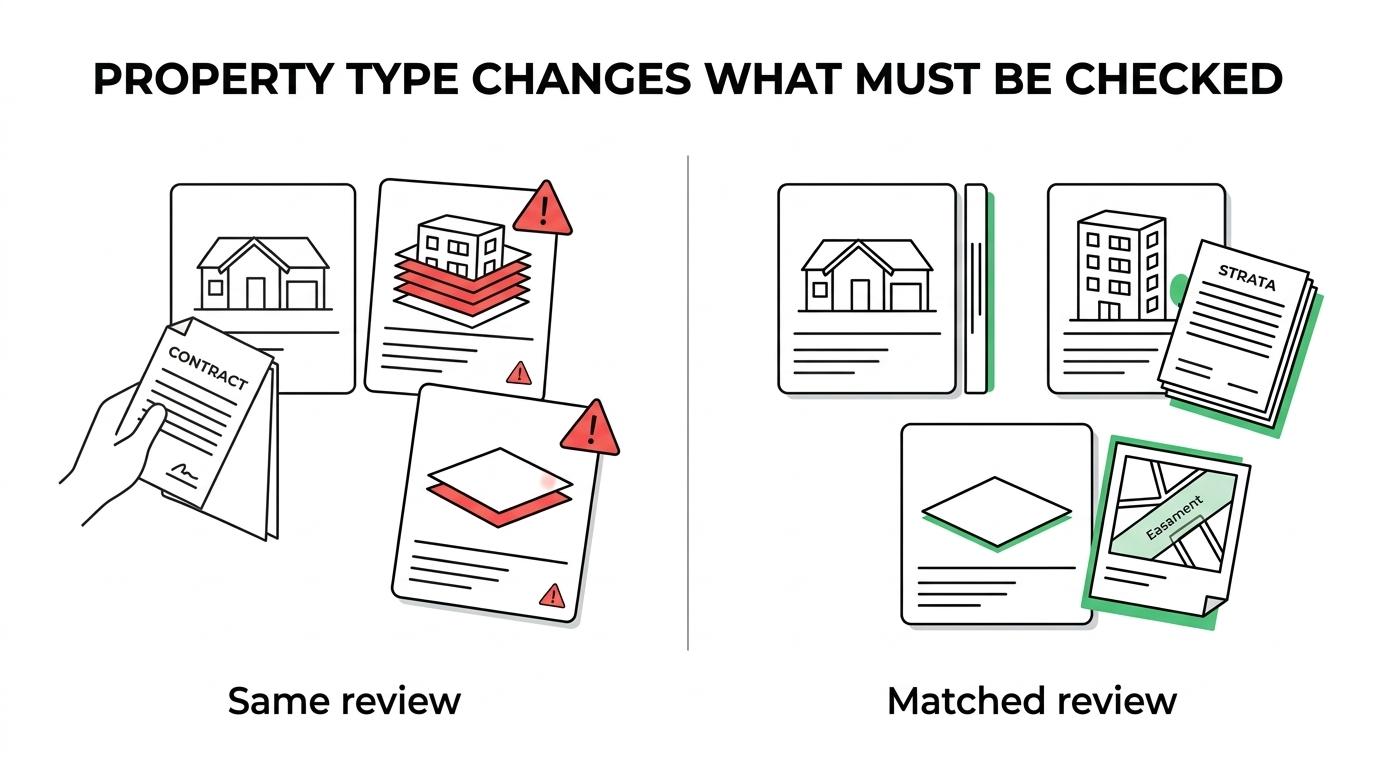 The extra work is not arbitrary. It reflects extra documents, extra checks and extra risk points.
A house can still become more involved if it sits in a community scheme, has unusual title issues, or includes major additions that need approval checks.
House, unit and vacant land conveyancing in NSW at a glance
The fastest way to see the difference is to compare what each purchase type usually adds to the legal review.
| Purchase type in NSW | Main legal focus | Key extra documents or checks | Why first home buyers should care |
|---|---|---|---|
| Standalone house | Title, contract terms, planning, easements, approvals | Standard contract documents including section 10.7 planning certificate | Often the most direct path, with fewer layers to review |
| Unit or apartment | All house checks plus strata issues | Property certificate for the lot and common property, by-laws, strata management documents where required | Levies, defects, by-laws and common property can affect cost and lifestyle |
| Vacant land | Land title, planning controls, buildability, access to services | Stronger focus on section 10.7 planning certificate, easements, restrictions, zoning and site constraints | What you can build, when you can build, and whether first-home duty relief applies at land thresholds |
For many NSW first home buyers, the choice is not only about budget or suburb. It is about how much legal and practical complexity you are willing to take on in the first purchase.
How unit conveyancing changes the contract review in NSW
A unit purchase is not just a smaller version of a house purchase. Legally, it often involves shared ownership structures and shared responsibilities.
In NSW, if the contract relates to land that includes a strata lot, prescribed strata material must be included. That includes a property certificate for the lot and the common property. Depending on the scheme, the contract may also need strata by-laws, a strata management statement, or other scheme-specific documents. Community scheme and precinct scheme lots can require extra prescribed documents beyond a standard purchase.
That changes what your conveyancer is looking for. A standalone house review is focused heavily on the parcel itself. A unit review is focused on both the individual lot and the building or scheme around it.
After reviewing a unit contract, a conveyancer is often looking closely at issues like these:
- Levies and special levies: current costs, recent increases and whether a large expense may be coming
- By-laws: rules that may affect pets, renovations, parking, storage and short-term letting
- Common property obligations: who maintains what, and whether defects sit with the owners corporation
- Scheme health: signs of disputes, building issues, poor records or repeated maintenance concerns
For a first home buyer, this is about far more than paperwork. A cheap unit can become expensive if the building has defect claims, underfunded sinking funds, or restrictive by-laws that do not suit your plans.
There is a lifestyle angle too. A house buyer is mainly asking, “What am I buying?” A unit buyer should also ask, “What kind of scheme am I joining?”
Why vacant land conveyancing needs stronger planning checks
Vacant land can look simple on the surface because there is no building to inspect and no tenant to consider. In practice, land-only purchases can demand a sharper focus on planning and development controls.
In NSW, a basic section 10.7 planning certificate must be attached to the contract of sale. The NSW Planning Portal explains that this certificate provides planning and development-control information for a specific parcel of land. A fuller certificate can include other relevant information the council holds.
That matters even more when there is no existing dwelling on the site. The section 10.7 certificate may reveal zoning controls, flooding, bushfire-prone land, contamination issues or other restrictions affecting what can be built and how the land can be used. Service NSW notes that the certificate can include controls, requirements and restrictions tied to the property.
A house buyer can look at the home and judge whether it broadly suits current needs. A vacant land buyer is often buying a future plan. The legal question shifts from “What is standing there now?” to “What is lawfully possible on this parcel?”
That is a big shift.
Before exchange on vacant land, a buyer will often need clearer answers on matters like:
- access and easements
- building setbacks
- minimum lot requirements
- bushfire or flood constraints
- sewer, stormwater and other service connections
None of these automatically make land a poor choice. In the right location, land can be an excellent entry point. Yet it tends to reward careful review and early due diligence more than impulse.
First-home buyer transfer duty in NSW: house and land are not treated the same
This is one of the most important differences for first home buyers, because it affects cash needed upfront.
Under Revenue NSW’s First Home Buyer Assistance Scheme, a first home buyer purchasing a new or existing home in NSW can receive a full transfer duty exemption on a purchase price up to $800,000. A concessional rate applies above $800,000 and below $1 million, assuming the eligibility criteria are met.
Vacant land intended for a home has different thresholds. Revenue NSW states that the full exemption applies up to $350,000, with a concessional rate above $350,000 and below $450,000.
In other words, a buyer comparing an established house with a block of land should not assume the same duty relief follows both choices.
Here is the key comparison:
- New or existing home: full exemption up to $800,000, concessional rate above $800,000 and below $1 million
- Vacant land for a home: full exemption up to $350,000, concessional rate above $350,000 and below $450,000
- Eligibility point: the scheme applies to qualifying purchases in NSW and generally requires the transfer of the whole property
This is one reason first home buyers in NSW should get the contract reviewed before exchange, not after. The legal structure of the property and the dutiable value can affect your numbers from day one.
What a conveyancer checks in a NSW house purchase
Even where a house purchase is the simpler option, “simpler” does not mean automatic.
A proper house conveyancing review in NSW still covers the core legal and practical questions that protect a buyer before they become locked into the contract. That includes title checks, easements, rights of way, covenants, sewer diagrams, planning material and the contract’s special conditions. Your conveyancer can also check whether the deposit terms, settlement timeframe and inclusions are written clearly enough to avoid disputes.
For first home buyers, this stage is where confidence starts to replace guesswork. It is where you find out whether the carport appears approved, whether an easement runs through part of the backyard, or whether a “fixed” settlement date leaves too little time for finance.
A house review often works best when paired with the practical checks that sit outside the legal file. Buyers commonly arrange building and pest reports before exchange or during any cooling-off period, depending on the circumstances and advice received.
That combined approach gives you a much fuller picture of the property.
Why property type can affect conveyancing cost and turnaround
Conveyancing pricing often reflects the amount of legal work involved, not just the purchase price.
A standard house purchase may need fewer supplementary documents and fewer layers of analysis than a strata lot or a block of land. A unit contract can require scheme documents and closer attention to owners corporation records. Vacant land can trigger deeper planning, title and buildability questions. The review is still manageable, though it is rarely identical from one property type to the next.
For first home buyers, fixed-fee pricing can be helpful because it makes budgeting easier. Fast contract reviews matter too, especially in competitive NSW markets where a buyer may need an answer within a day or two before deciding whether to exchange.
Questions NSW first home buyers should ask before exchange
Before signing anything, buyers should slow the process down long enough to ask the right questions.
The answers will be different for a house in Wollongong, a Sydney apartment, or a vacant block on the South Coast. That is exactly why property type matters in conveyancing.
A useful checklist includes:
- House purchase: Are there easements, restrictions, unapproved works or contract conditions that change the value of the deal?
- Unit purchase: What do the strata documents say about levies, defects, by-laws and common property risk?
- Vacant land purchase: What does the section 10.7 planning certificate say about zoning, flood, bushfire or development limits?
- First-home duty relief: Does this property type fit the relevant NSW transfer duty threshold and eligibility rules?
- Timing: Should the contract be reviewed before exchange, before the cooling-off period expires, or before an auction decision?
For many buyers, that single contract review is the point where the purchase becomes clearer. A house may prove to be the straightforward option you hoped for. A unit may still be a smart buy, but only once the strata position is clear. A vacant block may offer real long-term value, provided the planning and duty issues stack up the way you expect.


