

Buying your first home in New South Wales can feel like a leap into a very technical system. Titles, settlements, lodgment, mortgages, easements, registration. The language alone can make property law seem distant from everyday life.
Yet one of the strongest protections available to NSW buyers sits right at the centre of that process: the Torrens system. It is the framework that makes the land titles register the legal source of ownership, and it gives buyers real confidence that once their purchase is properly registered, their title is recognised and backed by the state.
What the Torrens system means for NSW property ownership
The Torrens system is the land title system used for most property in NSW. Its core idea is simple: ownership is determined by the official register, not by who happens to hold an old paper deed.
That matters because a buyer wants certainty, not a chain of historical documents that may be incomplete, lost or difficult to verify. Under the Torrens system, the register records the property description, the registered proprietor, and other recorded interests affecting the land, including mortgages, easements and restrictions.
For first home buyers in NSW, this is good news. It means the legal question of ownership is designed to be clear and centralised. Instead of relying on paper title documents, the land titles registry acts as the single source of truth for who owns the property.
This has become even more obvious in recent years. Existing paper certificates of title in NSW were cancelled from 11 October 2021, and new ones are no longer issued. In practical terms, the register is now the operative title record.
How the NSW land titles register protects buyers
When people say the Torrens system protects buyers, they usually mean two things. First, the register itself is authoritative. Second, the transfer process updates that register so the buyer becomes the recognised owner on registration.
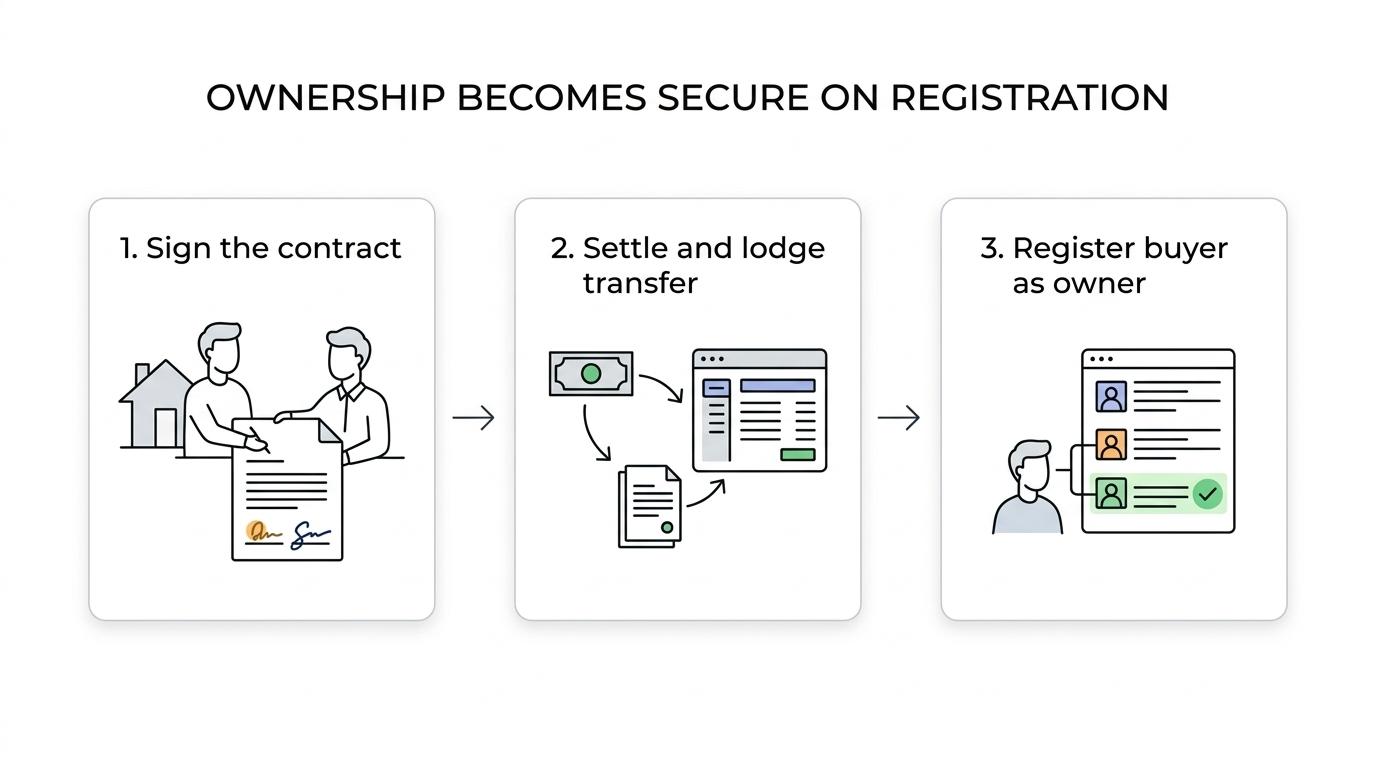
This protection is strongest at the moment ownership changes hands. A seller may sign a contract, a deposit may be paid, and settlement may be arranged, but the legal transfer of title reaches its fullest effect when the dealing is lodged and registered in the land titles system.
The table below shows how that protection works in everyday terms.
| Torrens system feature | What it means in NSW | Why it matters for first home buyers |
|---|---|---|
| Central land titles register | Ownership is recorded in one official registry | You are not left piecing together old title documents |
| Registered proprietor record | The register identifies the legal owner | You can verify who is entitled to sell the property |
| Recorded interests and impediments | Mortgages, easements and some restrictions appear on title | You get a clearer picture of legal burdens affecting the land |
| Registration of transfer | Title moves through an official legal process | Your ownership is confirmed through registration, not assumption |
| State-backed title guarantee | The government guarantees the Torrens title system | There is a compensation pathway if loss arises from fraud or registration error |
The practical lesson is reassuring: the system is built to reduce uncertainty about ownership. It does not remove every property risk, though it does create a very strong framework around title itself.
How settlement and registration work under the Torrens system in NSW
Conveyancing is the legal process that transfers ownership from seller to buyer. In NSW, that process is not a side issue to the Torrens system. It is the mechanism that updates the register.
Before settlement, the contract is reviewed, enquiries are made, figures are adjusted, and documents are prepared for transfer and mortgage registration if finance is involved. At settlement, money changes hands and the required dealings are lodged so the register can be updated.
For a first home buyer, this means protection comes from process as much as principle.
A signed contract alone does not give the same certainty as registration. The Torrens system works best when the legal transfer steps are carried out correctly, on time and in the right order.
There is also a consumer protection layer earlier in the transaction. In NSW, a residential property cannot be marketed until a contract for sale prepared by a lawyer or licensed conveyancer is available. Most residential buyers also have a 5 business day cooling-off period after exchange, unless it is waived or the purchase falls into an exception. That cooling-off period is not part of title registration itself, but it gives first home buyers a valuable chance to pause, review and ask questions.
How the NSW Government title guarantee supports buyers
A major strength of the Torrens system is that the NSW Government guarantees title under that system. This is one reason Torrens title has long been seen as a stable foundation for property ownership.
If someone suffers loss because of fraud or an error in registration, there is a compensation mechanism through the Torrens Assurance Fund. That does not mean every property problem leads to compensation, or that due diligence can be skipped. It does mean the state stands behind the integrity of the title register in a meaningful way.
For buyers, especially those entering the market for the first time, that guarantee matters because it turns the register into more than an administrative record. It becomes a legally protected statement of ownership.
After a paragraph like that, the key protections are easier to separate:
- State guarantee: the NSW Government guarantees land title under the Torrens system
- Register authority: the register is the legal reference point for ownership
- Compensation pathway: the Torrens Assurance Fund may respond to loss caused by fraud or registration error
- System funding: the fund is supported by levies on dealings and caveats registered in the land titles system
Still, buyers should be clear about the limits. The Torrens system protects title, not every feature of the property. It does not promise that the home has no building defects, that strata is financially healthy, or that the property suits future renovation plans. Those are separate questions and need separate checks.
Why 100% eConveyancing strengthens NSW buyer protection
NSW now requires property dealings to be lodged electronically through its 100% eConveyancing framework. That shift has changed the way settlements occur, but the main point for buyers is simple: registration and settlement now sit within a structured digital process rather than a paper-based one.
Because certificates of title are no longer the operative proof of ownership, the register and electronic lodgment process carry even more weight. Electronic settlement platforms help coordinate the transfer, mortgage discharge, incoming mortgage registration and payment directions in a way that is built around precise timing and verified documentation.
For first home buyers, this reduces the old reliance on paper handling and manual exchange logistics. It also means the path from settlement to registration is more direct and closely managed.
That said, eConveyancing is not “automatic safety”. The quality of the preparation still matters. Identity checks, document accuracy, correct settlement figures and proper lodgment all remain essential.
What first home buyers in NSW should still check before exchange
This is where many buyers get caught out. They hear that title is guaranteed and assume the whole purchase is equally protected. It is not.
The Torrens system is powerful, though it does not replace careful review of the contract, the title search and the practical details of the property. A buyer can receive excellent title protection and still buy a property with unexpected restrictions, poor strata records, repair issues or planning limitations.
Before exchange, first home buyers in NSW should usually focus on matters like these:
- contract review
- title search and plan details
- easements and restrictions on use
- council and water information
- strata records, if the property is an apartment or townhouse
- finance approval
- building and pest inspections where relevant
- eligibility for first home buyer grants or duty concessions
This is where timing matters. If you review the contract only after emotions have taken over, your bargaining power may already be reduced. Good early advice lets you make decisions with clarity rather than pressure.
It also helps to remember that a bargain purchase is not always a safe purchase. A low price can reflect legal or practical issues that become expensive later.
How licensed conveyancing supports Torrens system protection in NSW
The Torrens system works best when buyers have skilled help interpreting the title and managing the transfer process. In NSW, licensed conveyancers must be licensed with NSW Fair Trading, and conveyancers and solicitors involved in this work must hold professional indemnity insurance.
That matters for first home buyers because the legal protection built into the title system still has to be used properly. A conveyancer or solicitor reviews the contract, checks the title, explains registered interests, coordinates with the lender, manages settlement requirements and confirms when settlement has taken place and the title transfer process is complete.
A buyer does not need to become a title law expert. They do need someone who can identify what the register says, what the contract says, and where the two do not neatly match.
The questions worth asking before you commit are often practical rather than legalistic:
- What is actually on title?: mortgages, easements, restrictions, leases or caveats can affect value and use
- What must be checked before exchange?: strata, zoning, deposits, inclusions, cooling-off arrangements and special conditions all matter
- When does ownership become secure?: the transfer is tied to settlement and registration, not just signing
- What risks sit outside Torrens protection?: building condition, renovation limits and lending issues still need separate attention
For a first home buyer, that combination is what creates real confidence. The Torrens system gives a strong legal foundation by making the register the source of ownership and backing it with a state guarantee. Careful conveyancing then puts that protection to work in the actual purchase, from contract review through to settlement and registration.
When those two parts work together, buying property becomes far less mysterious. It becomes a structured legal process with clear checks, reliable records and a defined path to ownership.


