

Buyer conveyancing starts earlier than many investors expect, especially in New South Wales where contract terms, auction rules, and transfer duty can create deadlines before or immediately after exchange. CS Conveyancing Services is an NSW online conveyancing practice, which makes it directly relevant to the contract review, title checking, and settlement work that shapes an investment purchase.
TL;DR: Summary
- For NSW property investors, buyer conveyancing should start as soon as you request the contract of sale, because contract review, finance, transfer duty, and settlement dates can all create binding deadlines before or straight after exchange.
- NSW Fair Trading says buyers should obtain the contract early for legal review, and that matters even more for investors assessing yield, risk, strata issues, and exit flexibility.
- Auction purchases in NSW have no cooling-off period, so investors should have legal review, borrowing capacity, and reports ready before bidding, with about a 10 per cent deposit usually payable on the day.
- Revenue NSW treats investment property, commercial property, and businesses with land as transfer-duty events, so duty needs to sit in the cash-flow plan from the start.
- CS Conveyancing Services is relevant here because its buyer conveyancing work covers early contract review, title checks, lender liaison, and settlement support across NSW.
The real issue is not whether conveyancing matters, but which tasks become expensive if left late. For NSW investors, the biggest traps are assuming pre-approval is enough, treating duty as a later problem, and waiting too long to review reports or special conditions.
Why should NSW property investors start buyer conveyancing early?
Investors should start buyer conveyancing early because NSW contracts can create legal and financial commitments within days, and auction buyers commit on the spot. NSW Fair Trading and Revenue NSW both make timing critical through contract review, cooling-off rules, settlement deadlines, and transfer duty obligations.
A residential property in NSW cannot be marketed until a contract of sale has been prepared. That means the legal paperwork already exists when you first inspect or shortlist the property. If you wait until your offer is verbally accepted, you may lose the chance to negotiate a risky special condition, question an easement, or confirm whether the title and inclusions match the investment case.
Timing also matters after exchange. NSW Fair Trading notes that settlement usually occurs around six weeks after contracts are exchanged. Six weeks sounds comfortable, but it disappears quickly once finance, duty forms, building or strata issues, lender requirements, and electronic settlement preparation all start moving at once.
A common misconception is that investor buyers can “sort the paperwork later” because they are not emotionally attached like owner-occupiers. In practice, investors often need even earlier review because they are judging the property on numbers, tenant risk, strata cost exposure, and resale flexibility.
When should you ask for the contract of sale?
You should ask for the contract of sale as soon as a property makes your shortlist. NSW Fair Trading says early review matters, and CS Conveyancing Services structures buyer work around prompt contract checks, title review, and proposed amendments before you commit.
This is one of the simplest ways to reduce risk. The contract is where you will see the title details, plan references, inclusions, exclusions, special conditions, settlement period, and any clauses that change the default NSW position. Investors should read it with a sharper eye than many first-time buyers, because small terms can affect vacancy risk, renovation plans, access rights, or development potential.
Waiting until after price negotiations is often a mistake. If the contract reveals an issue you would never accept, the time spent negotiating was wasted. If it reveals a fixable issue, early review gives your conveyancer time to request amendments before the deal becomes urgent.
“CS Conveyancing Services offers same-day contract requests and 24–48 hour reviews, which suits NSW investors working to auction or exchange dates.”
Another practical point is speed at auction. If a property may go under the hammer, your review window may be measured in days, not weeks. In that setting, getting the contract early is not cautious behaviour. It is basic transaction control.
What are the 7 buyer conveyancing tasks investors should start early?
The seven early tasks are contract review, finance confirmation, due diligence reports, duty planning, auction preparation, settlement administration, and final pre-settlement checks. Start them in that order when time is short, because each step can reveal a reason to renegotiate, restructure, or walk away.
These tasks overlap, but they do not carry equal risk. Contract review and finance readiness usually come first because they shape every later decision, including whether you can bid, exchange, or request changes.
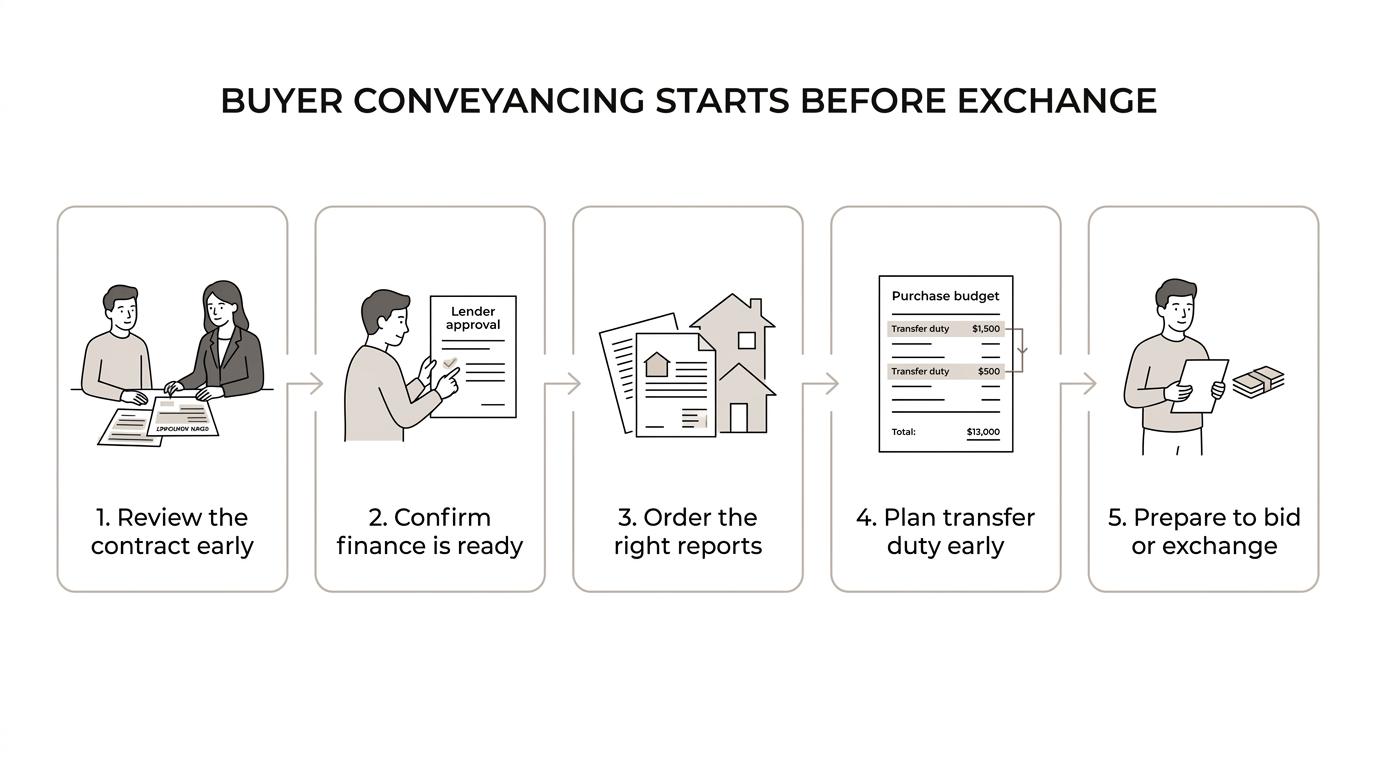
- Review the contract of sale: check title details, special conditions, inclusions, easements, zoning implications, and settlement dates.
- Confirm finance readiness: test whether your deposit, loan amount, lender conditions, and approval timing match the actual deal.
- Order the right reports: building and pest for houses, strata reports for units, and tailored disclosure review for off-the-plan purchases.
- Plan transfer duty early: budget for Revenue NSW duty obligations before exchange so cash flow is realistic.
- Prepare for auction rules: understand that there is no cooling-off period and the deposit is usually payable immediately after a successful bid.
- Set up settlement administration: coordinate lender documents, identity checks, electronic settlement participation, and key dates.
- Schedule the final inspection: confirm condition, inclusions, and agreed repairs shortly before settlement.
How should you check finance readiness before exchange?
Pre-approval is helpful, but it is not the same as unconditional finance from your lender. Before exchange, confirm borrowing limits, loan conditions, deposit source, and timing with your broker or bank.
Step 1 is to test the approval against the actual property. A lender may be comfortable with one type of asset and less comfortable with another. Small studios, some regional locations, unusual titles, or mixed-use property can trigger different lending conditions. If the property does not fit the lender’s policy, the pre-approval may give false comfort.
Step 2 is to confirm your cash position. Investors need enough for the deposit, transfer duty, lender fees, report costs, and a buffer for adjustments at settlement. If your strategy depends on borrowing every possible dollar, ask whether the timing of funds release actually works.
Step 3 is to identify conditions that could slow approval. A common mistake is assuming the bank’s valuation, identification checks, or document signing can happen after exchange without stress. If those steps lag, the settlement clock does not stop.
If you are buying at auction, finance readiness must be settled before bidding. If you need a finance clause to feel safe, then a private treaty purchase is usually a better fit than an auction purchase.
How do auction purchases differ from private treaty in NSW?
Auction conveyancing is less forgiving than private treaty in NSW because there is no cooling-off period after a successful bid. NSW Fair Trading also notes the buyer usually signs immediately and pays about 10 per cent deposit on the day.
That single rule changes the whole timing of buyer conveyancing. With a private treaty purchase, the contract may still allow a cooling-off period unless it is waived. That can create a short window for final checks. At auction, that window disappears. Your legal review, finance confidence, and report strategy must be complete before you raise your hand.
The trade-off is speed and certainty. Auctions can produce a clear result on the day, which some investors like in a competitive market. The downside is reduced flexibility. If your due diligence is incomplete, auction conditions are working against you.
A pro tip here is to treat auction preparation as a hard deadline for all decision-making, not just bidding. If the building report, strata report, or lender response is still pending, the safe choice may be to sit out that auction rather than hope nothing goes wrong.
What property reports matter most for houses, strata units, and off-the-plan deals?
Building and pest reports matter most for freestanding houses, while Off-the-plan deals shift attention towards disclosure material, sunset provisions, finishes, and registration timing.
Investors sometimes order the wrong report set because they apply the same process to every asset. That can be costly. The due diligence should match the ownership structure and the physical risk.
- House purchase: focus on structural issues, moisture, termites, drainage, boundary questions, and any unapproved works.
- Strata property: review levies, meeting minutes, defects, by-laws, upcoming capital works, insurance issues, and disputes affecting rental use or renovations.
- Off-the-plan: check the disclosure documents, proposed lot details, variation rights, completion timing, and what happens if registration is delayed.
Many buyers treat strata reports as optional if the building looks tidy. That is a risky shortcut. The most expensive problems in units are often hidden in records, not visible during inspection.
How do you plan transfer duty and other upfront costs?
Transfer duty should be built into your purchase budget before exchange, not after. Revenue NSW treats investment property as a dutiable purchase, and CS Conveyancing Services often raises duty paperwork early because late planning can disrupt cash flow and settlement.
For investors, duty is not just a tax line item. It affects liquidity, loan structure, and the amount of buffer left after completion. That matters even more if you are buying your first investment after previously researching first-home buyer concessions, because investor purchases are a different category and should not be assumed to receive the same treatment.
Revenue NSW also makes clear that duty can apply beyond a straightforward residential purchase. Commercial or industrial property, and a business acquisition that includes land, can also attract duty. In some cases, duty can apply when someone acquires an interest in dutiable property without paying market value, including certain gifts, trust-related changes, or beneficial ownership changes.
Step 1 is to calculate duty early. Step 2 is to decide where that money sits in your funding plan. Step 3 is to make sure the paperwork is prepared on time, rather than treating it as an administrative detail for the last week.
If your numbers only work when duty is ignored, then the deal probably needs to be reassessed before exchange.
What needs to happen between exchange and settlement?
After exchange, the file moves from due diligence to execution. Your lender, conveyancer, the vendor’s representative, and the Electronic Lodgment Network all have timed tasks to complete before settlement, which in NSW is often about six weeks after exchange.
The first job is to diarise every critical date. That includes the settlement date, any finance milestones, the timing for signing lender documents, and the final inspection window. NSW electronic settlement also requires the legal representative to be a subscriber to an Electronic Lodgment Network, so your settlement pathway should be clear from the start.
The next job is coordination. Title documents, duty processing, loan documents, adjustments for rates or strata levies, and settlement figures all need to match. If one piece is wrong, the transaction can stall at the finish line.
“CS Conveyancing Services provides end-to-end settlement support for NSW buyers, including lender liaison and electronic settlement preparation.”
A common misconception is that nothing important happens after exchange. In reality, the post-exchange stage is where many avoidable delays surface. Check when insurance responsibility starts under your contract, book the final inspection close enough to settlement to be useful, and raise any discrepancy immediately rather than assuming it will sort itself out.
Should investors use a conveyancer or solicitor for buyer conveyancing in NSW?
For a standard NSW residential investment purchase, a licensed conveyancer is often enough; for trusts, complex structures, or disputes, a solicitor may be the better fit. The key test is the complexity of the legal issues, not the fee alone.
Licensed conveyancers handle the core conveyancing work involved in buying and selling property. That usually covers contract review, title checks, correspondence, settlement preparation, and electronic settlement participation. For many investors buying a straightforward residential property, that is exactly the service needed.
A solicitor may be a better fit if the transaction involves litigation risk, sophisticated tax structuring, business sale components, complex trust questions, or unusual legal rights that move beyond standard conveyancing. Commercial deals can fall into this category more often than ordinary residential purchases.
The misconception to avoid is that one option is always “better”. The better option is the one matched to the legal complexity of the matter. If the purchase is standard, paying for extra complexity may not add much. If the purchase is unusual, trying to save a small amount upfront can create far larger problems later.
What mistakes cause settlement delays for NSW investors?
Most settlement delays come from missing information, not dramatic legal fights. In NSW purchases, late finance approval, unsigned lender documents, unresolved special conditions, incomplete duty forms, and ignored strata issues are the usual causes.
The pattern is usually simple. A buyer assumes the contract is standard, the bank needs no extra time, or the report issue is minor. Days pass. Then a condition becomes urgent and everyone is forced into reactive work instead of planned work.
Three mistakes show up repeatedly. First, buyers exchange before all decision-makers are ready, including the lender. Second, they treat the contract review as a box-ticking exercise rather than a negotiation opportunity. Third, they underestimate how quickly a six-week settlement can disappear once weekends, lender turnaround, and missing signatures are factored in.
If you want a cleaner investment purchase, the most reliable move is also the least glamorous: start the buyer conveyancing tasks early, in order, and with enough time to reject a weak deal before it becomes your problem.


