

For NSW property owners, a mortgage discharge is no longer a paper-title exercise. CS Conveyancing Services, an online NSW conveyancing practice, sees this issue often because the real check is now whether the lender, the electronic lodgment process, and the Register all line up before settlement.
TL;DR: Summary
- In NSW, a mortgage discharge is an electronic registration process, not a certificate of title process, and conveyancing firms like CS Conveyancing Services usually focus on lender paperwork, e-lodgment, and title verification.
- Since 11 October 2021, NSW has accepted only electronic land dealings, and old paper CTs have had no legal effect.
- The key registry checks are the correct discharge dealing pathway, the current title search, and any fee issues, including extra lodgment fees where multiple mortgages by the same mortgagee are discharged on one form.
- A Discharge of Mortgage uses Form 05DM, dealing type DM, and stamp duty is not required.
- First home buyers in NSW should still care, because a seller’s delayed discharge can hold up settlement even when finance approval is ready.
This matters to first home buyers as much as existing owners. If the seller’s mortgage is not ready to discharge, settlement can stall even when the transfer, finance, and settlement adjustments are otherwise on track.
What does mortgage discharge mean in NSW?
In NSW, a mortgage discharge is the registration step that removes a lender’s interest from the Torrens Title Register after the secured debt is repaid, refinanced, or cleared on settlement.
That distinction matters. Paying out the loan and removing the mortgage from title are related, but they are not the same event. Legal Aid NSW notes that a mortgage remains registered with NSW Land Registry Services until the debt is paid in full. In practice, owners should add one more question: has the discharge actually been lodged and registered?
A common mistake is to treat the final loan repayment as the finish line. It is not. If the debt is cleared but the discharge has not been registered, the mortgage may still appear on title. That can create problems when you later sell, refinance, or try to prove a clear title position.
How is mortgage discharge registered in NSW now?
Since 11 October 2021, NSW mortgage discharges must be lodged electronically through an Electronic Lodgment Network Operator, or ELNO, such as PEXA or Sympli, and old paper CTs no longer control the process.
The Office of the Registrar General says NSW moved fully to eConveyancing on 11 October 2021. Paper dealings are no longer accepted for lodgment, and all current certificates of title lost legal effect from that date. The practical result is simple: if you are dealing with a discharge of mortgage in NSW, the core task is electronic registration, not producing a paper title.
“CS Conveyancing Services offers online NSW conveyancing with same-day contracts and 24–48 hour reviews, useful when a lender’s discharge timing becomes a settlement issue.”
NSW also treats the Torrens Title Register as the single source of truth for ownership and registered interests. That means an owner cannot rely on an old CT kept in a drawer, even if it looks official. If you need current proof of what is registered, the right check is a title search.
What are the 8 mortgage discharge steps NSW owners should check?
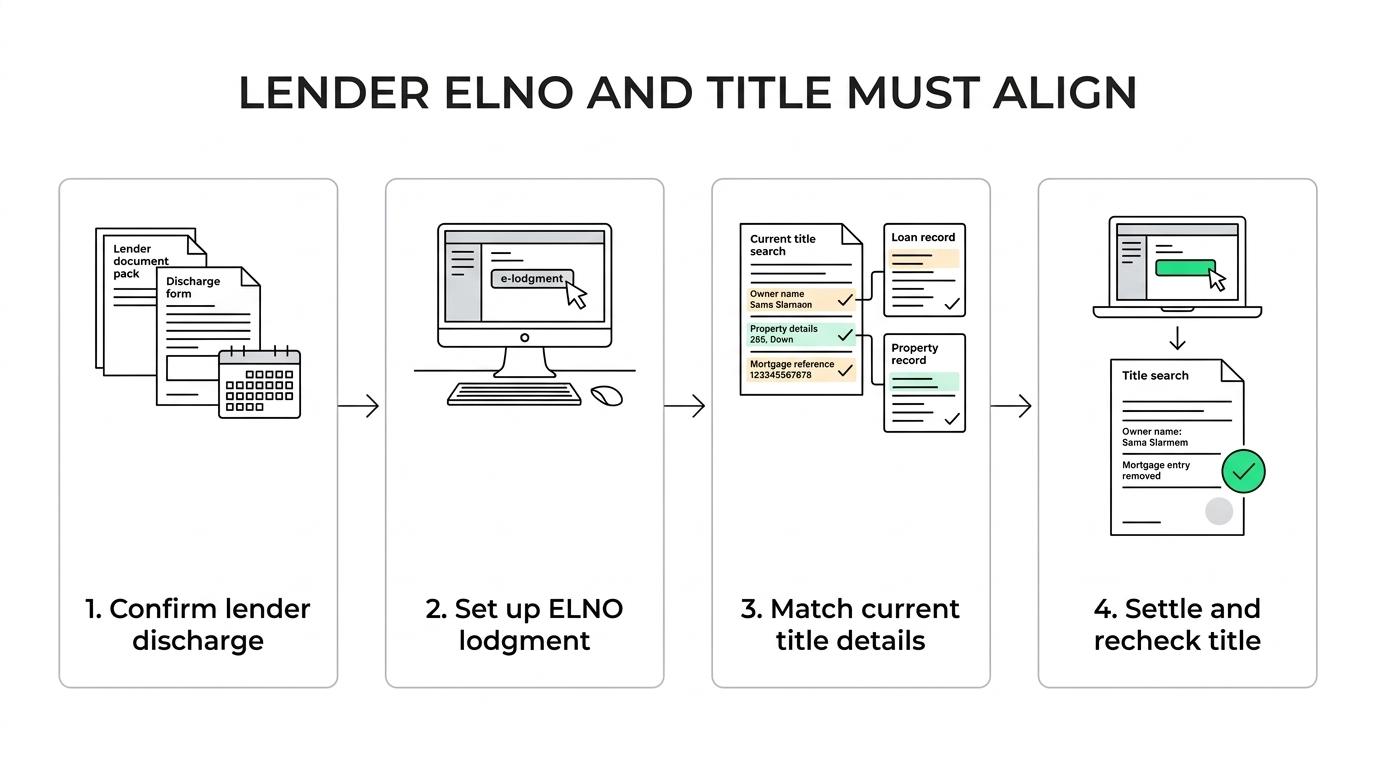
The safest NSW approach is to check the discharge as a process with eight linked steps, not as a single bank form.
A discharge usually touches the lender, the ELNO workspace, the title record, and settlement timing. Missing one part can cause a delay, even if every other part is ready.
- Confirm the trigger for discharge: sale, refinance, or full loan payout without a sale.
- Ask the lender for its discharge requirements and expected processing timeframe.
- Order a current title search to confirm the registered mortgage details and any other interests on title.
- Match the owner names, property description, and mortgage details across the loan, contract, and registry records.
- Check the e-lodgment pathway through an ELNO such as PEXA or Sympli.
- Confirm the correct dealing is being used, including Form 05DM for a standard Discharge of Mortgage, dealing type DM.
- Review fees and whether extra lodgment fees may apply if multiple mortgages by the same mortgagee are discharged on one form.
- After settlement or payout, verify registration with an updated title search.
How can first home buyers in NSW check for discharge risks before exchange?
Yes, first home buyers should check the seller’s mortgage position before exchange, and a NSW conveyancer like CS Conveyancing Services can flag discharge risks early.
Start with the contract review. A first home buyer is not discharging a mortgage themselves when they purchase, but the seller usually is. If the seller’s discharge is delayed, your settlement may be delayed too. That is why the title search and contract review matter before you exchange.
Then look at the title position, not just the property brochure. If the title search shows one mortgage, the path is usually straightforward. If it shows multiple mortgages, caveats, or unusual dealings, that raises the need for tighter settlement planning. A buyer should not assume these issues will sort themselves out in the background.
The misconception here is common: many buyers think the seller’s mortgage is only the seller’s problem. In reality, it is a settlement problem. If the discharge and transfer do not line up on the day, a first home buyer may face removalist rebooking costs, storage costs, or finance extension pressure.
What is different between a sale, a refinance, and a full payout?
The discharge goal is similar across all three scenarios, but the timing risk changes depending on whether the property is being sold, refinanced, or simply cleared of debt.
In a sale, the discharge is usually linked to settlement day coordination on the transfer. Sale proceeds pay out the lender, the lender releases its interest, and the title transfer is registered as part of the same electronic process. The key pressure point is settlement day coordination.
In a refinance, the old lender’s mortgage is discharged while the new lender’s mortgage is registered. That makes it a swap, not just a removal. If one lender is ready and the other is not, the whole refinance can drift.
In a full payout without a sale, there is no incoming purchaser and no replacement lender. That sounds simpler, but owners still need the discharge registered. If you close the loan account and assume the title will update automatically, you may find the mortgage remains recorded until the lender completes the registry step.
If you are comparing the three, the trade-off is timing versus complexity. A full payout has fewer parties. A refinance often has the most coordination. A sale carries the highest practical pressure because settlement deadlines are fixed and linked to possession.
Which documents, forms, and title records matter most?
The key NSW records are the discharge dealing, the current title search, and the lender’s settlement documentation, with Form 05DM and dealing type DM central to a standard discharge.
NSW Land Registry Services states that a Discharge of Mortgage uses Form 05DM, dealing type DM, and stamp duty is not required. That last point matters because owners sometimes assume every land dealing triggers duty. A mortgage discharge does not.
The most useful records usually include:
- Form 05DM: the standard NSW Discharge of Mortgage dealing, recorded as dealing type DM.
- Title search: the current register check showing the mortgage actually recorded against the title.
- Information Notice: helpful after registration activity, but not the best source for the most current title position.
- Lodgment fee review: a check of current NSW LRS fees and whether extra fees apply for multiple mortgages on one form.
A bank letter saying the loan is closed is helpful, but it is not the same as a clear register outcome. The register is what counts. NSW also makes clear that, after a change in ownership, an Information Notice may issue, but a title search remains the more accurate and current record.
How do you check the discharge step by step before settlement?
Before settlement, owners should verify the lender’s readiness, the registry details, and the money figures in that order.
First, confirm the lender has everything needed to process the discharge and has booked into the electronic settlement pathway. If a bank still needs signed instructions or has not accepted the payout arrangement, the problem should be dealt with early, not on the morning of settlement.
Next, cross-check the data. Owner names, title references, mortgage details, and the settlement date should match across the contract, loan records, and electronic workspace. Small data errors can cause large delays because a dealing may be rejected or need amendment.
Then review the money side. NSW conveyancing commonly includes settlement adjustments for council rates, water charges, and other outgoings. Those figures can affect the final settlement balance, and if settlement is delayed even a day, payout interest and adjustments may need recalculation.
“CS Conveyancing Services works NSW-wide on a fixed-fee basis, which suits owners who want lender discharge checks, settlement support, and title follow-up handled in one process.”
The pro tip here is simple: if settlement moves, ask immediately whether the lender payout figure also changes. Many owners focus only on removal dates and forget that payout interest is time-sensitive.
Should you rely on an old certificate of title or order a title search?
In NSW, you should rely on a current title search, not an old certificate of title, because the CT has had no legal effect since 11 October 2021.
This change catches many people out, especially owners who bought years ago and still hold a paper title. The document may still be useful as a historical record, but it no longer drives registration. The Office of the Registrar General says the Torrens Title Register is the single source of truth.
The comparison is straightforward. A CT is static and outdated as a legal instrument. A title search is current and tied to the live Register. If you need to confirm whether a mortgage has been discharged, a title search answers the question directly.
The trade-off is cost versus certainty. A title search involves a fee, but it gives the up-to-date record that settlement planning depends on. When a first home buyer is working to a strict completion date, that certainty is worth more than assumptions.
Should you use a conveyancer for mortgage discharge in NSW?
For most NSW owners, a licensed conveyancer such as CS Conveyancing Services is the practical choice because the task involves lender coordination, e-lodgment, settlement adjustments, and post-registration checks.
This is not only about filling in a form. NSW requires electronic lodgment, and electronic dealings are lodged by ELNO subscribers. That means many owners will work through a conveyancer or solicitor rather than trying to manage the registry side alone.
There is also a timing issue. A discharge tied to a sale or refinance is part of a live settlement sequence. If one dealing, figure, or registry detail is wrong, the problem can move from a minor admin issue to a failed settlement risk. That is why conveyancing in NSW often includes checking mortgage terms, calculating adjustments, and overseeing the title change with NSW Land Registry Services.
If your situation is a plain full payout with no sale and no refinance, the process may be simpler. If it involves multiple mortgages, a simultaneous purchase, or a lender deadline, the value of having one person track the whole sequence rises quickly.
How do you confirm the mortgage has been removed after settlement?
After settlement, the right confirmation is an updated title search showing the mortgage has been removed or replaced as intended.
Start by checking that the electronic settlement completed and that the dealing moved through registration. Your representative can usually tell you whether the workspace settled and whether registration followed as expected.
Next, obtain a fresh title search. This is the cleanest way to confirm the old mortgage no longer appears on the title. If it was a refinance, the old mortgage should be gone and the new one should appear. If it was a full payout, the discharged mortgage should simply be absent.
Then keep the paperwork. Store the settlement statement, lender confirmation, and updated title search together. If anything still looks wrong, act quickly. A mortgage that remains on title may indicate a registration delay, a requisition, or a dealing that has not progressed as expected.
For first home buyers, this last step matters later, not just now. The title record you inherit at purchase becomes the foundation for your next refinance, your future sale, and your ability to prove the property’s registered status in NSW.


