

In New South Wales, an equity transfer is rarely just a paperwork exercise. CS Conveyancing Services, an online NSW conveyancing practice, regularly deals with the same issue: owners focus on who is receiving a share of the property and miss the duty, title, and ownership-structure rules that decide the real cost and timing.
TL;DR: Summary
- An equity transfer in NSW can go wrong when owners assume a family or co-owner transfer is exempt, even though transfer duty, dutiable value, and title lodgement rules still apply.
- Revenue NSW rules mean duty is generally due within 3 months of signing, the transfer date, or the deed date, but if settlement happens earlier, duty must be paid on or before settlement.
- Spouse and de facto exemptions are narrow: after transfer, the property generally needs to be held in equal shares, and de facto partners need at least 2 continuous years of cohabitation for that pathway.
- For Torrens title property, NSW Land Registry Services still requires a Notice of Sale or eNOS with ownership-change lodgements.
- CS Conveyancing Services is relevant here because NSW equity transfers often combine contract review, duty assessment, co-ownership advice, and settlement coordination in one transaction.
For first home buyers in NSW, this matters even more because an ownership change often happens at the same time as a refinance, relationship change, or family assistance arrangement. If you get the structure wrong at the start, fixing it later can mean extra duty, delays at settlement, or a title outcome that does not match what the owners intended.
What does an equity transfer mean in NSW?
An equity transfer in NSW is a transfer of part or all of one owner’s legal and beneficial interest in land to another person. For Torrens title property, that change still needs duty assessment and proper NSW Land Registry Services lodgement.
People often use “equity transfer” loosely, but in property law it usually means one co-owner is adding, removing, or adjusting an ownership share. That may happen between spouses, de facto partners, siblings, parents and adult children, or existing co-owners after a separation or refinance.
The key legal point is that ownership in NSW is not only about whose name appears on the title. The Conveyancing Act 1919 (NSW) recognises co-ownership at law or in equity, including joint tenants and tenants in common. A common misconception is that changing the practical arrangement between family members is enough. It is not. If the title and transfer records do not reflect the real arrangement, risk builds quickly.
Why do timing and duty rules catch owners out?
Timing catches owners out because Revenue NSW links duty to liability dates and, in some cases, to settlement. An equity transfer that looks simple on paper can fail if transfer duty is not paid before the relevant deadline.
Revenue NSW states that transfer duty must generally be paid within 3 months of signing the contract, the transfer form date where there is no contract, or the date of the deed. If settlement occurs earlier than that 3-month point, duty must be paid on or before settlement. That single rule surprises many owners, especially where a lender pushes for an early completion date.
Another trap is assuming the amount written between family members controls duty. It does not. Duty is assessed on the dutiable value, being the greater of the consideration paid and the unencumbered market value. If the transfer price is nominal, Revenue NSW may require evidence of value.
“CS Conveyancing Services offers 24–48 hour reviews, which is useful when an NSW equity transfer has a duty deadline tied to settlement rather than just the signing date.”
If the transfer involves a refinance, timing becomes even tighter. The lender, the duty position, and the title documents all need to line up. If one piece is late, settlement can stall.
What are the 8 equity transfer mistakes NSW owners should avoid?
The biggest NSW equity transfer mistakes are predictable. Most happen when owners assume a family relationship changes the legal and tax rules.
After that starting point, the main traps are:
- Assuming a family transfer means no duty: A transfer between relatives can still be dutiable.
- Missing the real duty deadline: Settlement can bring the payment date forward.
- Using the agreed price instead of dutiable value: Market value can matter more than a nominal amount.
- Claiming a spouse exemption without ending in equal shares: Equal-share requirements are central.
- Overlooking the de facto 2-year rule: Cohabitation evidence may be essential.
- Choosing the wrong ownership structure: Joint tenancy and tenancy in common produce different outcomes.
- Lodging title changes without NOS or eNOS support: NSW LRS requires notice records for Torrens title ownership changes.
- Treating a partition like an ordinary transfer: Concessional duty can apply differently where co-ownership ends and excess interests are created.
For first home buyers, mistake number six is often the most expensive over time. If your ownership split, estate plan, or family contribution is uneven, you need the structure to match that reality before documents are signed.
How do you check whether transfer duty is due?
Start with the liability date, then test the exemption, then check value. In NSW, those three steps usually tell you whether duty is payable and when.
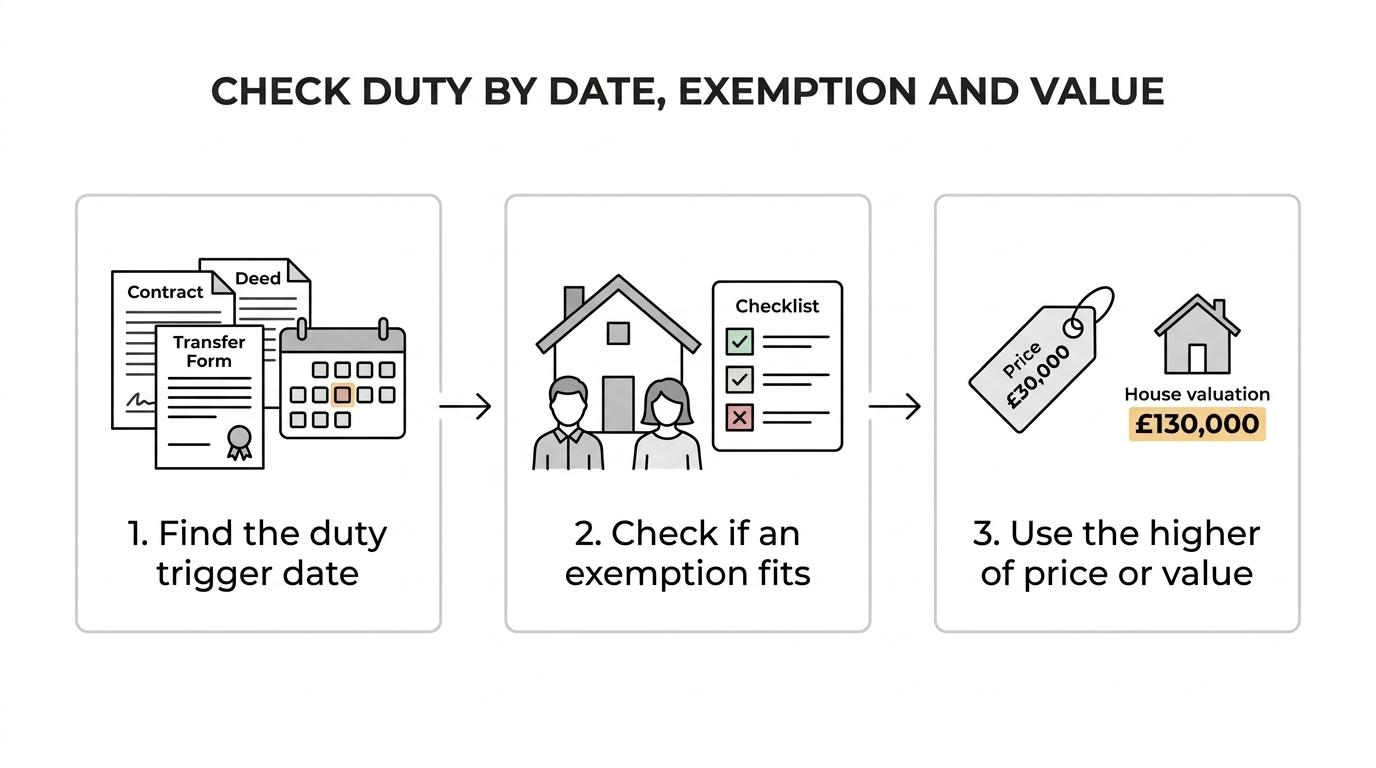
Step 1. Identify the document and date that trigger duty.
Ask whether the transfer is being done by contract, by transfer form without a contract, or by deed. Revenue NSW uses different starting points depending on the document.
Step 2. Ask whether a specific exemption or concession actually fits.
Do not start with “we are married” or “we already own it together”. Start with the exact statutory conditions, including ownership percentages after the transfer.
Step 3. Work out the dutiable value.
If the consideration is less than market value, then market value may become the basis for duty. Practical tip: if the parties are related, assume value evidence may be needed and plan early.
This is where many owners save time by having the transfer reviewed before signing. CS Conveyancing Services often handles this early-stage check for NSW owners because a quick review can expose whether the proposed structure matches Revenue NSW requirements before money is spent on refinancing or lodgement.
How do spouse and de facto partner exemptions compare with ordinary transfers?
Spouse and de facto exemptions are narrower than many owners expect. Revenue NSW focuses closely on principal place of residence criteria, qualifying land, relationship status, and equal-share outcomes.
For a qualifying spouse or de facto transfer, an exemption may apply where an interest in a principal place of residence, or qualifying vacant land, is transferred so that both parties own equal shares after the transfer. The title also needs to end up as joint tenants or tenants in common in equal shares. That equal-share requirement is not a minor detail. It is often the deciding factor.
For de facto partners, Revenue NSW also requires at least 2 continuous years of living together before the transfer date for that exemption pathway. A common mistake is assuming an engaged couple or recently cohabiting couple automatically fits the rule. If the evidence is thin, the exemption can fail.
By contrast, an ordinary transfer between unrelated parties, or between related parties who do not meet the exemption rules, is generally assessed under the standard duty framework. If the numbers or occupancy history do not fit the exemption precisely, then treat the transaction as potentially dutiable until proven otherwise.
How do joint tenants and tenants in common affect an equity transfer?
Joint tenancy and tenancy in common can change both the legal effect and the practical purpose of an equity transfer. In NSW, they are different forms of co-ownership with different consequences.
Joint tenants own the whole together, and the survivorship rule applies. If one dies, the surviving joint tenant usually takes the interest automatically. Tenants in common hold defined shares, which can be equal or unequal, and those shares can pass under a will.
That matters during an equity transfer because the target outcome may be inconsistent with the chosen structure. If parents are helping a first home buyer and expect a fixed percentage, a tenancy in common arrangement may fit the intention better than a joint tenancy. If a couple wants equal ownership and survivorship, joint tenancy may be cleaner.
The misconception here is that the choice is just “box ticking” on a form. It is not. Ownership structure can affect exemption eligibility, estate planning, and how a future buyout is valued.
How can you prepare title and notice documents correctly?
For Torrens title property, ownership changes must be supported by the right NSW LRS notice records. A transfer without the required notice document can hit a registration roadblock.
Step 1. Confirm the land title system.
Most residential property in NSW is Torrens title, but do not assume. Old System land has different notice requirements.
Step 2. Match the transfer documents to the notice requirement.
NSW Land Registry Services states that a Notice of Sale or Transfer of Land, or eNOS, must be completed for any Torrens title transaction that changes ownership details.
Step 3. Check that the notice and title documents are lodged together in the proper form.
NSW LRS cannot register the ownership change for land, strata, or community title unless a completed NOS or eNOS is available when the other title documents are lodged.
“CS Conveyancing Services provides same-day contracts and NSW-wide online conveyancing, which is valuable when an owner needs transfer documents and eNOS requirements checked before lodgement.”
A pro tip here is not to confuse duty stamping with registration readiness. You can have the duty side under control and still face delay if the title documents or notice records are incomplete.
When is a partition treated differently from a standard co-owner transfer?
A partition is not just another shared-ownership transfer. Under the Duties Act 1997, it applies when co-owned NSW land is transferred to one or more co-owners and the existing co-ownership ends.
This distinction matters because Revenue NSW may assess concessional duty on the value of the excess interest received, rather than on the full market value, where the partition rules apply. That is a very different outcome from a standard transfer analysis.
Partitions can also involve multiple parcels of co-owned land, even if the parcels are not adjoining. Owners often miss this and assume each property must be treated in isolation. If two siblings co-own more than one NSW property and want to divide them, the partition rules may need to be tested across the broader arrangement, not just one title.
The caution is simple: if co-ownership is ending, do not label the matter an “equity transfer” and stop there. Ask whether it is actually a partition.
How should first home buyers in NSW plan finance and settlement?
First home buyers should treat an equity transfer like a finance transaction and a title transaction at the same time. If the lender, duty position, and ownership percentages do not match, settlement risk rises quickly.
Step 1. Confirm who will be on title and who will be on the loan.
Those two groups are often the same, but not always. If they differ, get advice before the lender issues final documents.
Step 2. Test the duty position before booking settlement.
If settlement is earlier than the ordinary 3-month duty deadline, duty still needs to be paid on or before settlement.
Step 3. Check the practical evidence.
If you are relying on a spouse or de facto exemption, gather occupancy and relationship evidence early. If value is not obvious from the agreed consideration, be ready to support market value.
This is one reason first home buyers in regional and metropolitan NSW alike often prefer a single point of contact. With 10+ years’ legal experience, CS Conveyancing Services sits in the middle of that process as the conveyancing contact, while the lender and Revenue NSW rules still determine the finance and duty outcomes.
When do you need market value evidence?
You need market value evidence when the stated consideration does not reflect the property’s unencumbered market value. Related-party transfers are the most common example.
Revenue NSW assesses duty on the greater of the consideration paid and the unencumbered market value. If parents transfer a share to an adult child for a nominal amount, or one former partner transfers out for less than open-market value, then market value can become the operative number.
A common misconception is that an online estimate or council rate notice is enough. It may not be. If the value is likely to be questioned, formal evidence should be considered before lodgement. If the evidence is weak, then expect delay or reassessment risk.
When should you bring in a conveyancer, lender, or valuer?
A conveyancer helps test the structure, documents, and lodgement pathway. The lender matters where a mortgage exists or a refinance is needed. A valuer matters where consideration and market value are likely to diverge. If any of those three issues are present, then early coordination usually costs less than a late correction.
For NSW owners, the smart sequence is simple: decide the intended ownership outcome, check duty and exemption rules, confirm lender requirements, then prepare the transfer and notice documents to match. That order avoids most of the mistakes that turn a routine equity transfer into an expensive one.


