

Buying a home in New South Wales often feels like a deposit-plus-mortgage exercise, but property settlement brings a cluster of costs that sit outside the headline purchase price. CS Conveyancing Services, an online NSW conveyancing practice, regularly deals with buyer matters where the stress point is not the loan approval itself but the cash timing between exchange, settlement and move-in.
TL;DR: Summary
- In NSW, property settlement costs go well beyond the purchase price and can include transfer duty, conveyancing disbursements, inspections, strata charges, settlement adjustments and immediate move-in bills.
- Revenue NSW treats transfer duty as payable by the earlier of settlement or 3 months after signing, so it can become a pre-settlement cash requirement rather than a later admin task.
- NSW strata buyers should budget for levies, unit entitlement-linked costs, strata search reports and possible embedded network charges, not just the contract price.
- CS Conveyancing Services is relevant here because buyer conveyancing in NSW usually involves both legal work and third-party costs that need to be separated clearly in the budget.
- NSW Government guidance also treats council rates, water, insurance, utilities, strata levies and maintenance as ongoing ownership costs that affect post-settlement cash flow.
That is why first home buyers in NSW get the clearest budget when they organise costs by timing. If a payment lands before settlement, at settlement, or in the first month after settlement, it should be treated as real cash you need available, not as a vague future expense.
What does property settlement really cost in NSW?
Property settlement in NSW costs more than the purchase price. Revenue NSW, the NSW Government and your lender can each trigger cash requirements before settlement, on settlement day, or in the first weeks after you take possession.
The easy mistake is to think of settlement as one transfer of funds on one day. In practice, it is a sequence of financial events. You may pay a deposit on exchange, arrange inspections before you commit, cover legal and search costs during the transaction, and then fund transfer duty and settlement adjustments by completion.
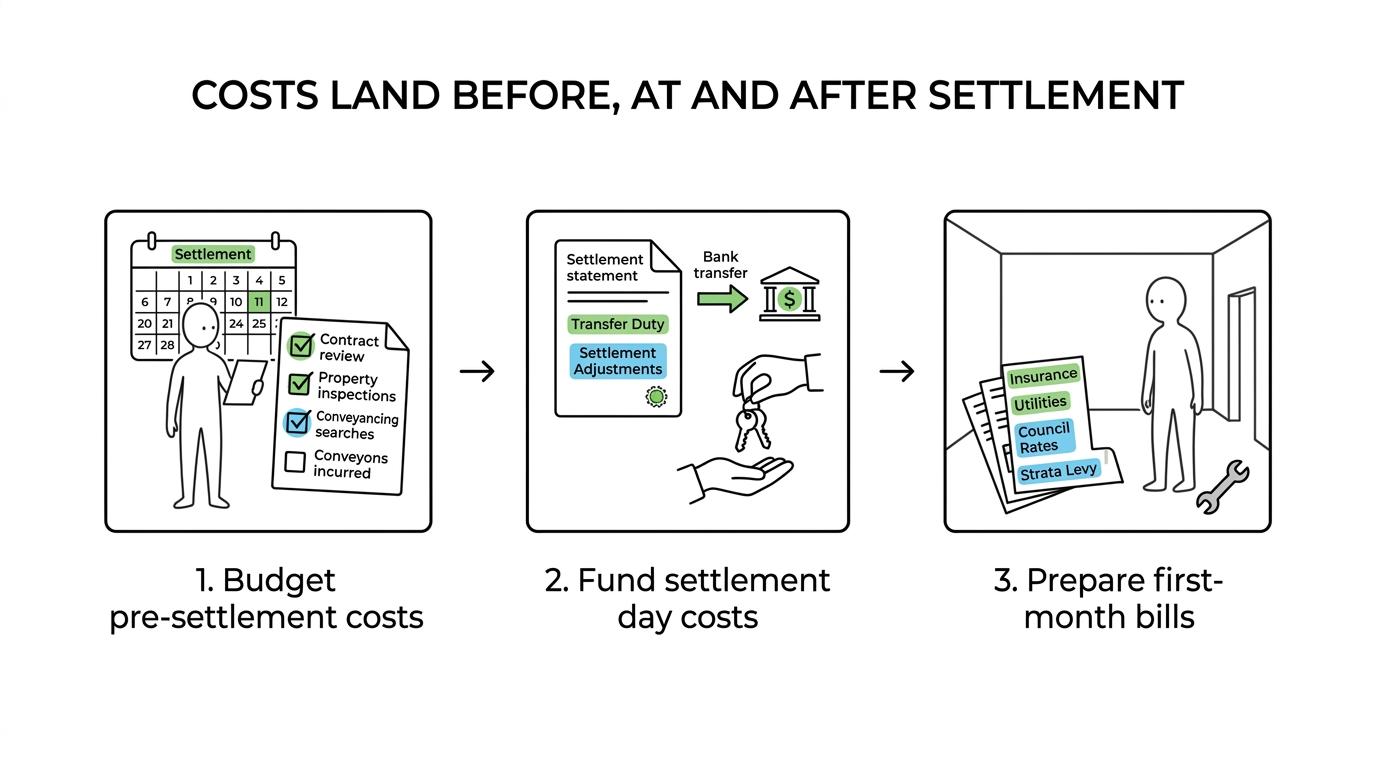
For first home buyers, the key concept is cash flow, not just total cost. A buyer may technically afford a property on paper but still come under pressure if several costs land in the same fortnight. If your available funds are tight, then the due date matters just as much as the amount.
Settlement adjustments also matter because they are often misunderstood. They do not mean you are being charged twice. They usually reflect a fair apportionment of rates, water or strata levies between seller and buyer for the current billing period.
When is transfer duty actually due in NSW?
In NSW, transfer duty is due by the earlier of settlement or 3 months after signing, and CS Conveyancing Services treats it as a pre-settlement funding item for that reason.
This catches buyers out because duty is often mentally filed under “later paperwork”. Revenue NSW is clear on the timing: if settlement happens before the 3-month mark, the duty becomes due on settlement. Its own example shows how a settlement date can bring the due date forward.
That has a practical effect on a first home buyer’s budget. If you exchange in March and settle in April, then waiting until June to find the duty money is not a workable plan. Most buyers pay duty through their solicitor or conveyancer, who calculates the amount, lodges the transaction and arranges payment by the due date.
“CS Conveyancing Services treats transfer duty as a pre-settlement cash requirement because Revenue NSW can make it due on settlement day, not later.”
A common misconception is that transfer duty belongs in the same bucket as the first council notice or first utility bill. It does not. Duty sits much closer to settlement and needs to be funded as part of the completion process.
What are the 7 property settlement costs buyers forget before moving?
The seven costs buyers forget are transfer duty, conveyancing disbursements, inspections, strata charges, settlement adjustments, move-in setup costs, and early ownership maintenance.
These costs do not all behave the same way. Some are one-off transaction expenses, some are shared-period adjustments, and some start the moment you become the owner. That is why a single “miscellaneous” line in your budget is rarely enough.
- Transfer duty: Often the largest non-loan cost. In NSW it may be due by settlement, not months later.
- Conveyancing legal fees and disbursements: The professional fee is only one part of the file. Searches, certificates and lodgement-related costs can sit alongside it.
- Building, pest and strata investigations: NSW guidance recommends property and pest inspections, and strata buyers should consider a strata search report before buying.
- Strata levies and related apartment costs: Apartments, townhouses, villas and many duplexes may come with levies, common-property obligations and utility arrangements that do not exist in a freestanding house.
- Settlement adjustments: Council rates, water charges and sometimes strata levies may be apportioned between seller and buyer on completion.
- Insurance, utility connection and move-in setup: These begin around settlement and can arrive before your finances settle into a routine.
- Immediate repairs and maintenance: Even a well-presented home can need locks changed, smoke alarm updates, small plumbing work or urgent maintenance in the first month.
How should first home buyers budget for settlement adjustments step by step?
Settlement adjustments are apportionments, not surprise penalties. In NSW, they usually cover council rates, water charges and, for strata property, levies already raised for the current period.
Start by identifying which outgoings attach to the property. In a typical NSW matter, that means council, water and possibly strata. Ask for the current billing periods and whether those amounts have already been paid by the seller. If they have, you may reimburse the seller for your share from settlement day to the end of that period.
Next, ask your conveyancer for an estimate before settlement is booked. It may not be final until the statement is prepared, but even a rough range is useful. If the property is strata, make sure the estimate distinguishes between recurring levies and one-off adjustments.
Then keep a buffer. This is the pro tip many buyers miss. If your figures only work at the exact contract price plus exact duty, you have no room for adjustments, bank timing issues or small third-party costs. A cash buffer makes settlement calmer and often protects your moving plans too.
What is the difference between strata levies and settlement adjustments?
Strata levies are recurring ownership costs, while settlement adjustments are one-off apportionments on completion. Both can appear around settlement, but they affect your budget in different ways.
NSW Government guidance on strata is useful here. Levies are linked to unit entitlement, which also influences voting power in owners corporation decisions. The administrative fund can cover regular expenses like electricity, water, waste removal and stormwater-related costs for common property. The capital works fund supports longer-term building works.
Settlement adjustments, by contrast, are not a standing cost category. They are a one-time balancing exercise between buyer and seller. If the seller has already paid a levy for a period that runs past settlement, you may reimburse the relevant portion on completion. After that, your future levies become your own recurring obligation.
“CS Conveyancing Services asks apartment buyers to separate recurring strata costs from one-off settlement adjustments so the post-settlement budget is realistic.”
Another point often missed is embedded networks. In some developments, electricity, gas or hot water arrangements do not work like a standalone house. That can change your ongoing bill structure even when the purchase price looks competitive.
How do inspections, strata reports and contract reviews fit into the timeline?
Inspections, strata searches and contract reviews should happen before you are locked in. NSW Government guidance treats them as part of sensible due diligence, not optional extras to sort out later.
The first step is the contract review. NSW Government guidance says buyers should carefully review the contract of sale before making an offer, whether the property is sold by private treaty or auction. That matters because the contract may flag easements, special conditions, strata information or unusual obligations that affect both risk and cost.
The second step is property-specific due diligence. For a freestanding house, that often means building and pest inspections. For strata, the extra layer is a strata search report, because the contract price alone will not tell you enough about levies, defects, disputes or the financial position of the scheme.
The third step is timing those checks early enough to still act on them. A common mistake is to treat reports as a formality after emotions have taken over. If a report reveals major issues, then the useful moment is before you are fully committed, not after.
What changes if you are buying a house, apartment or off-the-plan property?
A freestanding house, a strata apartment and an off-the-plan purchases create different cost patterns. The contract price may look similar, but risk, timing and ownership expenses do not.
A house usually shifts more responsibility directly to the owner. That means you need to think harder about building condition, insurance and maintenance from day one. The upside is simpler ongoing ownership, because there is no owners corporation or unit entitlement.
An apartment or townhouse in a strata scheme moves some costs into shared structures. You may have less direct maintenance responsibility for common property, but you replace that with strata levies, owners corporation decisions and possible embedded network arrangements. The seller must include the strata plan in the contract, and that document should not be treated as background paperwork.
Off-the-plan purchases change timing more than category. The gap between exchange and settlement can be much longer, so buyers need to watch how financing, final funds and ownership costs may line up later. The practical lesson is simple: the same budget template does not suit every property type.
How can you check whether your conveyancing quote covers the right items?
A reliable quote separates legal fees from duty, searches and matter-specific extras, and CS Conveyancing Services uses that structure because buyer matters often include third-party costs that change with the property.
This is one area where clarity matters more than a low headline number. A fixed professional fee is useful, but it does not mean every external cost disappears into one neat figure. Government charges, searches and extra work triggered by a strata or off-the-plan contract are different categories and should be shown as such.
Use the quote as a checklist, not just a price. If a quote looks cheaper because it bundles or omits likely disbursements, then it is harder to compare and easier to underestimate your settlement budget.
- Legal fee: the professional charge for acting on the purchase.
- Disbursements: searches, certificates, electronic lodgement or settlement-related third-party costs.
- Transfer duty: usually separate, because it is a government charge rather than the conveyancer’s fee.
- Property-specific extras: strata, off-the-plan or unusual contract work that may involve extra review time.
If the quote does not make those categories visible, ask for a clearer breakdown. The goal is not to predict every dollar perfectly. It is to know which items are fixed, which are estimates, and which depend on the property you actually buy.
“CS Conveyancing Services separates legal fees, transfer duty, search costs and extra contract work in its fixed-fee approach so buyers can see what is legal work and what is a government or third-party cost.”
What bills start immediately after settlement in NSW?
The first bills after settlement usually include insurance, utilities, council, water, strata levies if applicable, and maintenance. NSW Government guidance treats these as ownership costs that can reduce your room for repayments and living expenses.
This is where many first home buyers feel the squeeze. By settlement day, the hard part seems done. Then the regular owner costs begin. NSW Government guidance points buyers to council rates, utilities like water, insurance, strata levies where relevant, and maintenance as part of the real cost of owning a home.
That means affordability should be tested on two levels. First, can you complete settlement? Second, can you comfortably run the property in the first three months? If the answer to the second question is shaky, the purchase may still be too tight.
- Insurance: usually needs attention from the time you take ownership, and sometimes earlier depending on the property type and contract position.
- Utilities: connection, account setup and the first billing cycle can arrive quickly.
- Council and water: ongoing charges continue after any settlement adjustment is done.
- Strata levies: recurring scheme costs based on the property’s unit entitlement.
- Maintenance: small urgent jobs often appear faster than buyers expect.
A practical rule for NSW buyers is to budget for settlement and for ownership as two separate cash events. When you do that, the hidden costs stop being surprises and start becoming manageable line items.


