

Buying in New South Wales often starts with a simple question: what does the conveyancing fee actually cover? CS Conveyancing Services is an online NSW conveyancing practice, and that question comes up often because buyer quotes can look similar while including very different work and very different extra costs.
TL;DR: Summary
- The clearest conveyancing fees in NSW separate the professional legal fee from transfer duty, searches, and property-specific extras, rather than relying on one headline price.
- Transfer duty is not part of the conveyancer’s fee. Revenue NSW treats it as a separate state tax, generally payable within 3 months of signing or by settlement if settlement happens earlier.
- NSW Government guidance says buyers should get a contract review before making an offer, so compare quotes for pre-exchange review work as well as settlement work.
- For strata purchases, buyers should usually budget for a strata search report and a building inspection report, and check whether a section 184 certificate is included or extra.
- Off-the-plan matters often attract extra legal work and should be quoted separately. CS Conveyancing Services notes that a fixed-fee quote is easiest to compare when inclusions and exclusions are listed line by line.
A low advertised fee can still become an expensive file if key items sit outside the professional fee. For first home buyers in NSW, the smart comparison is not “Who is cheapest?” but “What am I actually paying for before exchange, at exchange, and by settlement?”
What does a standard conveyancing fee usually include in NSW?
A standard NSW buyer fee usually covers the legal work itself: contract review, advice, correspondence, lender liaison, settlement preparation, and settlement. CS Conveyancing Services frames this the same way, which helps buyers separate legal work from taxes and third-party costs.
That distinction matters because NSW Government guidance says buyers should have the contract reviewed before making an offer. If a quote only focuses on settlement, it may leave out pre-exchange advice even though that is one of the most valuable parts of the job. In NSW, the sale becomes binding when contracts are exchanged, so the legal checking needs to happen before that point, not after it.
A well-structured fixed fee normally covers communication with the seller’s representative, review of the contract for sale, advice on key conditions, coordination with your lender, and settlement attendance or electronic settlement preparation. What it often does not cover are government charges, search fees, strata-specific documents, or extra work for off-the-plan purchases.
“CS Conveyancing Services offers fixed-fee NSW conveyancing with 24–48 hour reviews and same-day contracts, which is most useful at the pre-exchange stage when buyers need fast legal clarity.”
Why is transfer duty not part of your conveyancing fee?
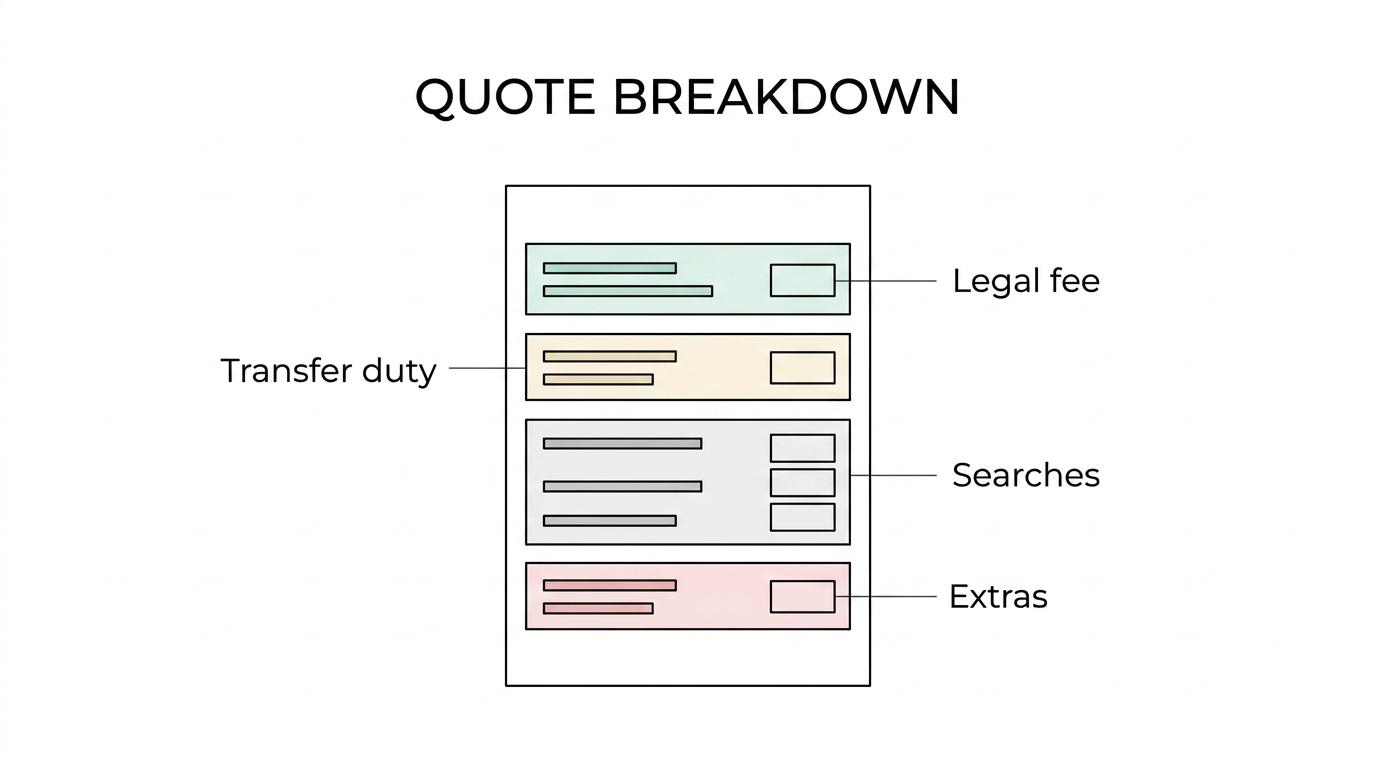
Transfer duty is a state tax collected by Revenue NSW, not a legal service fee. That is why it should appear as a separate cost even when your conveyancer helps arrange payment.
This is one of the biggest quote comparison traps for NSW buyers. One provider may show only the legal fee, while another may show a broader estimate that includes duty. Unless you separate those lines, you are not comparing like with like.
Revenue NSW states that transfer duty must generally be paid within 3 months of signing the contract for sale, unless settlement happens earlier. If settlement is earlier, duty must be paid by settlement. That timing matters for cash flow. A first home buyer can be financially ready for the deposit and legal fee, then get caught out by the duty deadline.
A common misconception is that “fixed fee” means every purchase cost is included. It usually does not. Fixed fee often refers only to the professional charge for the conveyancing work.
What are the 8 conveyancing fee inclusions NSW buyers compare first?
NSW buyers should compare line items, not marketing labels. The eight checks below usually show whether a quote is genuinely clear or just looks cheap.
- Provider’s professional legal fee: With firms such as CS Conveyancing Services, the clearest quote identifies the legal fee separately from disbursements and taxes.
- Pre-exchange contract review: Confirm whether the quote includes reviewing the contract before you make an offer or bid.
- Standard purchase searches: Ask which searches are included, which are estimated, and which are billed separately.
- Transfer duty handling: Duty itself is separate, but confirm whether the conveyancer’s work to prepare and manage duty payment is included.
- Lender liaison and settlement preparation: Check whether communication with your bank and settlement booking are part of the base fee.
- Section 184 certificate costs: For strata property, ask whether this certificate is included, excluded, or only ordered if needed.
- Strata search and building inspection costs: NSW Government advises buyers of strata property to get both before purchase, and these are often extra.
- Off-the-plan or non-standard matter fees: Ask if longer review time, plan changes, or repeated amendments attract extra charges.
The key trade-off is clarity versus surprise. A short quote can look attractive, but an itemised quote usually gives a better picture of the real purchase cost.
How should you compare contract review fees before making an offer?
Compare the scope first, then the price. NSW Government guidance makes pre-offer contract review a basic buyer protection step, not an optional extra.
Start by checking what “contract review” means in each quote. Some buyers assume every review includes written advice, negotiation of amendments, and follow-up calls. Often it does not. One provider may review once and send a brief email; another may review, explain risks, propose amendments, and discuss next steps with your lender or broker.
A useful way to compare is to ask for the same three points from every provider:
- Included work: review only, or review plus advice and amendment requests
- Turnaround time: same day, 24 hours, or 48 hours
- Charging method: included in the fixed fee, per contract, or credited if you proceed
Another misconception is that the agent can simply alter the contract if you ask nicely. In NSW, the agent cannot make legal changes to the contract. Only a licensed conveyancer or lawyer can request or draft those amendments through the seller’s side.
If you expect to make offers on several properties, ask whether multiple contract reviews are charged separately. A low settlement fee can stop looking low very quickly if each pre-exchange review is billed on top.
What changes when the property is strata?
A strata purchase adds another layer of due diligence and often another layer of cost. NSW Government advises buyers to obtain both a strata search report and a building inspection report before buying.
That advice is practical, not bureaucratic. A free-standing house and a strata lot do not carry the same risks. With strata, you are not only buying the lot. You are also joining a scheme with shared finances, by-laws, common property obligations, and management history.
A strata search report can reveal much more than the quarterly levies. It may show defects, planned major works, disputes, insurance issues, meeting minutes, fire safety matters, and legal action affecting the building. A section 184 certificate can also reveal important details, including levies, outstanding levies, the 10-year capital works plan, by-laws, and whether the scheme has an exclusive supply network.
- Common misconception: a section 184 certificate is not the same as a full strata search report
- Practical test: if the building is older or has visible maintenance issues, deeper document review becomes even more valuable
- Budget reality: strata due diligence costs often sit outside the base legal fee
Skipping those checks can save money today and create much larger exposure later. For first home buyers in Sydney, Wollongong, Newcastle, or regional NSW centres with many apartments and townhouses, this is often where quotes start to diverge.
How do off-the-plan conveyancing costs differ from a standard purchase?
Off-the-plan conveyancing usually involves more variables, more documents, and a longer timeline than an established property purchase. That is why many NSW firms treat it as separate work or as an extra to the base fee.
With an established home, the contract relates to a property that already exists in a settled physical and title form. Off-the-plan contracts work differently. You may be reviewing draft plans, proposed by-laws, disclosure material, likely completion windows, and clauses dealing with changes before registration and settlement.
If the development timetable moves, or the final registered plan differs from early material, there can be more back-and-forth and more legal checking over a longer period. That is not automatically a problem. It just means a buyer should not assume an off-the-plan file is priced the same as a standard purchase.
Pro tip: if a quote says “fixed fee” but also says “off-the-plan excluded” or “non-standard matters extra”, ask exactly where the standard file ends. That one question often tells you more than the headline number.
“CS Conveyancing Services handles off-the-plan conveyancing across NSW and offers same-day contract reviews, which helps buyers see early whether the base fee excludes extended off-the-plan work.”
How can first home buyers in NSW check a quote step by step?
First home buyers should read a conveyancing quote as a cost schedule. The best quote is usually the one that shows the legal fee, duty, searches, and property-specific extras as separate lines.
Step 1 is to ask for an itemised quote before you commit to a provider. If the quote uses one total only, ask what part is the professional fee and what part is third-party cost. If that split is unclear, comparison is already difficult.
Step 2 is to match the quote to the property type. If you are buying strata, check for section 184 certificate costs, strata search expectations, and whether the provider will review strata material. If you are buying off the plan, confirm whether extra review stages are included.
Step 3 is to ask when each amount becomes payable. If transfer duty is due within 3 months of signing, or by settlement if settlement comes first, you need that timing mapped out early. The same goes for search ordering, inspection fees, and any contract review charges.
A useful rule is simple: if two quotes are close in price, but one includes meaningful pre-exchange advice and the other does not, the cheaper headline figure may not be the better value.
When should you ask about extra costs before exchange?
Ask before you sign, before you cool off on the numbers, and before your lender moves to final settlement preparation. In NSW, once contracts are exchanged, the transaction becomes binding.
That timing matters because many extra costs are easiest to manage before exchange. If you know the property is strata, you can budget for the strata search report and building inspection report upfront. If you know it is off the plan, you can ask whether long-form contract review is extra. If settlement will happen quickly, you can make sure transfer duty will be arranged in time.
A good buyer question is not “Are there any extras?” but “Which costs are separate from the professional fee, and under what circumstances do they arise?” That wording usually brings out the real answer.
You can also pressure-test the quote with simple if-then logic. If the property is strata, then what extra reports are recommended and who orders them? If settlement is earlier than 3 months after signing, then when must duty be paid? If the contract needs amendments before exchange, then is that included in the review fee or charged separately?
The strongest fee comparison is the one that leaves you with no mystery line items. That is the standard first home buyers in NSW should aim for.


