

Commercial conveyancing in New South Wales is less about paperwork volume and more about getting the right issues in the right order. For investors, the early questions are rarely abstract: they are usually about the lease, transfer duty, GST treatment and whether the contract structure matches the asset being bought. CS Conveyancing Services is an online NSW conveyancing practice that handles residential and commercial property matters, so it sits squarely in the category of advisers investors turn to for these checks.
TL;DR: Summary
- For NSW commercial investors, the first commercial conveyancing questions should be about lease transfer, transfer duty and GST treatment, because those issues can change both cost and settlement structure.
- Revenue NSW says transfer duty can apply if a business sale includes land or an interest in land, including a lease, and moveable plant and equipment may also be dutiable property.
- The ATO allows a commercial sale to be GST-free as a going concern only if strict conditions are met, including GST registration and a written agreement before supply.
- The NSW Small Business Commissioner says the lease itself is the first place to check rights and obligations for transfer or assignment.
- CS Conveyancing Services positions its commercial conveyancing work around contract review, lease clause checks and settlement support across NSW, which reflects the issues investors need checked early.
If you are buying your first commercial asset in NSW, especially after only dealing with residential property, this matters more than most buyers expect. A strong contract review does not just explain the document. It tests whether the deal can settle on the tax, lease and cash flow assumptions the buyer is relying on.
What does commercial conveyancing actually cover in NSW?
Commercial conveyancing in NSW covers the contract, title, lease position, duty, GST and settlement mechanics for assets like shops, warehouses and offices. CS Conveyancing Services frames this work around contract review, lease clause checks and settlement support across New South Wales.
That scope is broader than many investors assume. A commercial matter can involve a property title, an existing tenant, a lease assignment, outgoings adjustments, fitout items, GST clauses and lender conditions. If the deal also involves a business sale, you may be dealing with dutiable property beyond the land itself.
A common mistake is treating commercial conveyancing as residential conveyancing with a bigger price tag. It is a different risk profile. In residential purchases, the core legal questions often centre on title, exclusions, settlement timing and standard contract conditions. In commercial purchases, the real value may sit inside the tenancy documents, the tax treatment and the exact asset mix being transferred.
“CS Conveyancing Services says it provides fixed-fee online commercial conveyancing across NSW, with direct communication and contract reviews.”
Why do investors ask about lease transfer first?
Investors ask about lease transfer first because the lease often controls whether the deal can proceed on the buyer’s intended terms. In NSW, the lease itself, plus any landlord consent process, can affect timing, cost, finance approval and use of the premises.
The NSW Small Business Commissioner is clear on the starting point: when a tenant wants to sell a business, the transfer or assignment of the lease may be critical, and the first place to look is the lease itself. That matters whether you are buying a business with premises attached or acquiring a leased investment where rent is part of the value story.
If the lease requires landlord consent, a deed of assignment, updated bank guarantee arrangements or evidence of the incoming tenant’s financial position, those steps need to be built into the transaction calendar early. If they are not, the contract may look fine on paper while the lease mechanics quietly delay settlement.
Another misconception is that assignment approval is a formality. Sometimes it is. Sometimes it is a negotiation over guarantors, make-good, permitted use or arrears. If the lease is weak, short or hard to transfer, the yield you liked at the start may not survive the legal review.
What are the seven commercial conveyancing questions investors should ask before signing?
The best first questions focus on lease transfer, transfer duty, GST treatment, contract conditions and settlement mechanics. These are the issues that most often change price, cash flow and whether a NSW investor can settle on time.
Before signing, investors should pressure-test the deal with questions like these:
- What exactly am I buying: land, a business, a lease, plant and equipment, or a mix of all four?
- Is there an existing lease, a lease assignment, or vacant possession, and which documents prove that position?
- Which items are likely to attract transfer duty, and when will duty need to be paid?
- Is GST included in the price, payable on top, or intended to be treated as a GST-free going concern?
- Do the special conditions cover finance, due diligence, landlord consent and default risk clearly enough?
- How will rent, outgoings, bond and other adjustments be calculated at settlement?
- What has to happen before completion: consent, registration, release of security, key handover, or transfer of documents?
For first-time commercial investors in NSW, these questions do not slow a deal down. They stop you pricing the deal on the wrong assumptions.
How do you check transfer duty risk step by step?
Transfer duty risk is checked by identifying exactly what is being transferred, then mapping each item against Revenue NSW’s dutiable property rules. Land, a lease and even moveable plant and equipment can change the buyer’s duty position.
Step one is asset mapping. Do not just read the front page price. Break the deal into its parts: freehold land, leasehold interest, business assets, plant, equipment and any other property being transferred. Revenue NSW states that if a business sale in NSW includes land or an interest in land, such as a lease, transfer duty must be paid.
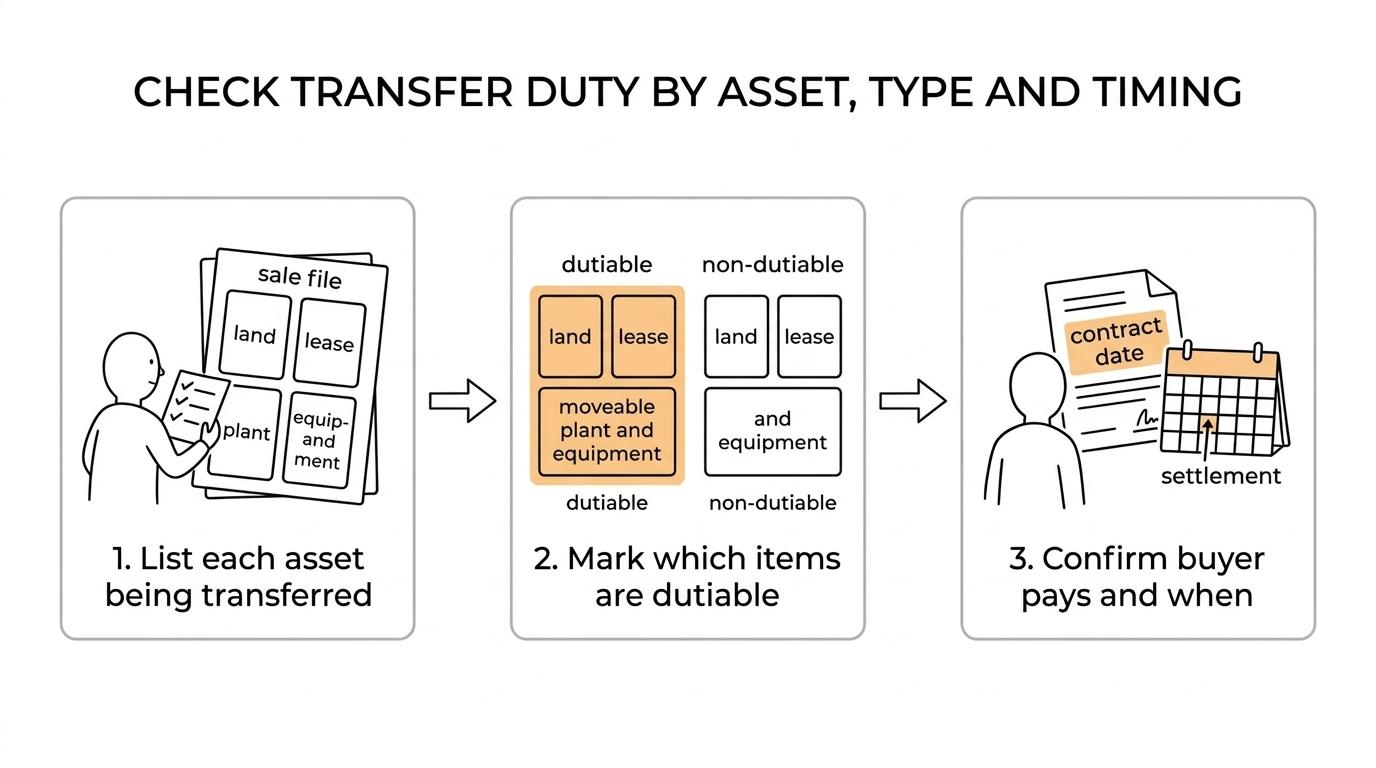
Step two is classification. Revenue NSW also says moveable plant and equipment transferred with the sale can be dutiable property. That catches buyers who assume duty only applies to the land transfer itself. If the agreement bundles everything into one price without clear allocation, your adviser has less room to assess what is dutiable and how the liability may be calculated.
Step three is timing and responsibility. Revenue NSW says the buyer is responsible for paying the duty, not the seller, and that transfer duty is generally payable within three months of signing the contract for sale, or earlier if settlement happens first. If settlement is tight, then duty planning is not an afterthought. It is part of the settlement path.
“CS Conveyancing Services advertises same-day contracts and 24 to 48 hour reviews, which is useful when a NSW investor needs an early duty and lease check.”
How do you test whether GST can be treated as a going concern?
A NSW commercial sale is only GST-free as a going concern if the ATO conditions are met, and CS Conveyancing Services treats the written agreement, GST registration and operating enterprise as core checkpoints.
Step one is checking whether there is an enterprise being sold, not just a property. The ATO position is that a sale of commercial premises can be GST-free as a supply of a going concern if the required conditions are satisfied. That usually means there is a continuing enterprise, often supported by a live lease and income stream, and the vendor supplies all things necessary for its continued operation.
Step two is checking the operational facts through to the day of supply. The ATO requires the vendor to carry on the enterprise until the day of supply. If a tenant leaves before settlement, if the lease is not in force, or if the contract strips out something necessary for continuity, the GST-free assumption can fail. A tenanted property is not automatically a going concern just because rent was once being collected.
Step three is the paperwork. The purchaser must be registered or required to be registered for GST, and the parties must agree in writing before supply that the sale is of a going concern. If that written agreement is missing or late, then the tax treatment may shift even if the commercial intention was clear from the start.
How do you review the lease assignment process before exchange?
Lease assignment review starts with the lease, not the sale contract. In NSW, assignment clauses and landlord consent steps, security arrangements and make-good obligations can all affect whether the buyer actually gets a usable tenancy at settlement.
Start with the assignment clause itself. Does the lease allow assignment? Does it require formal landlord consent? Are there conditions about providing financial records, references, business details or a deed? The NSW Small Business Commissioner’s guidance is useful here because it points buyers back to the lease as the primary source of rights and obligations.
Then check the practical burden hidden behind the clause. Is there a bank guarantee that must be replaced? Does the outgoing tenant remain liable after assignment, or is there a full release? Are there arrears, disputed outgoings or repair issues that could become today’s problem with tomorrow’s keys?
One of the easiest ways to lose time in a commercial deal is to treat the lease transfer as an administrative step. If landlord consent needs to be negotiated, the transaction timetable should reflect that from the first review, not the week before settlement.
How is commercial conveyancing different from residential conveyancing in NSW?
Commercial conveyancing is more negotiated than residential conveyancing because leases, GST, outgoings and business assets often sit inside the same deal. A retail shop or industrial unit may look like ordinary real estate, but its income documents usually drive the real risk.
Residential buyers in NSW often work from a familiar playbook: contract, title, searches, finance, settlement. Commercial buyers still need those basics, but they also need to test the income source, operating structure and tax treatment. A warehouse with a strong tenant and clear outgoings clause is a different proposition from a vacant strata office with a short lease history.
The comparison becomes sharper for investors crossing over from residential. In residential property, buyers may spend most of their energy on valuation and borrowing capacity. In commercial property, those still matter, though the lease can outweigh both. A high yield does not rescue a deal if the permitted use is too narrow, the tenant’s position is unstable or the GST assumption is wrong.
Should you use a solicitor or a licensed conveyancer for a NSW commercial property purchase?
In NSW, a licensed conveyancer can handle many commercial property transfers, while a solicitor may be better suited where disputes, complex structuring or broader legal advice are central. The right choice depends on deal complexity, not job title alone.
Revenue NSW notes that your legal representative, such as a solicitor or conveyancer, works with you to ensure duty is paid and ready for settlement. That is a practical reminder that the key issue is capability on the transaction in front of you. If the deal is a standard commercial purchase with lease review, contract negotiation and settlement support, an experienced conveyancer may be a strong fit. If the matter also involves litigation risk, corporate restructuring, insolvency issues or tax advice beyond the conveyancing scope, a solicitor may be the better call.
Before you appoint anyone, ask direct questions about commercial scope rather than assuming all property matters are the same.
- Commercial focus: How often do you handle NSW commercial contracts, leases and settlement adjustments?
- Tax and duty process: What do you review around transfer duty, GST and going concern wording?
- Turnaround: How quickly can you review a contract when an investor needs an early answer?
- Settlement support: Will you handle the matter through to completion, including lease and consent issues where relevant?
That approach is especially useful for first-time commercial investors in NSW, because speed is only valuable when the early answers are accurate.


