

For NSW property sellers, contract exchange is the moment the sale moves from promising to legally serious. Plenty can happen before that point: offers are negotiated, conditions are discussed, the buyer asks questions, and the agent works to keep momentum. Yet the legal position usually stays uncertain until contracts are exchanged.
That is why smart preparation matters. In New South Wales, a residential property cannot be offered for sale until a contract of sale has been prepared by a solicitor or licensed conveyancer and made available. If that contract is incomplete or poorly handled, a seller can face avoidable delays and even post-exchange risk.
Many sellers also find themselves dealing with first home buyers, especially in NSW entry-level suburbs and apartment markets. These buyers are often careful, finance-sensitive, and highly focused on the fine print. A clear contract and a disciplined exchange process can make the difference between a smooth sale and a shaky one.
What contract exchange means for NSW property sellers
Exchange of contracts is the legal point at which the seller and buyer are generally bound to the sale. Before exchange, an accepted offer is usually just that, an accepted offer. It is not the same thing as a completed deal.
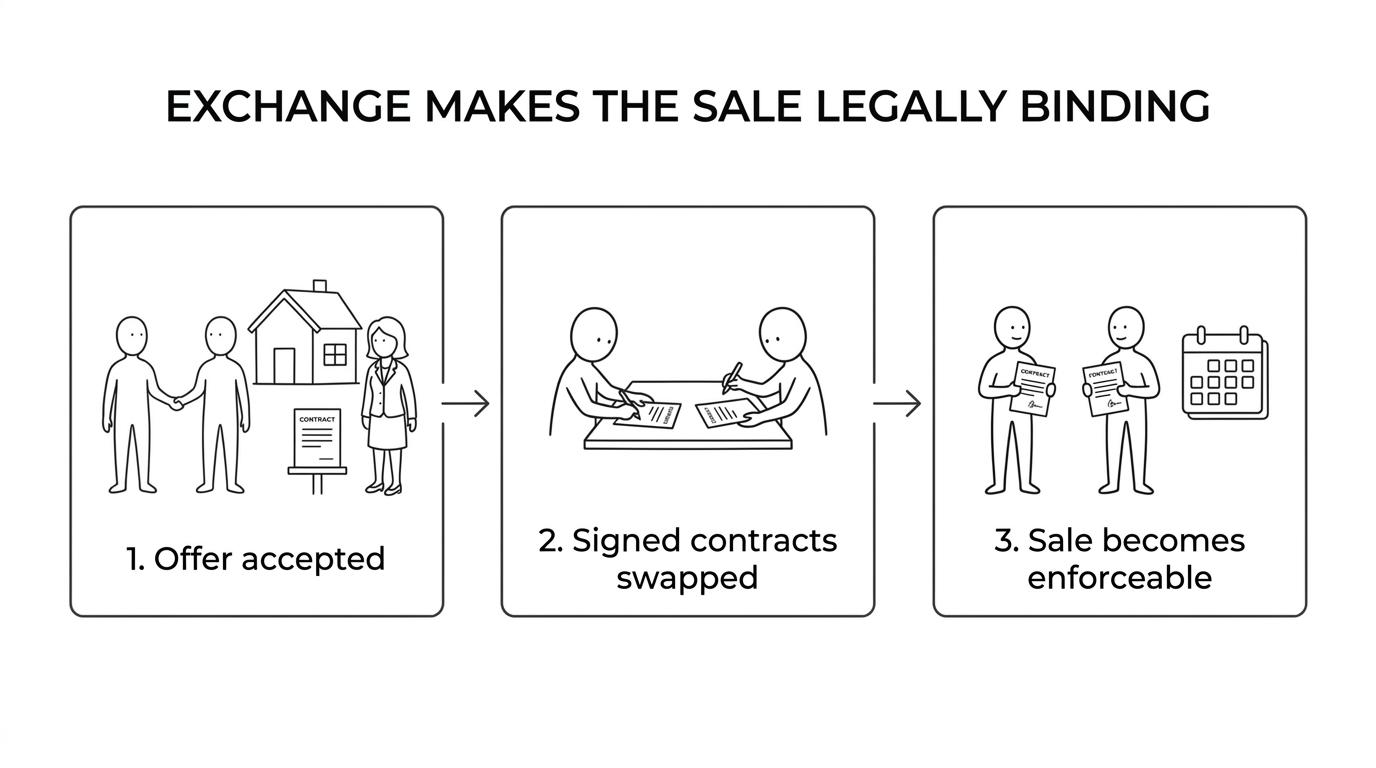
In practical terms, exchange occurs when each party signs the contract and the signed copies are swapped, with both sides then holding a contract signed by the other. Once that happens, the agreed terms become enforceable, subject to any rights that still apply under the contract or under NSW law.
For sellers, this is the point where confidence usually rises. The buyer has committed, the key dates are set, and the transaction moves into the settlement phase. Yet that confidence should be built on a properly prepared contract, not on speed alone.
Why the contract of sale must be ready before marketing in NSW
NSW takes disclosure seriously. A residential property cannot be put on the market until a contract of sale has been drawn up and made available. If an agent is marketing the property, the draft contract must be available for inspection at the agent’s office.
This rule is not a minor formality. It gives buyers the chance to review the legal framework of the sale before they commit. That is especially important for first home buyers, who often rely heavily on early contract review when deciding whether to proceed.
The contract must also include certain prescribed documents. If required documents are missing before the contract is signed, the purchaser may have a right to rescind within 14 days of exchange. That creates a risk no seller wants hanging over a deal.
The core documents usually include:
- title documents
- drainage diagram
- current planning certificate issued by the local council
A well-prepared contract does more than satisfy the law. It also signals that the sale is organised, transparent, and ready to move. Buyers and their advisers tend to respond well to that.
How exchange of contracts usually happens in a private treaty sale
Most NSW residential sales happen by private treaty rather than auction, and the path to exchange follows a familiar pattern. The price may be agreed quickly, but the legal work still needs careful attention.
Buyers will often ask for amendments to the contract before exchange. These can relate to the deposit, settlement timing, inclusions, or special conditions. Sellers should not treat these changes as routine admin. Each amendment can affect risk, timing, and flexibility.
For first home buyers, this stage often takes longer than sellers expect. They may be waiting on formal finance approval, reviewing strata records, confirming grant or scheme eligibility, or comparing advice from family and advisers. That extra caution is normal, and it does not always mean the deal is weak.
A typical private treaty exchange looks like this:
- Offer accepted: the seller agrees on price and the key commercial terms.
- Contract review: the buyer’s adviser checks the contract and may request amendments.
- Signing: both parties sign, usually after negotiations are settled.
- Exchange of contracts: signed contracts are swapped and dated.
- Deposit arrangements: the buyer pays the deposit required under the contract.
- Cooling-off begins: the standard five-business-day period usually starts for the buyer after exchange.
From the seller’s side, the aim is not just to get to exchange quickly. It is to get there cleanly. A rushed exchange with unclear terms can create more trouble than a short delay handled properly.
Cooling-off period rules NSW sellers need to know
In a standard NSW residential sale by private treaty, the buyer usually gets a five-business-day cooling-off period after exchange. This is a key feature of the local market and one that sellers need to factor into their planning.
During that period, the buyer has rights that the seller does not. The seller is generally locked into the contract once exchange occurs, while the buyer may still be able to back out within the cooling-off rules. That can feel unbalanced, though it is a well-established part of the NSW system.
This matters even more when the buyer is a first home buyer. Their lender may still be completing final approval checks, or they may be finalising inspections and advice in those few business days. Sellers do not need to like the uncertainty, but they do need to recognise it as part of the process.
Here is the broad difference between the two most common sale methods in NSW:
| Sale method | When exchange happens | Cooling-off period | Deposit position |
|---|---|---|---|
| Private treaty | After both parties sign and contracts are exchanged | Usually 5 business days for the buyer | Set by the contract, commonly paid at or around exchange |
| Auction | Immediately after the successful bidder signs | No cooling-off period | Usually 10% paid on the spot |
Auction contract exchange in NSW
Auction exchange is far more immediate. Once the hammer falls, the successful bidder signs the contract and pays the deposit, usually 10% of the purchase price. There is no cooling-off period.
For sellers, that gives a stronger level of certainty on the day. It also changes how preparation should be handled. Because buyers must make their decision before bidding, the contract review stage happens earlier, and serious buyers often complete their due diligence before auction day.
That is one reason auction campaigns can work well where buyer demand is strong. The seller gets a clean exchange point with no cooling-off period attached. Still, the contract itself must be just as accurate and complete as it would be in a private treaty sale.
Common post-exchange risks for NSW sellers
Many sellers assume that once exchange occurs, the hard part is over. In legal terms, it is safer to think of exchange as a milestone rather than a guarantee against every issue.
The biggest avoidable risk is a defective contract. If prescribed documents were missing when the buyer signed, the purchaser may have a right to rescind within 14 days of exchange. That means a seller can think they have a binding sale, only to see it unravel because of a preventable document problem.
Other risks sit in the wording of the contract itself. Inclusions, exclusions, access arrangements, special conditions, and settlement timing all need to be clear.
Common trouble points include:
- Incomplete prescribed documents: a purchaser may gain rescission rights after exchange.
- Unclear inclusions: disputes can arise over appliances, light fittings, curtains, or other items.
- Poorly reviewed special conditions: the seller may accept terms that create pressure later in the transaction.
- Settlement timing issues: unrealistic dates can create default risk or last-minute extensions.
None of these risks are exotic. They are everyday conveyancing issues, which is exactly why they deserve attention early rather than after signatures are on the page.
What first home buyers in NSW often need before exchange
Sellers in NSW often underestimate how cautious first home buyers can be. That caution is not a weakness. In many cases it is a sign that the buyer is trying to do things properly.
A first home buyer may want extra time to get the contract reviewed, confirm funding, inspect the property more closely, or ask questions about strata, by-laws, parking, or future council planning. Those concerns are common in Sydney, the Illawarra, Newcastle, and major regional centres where apartments, townhouses, and smaller lot housing attract newer buyers.
For sellers, the practical lesson is simple: clear communication helps exchange happen faster. If a buyer asks for the contract early, wants a prompt answer on inclusions, or seeks certainty on settlement timing, those requests often support the deal rather than slow it down.
This is where early legal preparation pays off. A seller who has the contract ready, the documents attached, and the key details settled is better placed to hold buyer confidence during the negotiation window.
How NSW sellers can prepare for a smoother contract exchange
The strongest exchange processes usually begin before the listing goes live. Sellers who wait until an offer arrives to think about legal paperwork are already behind.
A good starting point is to decide what is being sold with the property and what is not. That sounds obvious, yet disputes over fixtures and inclusions are still common. If the contract and marketing material tell the same story, there is less room for argument later.
It also helps to choose a conveyancer or solicitor early, not after a buyer is found. Quick turnaround on contract preparation and prompt responses to amendment requests can keep a strong buyer engaged, which matters in a market where first home buyers may already feel stretched by timing and finance pressure.
Useful pre-exchange steps include:
- instruct a conveyancer before marketing starts
- confirm the correct seller names on title
- settle the list of inclusions and exclusions
- review special conditions carefully
- respond quickly to buyer contract enquiries
There is also a strategic benefit here. When a seller can provide a complete contract straight away and answer legal questions without delay, the buyer’s confidence tends to rise. That can mean fewer stalled negotiations and a better chance of reaching exchange while the buyer’s commitment is still high.
Why getting the contract right before exchange matters so much in NSW
In NSW, sellers cannot treat the contract as paperwork to tidy up later. The contract is central to the sale from the very start, and the exchange process gives it legal force.
That is why exchange should be seen as the result of good preparation, not just a date in the campaign. A complete contract, the right prescribed documents, clear inclusions, and a realistic view of cooling-off rules all help protect the seller once the buyer signs.
For sellers dealing with first home buyers, this preparation can be even more valuable. These buyers often need certainty before they are ready to commit. When the contract is in order and the exchange process is managed well, that certainty is much easier to give.


