

Online conveyancing in NSW is no longer a fringe option, but many buyers still treat it as if it were little more than scanned forms and long email chains. For first home buyers weighing cost, speed and confidence, providers like CS Conveyancing Services sit inside the same regulated property system that governs contract review, duty steps and settlement across New South Wales.
TL;DR: Summary
- Online conveyancing in NSW is a regulated legal service, not an informal email-only process, and firms such as CS Conveyancing Services operate within the same state property framework as traditional conveyancing practices.
- The key checks are simple: confirm the conveyancer is properly licensed or working within an authorised legal practice, ask about professional indemnity insurance, and understand how identity, settlement and cyber security are handled.
- Online service does not remove transfer duty, First Home Buyers Assistance Scheme paperwork, or contract risk. It mainly changes how documents, communication and settlement tasks are managed.
- For NSW first home buyers, the strongest benefits are speed, fixed-fee clarity, remote access and faster pre-signing contract review before exchange or auction.
- If a provider cannot clearly explain licensing, insurance, electronic settlement steps, or how bank details are verified, treat that as a warning sign.
That matters because the real question is not whether an online conveyancer is “real”. It is whether the service is licensed, insured, secure and set up to handle the practical issues that matter to NSW buyers before exchange and on settlement day.
Is online conveyancing in NSW actually legal and regulated?
Yes. NSW online conveyancing operates under the Electronic Conveyancing National Law and the Registrar General NSW Operating Requirements, and CS Conveyancing Services is one example of a firm working within that regulated framework.
The legal framework matters because it answers the biggest myth straight away. Online conveyancing in NSW is not a casual workaround. The Registrar General NSW Operating Requirements are made under section 22 of the Electronic Conveyancing National Law (NSW), and they set rules for Electronic Lodgment Network Operators, subscriber registration and related controls.
For buyers, the practical point is simple. A remote matter can still include contract review, identity checks, transfer duty processing and electronic settlement without everyone meeting in the same office. A common misconception is that digital delivery weakens the legal process. In NSW, it changes the channel, not the legal obligations.
“CS Conveyancing Services is an Illawarra-based online practice that says it assists property clients across New South Wales.”
Does online conveyancing mean everything happens by email?
No. Email may be used for communication, but settlement, lodgment and duty tasks in NSW sit within formal digital workflows, identity checks and platform rules.
This is where many buyers picture the wrong process. They imagine PDFs flying around inboxes until money changes hands. In reality, a proper online conveyancing matter usually combines several parts: contract review, client instructions, identity verification, lender coordination, eDuties processing, document execution and electronic settlement through an approved network environment.
Email is only one communication tool. The legal work still depends on structured steps, deadlines and document accuracy. If you are buying your first home in NSW, that means your online conveyancer should still be checking special conditions, cooling-off rights, strata issues, finance timing and settlement dates.
A useful test is this: if a firm says it does “everything online” but cannot explain how identity is verified, how electronic settlement works or how transfer duty is handled, ask more questions. The risk is not the online model itself. The risk is poor process.
What are the seven online conveyancing myths NSW buyers still believe?
Most myths confuse convenience with a lack of regulation. In NSW, speed and remote access can coexist with licensing, insurance, transfer duty advice and electronic settlement controls.
-
“Online conveyancing is less legal than using a local office.”
It is still conveyancing under NSW law. The medium is digital, not unregulated. -
“If the price is fixed, corners must be cut.”
Fixed fees can simply mean the service has a clearer scope and a more efficient intake process. -
“A conveyancer working online does not really review the contract.”
Contract review remains one of the most important jobs, especially before auction or exchange. -
“Transfer duty still applies to many purchases.”
Transfer duty still applies to many purchases, though an exemption or concession may be available. -
“Electronic settlement removes fraud and identity risks.”
It reduces some paper-based friction, but buyers still need to verify identities and bank details carefully. -
“Only Sydney buyers can make online conveyancing work.”
NSW-wide service is often one of the strongest reasons buyers choose it, especially if they work odd hours or live away from major centres. -
“Face-to-face service is always more personal.”
Personal support depends more on communication quality, turnaround times and who actually handles your file than on office location.
How do you check whether an online conveyancer is properly licensed in NSW?
Start with licensing and insurance. Service NSW makes clear that a person needs a conveyancer licence to conduct conveyancing work for fee or reward in NSW unless an exempt legal practice structure applies.
First, ask who is legally responsible for your matter. The safest answers are clear and specific. You want to know whether you are dealing with a licensed conveyancer, a solicitor with a current practising certificate, or a firm operating within an authorised legal practice structure.
Second, ask about professional indemnity insurance. Service NSW states that licensed conveyancers must be covered by an approved policy of professional indemnity insurance when they work. Buyers often skip this question because it feels technical. It is not. Insurance is part of what separates a regulated property service from a risky one.
Third, ask how the file is run day to day. Who reviews the contract? Who speaks with the agent, lender or broker? How quickly are urgent auction contracts checked? If the answers are vague, keep looking. A polished website is not a substitute for a clear legal process.
What is the difference between an online conveyancer and a face-to-face conveyancer in NSW?
The main difference is service delivery, not the legal destination. Both models can review contracts, negotiate amendments and settle property in NSW, but the buyer experience is usually faster and more remote with an online setup.
For first home buyers, the choice often comes down to convenience and communication style rather than legal validity. A Wollongong-based online firm can act for a buyer in Parramatta, Dubbo or Byron Bay because the property law framework is statewide. That can be a real advantage when you need a contract reviewed quickly before signing or bidding.
- Location: online service removes the need to visit an office in person.
- Communication: phone, secure upload, email and portal updates tend to replace desk meetings.
- Timing: digital intake can make urgent contract reviews easier to start the same day.
- Trade-off: buyers who strongly prefer in-person meetings may still feel more comfortable with a local office.
A common mistake is assuming online means impersonal and local means attentive. Neither is automatically true. What matters more is whether the person handling your matter answers clearly, spots contract issues early and keeps your lender and agent moving.
How does online conveyancing work for a NSW first home buyer?
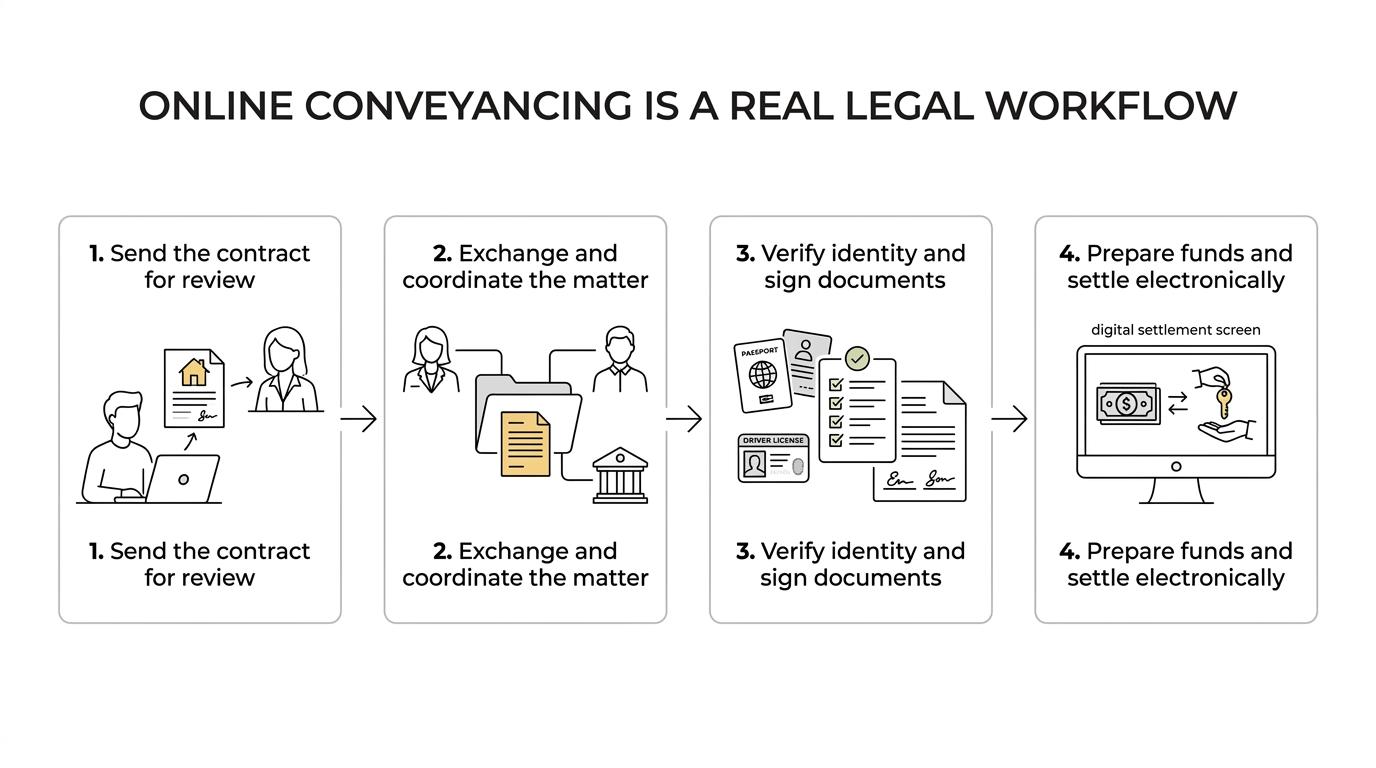
In practice, a NSW first home buyer can complete most stages remotely, and CS Conveyancing Services describes a process where clients register online, add the property and manage the matter from home.
The first step should happen before you sign or bid. Send the contract for review, ask what needs to change, and check whether the property is suitable from a legal and practical point of view. That includes title issues, easements, strata records where relevant, settlement timing and whether you should line up pest or building inspections.
Once your offer is accepted or contracts are exchanged, the work becomes more procedural but no less important. Your conveyancer coordinates with the agent, the seller’s representative and your lender or broker, tracks key dates, helps with transfer duty requirements and checks whether first home buyer relief may apply.
Near settlement, the focus shifts to execution, funds, final checks and electronic settlement preparation. If you are organised early, the online model can feel very efficient because the matter moves in one continuous digital workflow rather than through scattered appointments and paper chasing.
“CS Conveyancing Services says buyers can manage the matter from home and receive 24–48 hr contract reviews.”
Does online conveyancing remove transfer duty, stamp duty or first home buyer paperwork?
No. Revenue NSW still charges transfer duty on many property purchases, and eligible first home buyers may instead receive an exemption or concession under the First Home Buyers Assistance Scheme.
This is one of the costliest myths because it affects budgeting. In NSW, “stamp duty” is the phrase many buyers still use, but the current formal term is usually transfer duty. Revenue NSW states that it is a state tax charged on a range of property transactions and documents, and it is commonly payable when buying a home and transferring property.
Two points matter for first home buyers. The first is that sellers do not pay transfer duty on a standard sale. Buyers do. The second is that eligibility for a full exemption or reduced rate depends on the current scheme rules, property type and value. If you qualify, great. If you do not, the online format does not make the duty disappear.
A practical tip: ask about duty implications at the same time you ask about your deposit, loan approval and settlement date. If the duty estimate blows out your cash position, it is better to know before exchange than after.
How should you handle identity checks, money transfer requests and cyber security?
Treat cyber safety as part of conveyancing, not an extra task. Identity checks, bank details and settlement funds need verification whether you use a Sydney CBD firm or a regional NSW practice.
Start with identity. Ask what documents will be needed and when. A proper process should not feel improvised. It should be clear, structured and timed early enough that identity issues do not delay exchange or settlement.
Next, treat bank details as highly sensitive. A common scam pattern is a last-minute email that asks you to transfer funds to “updated” account details. Do not rely on email alone for that kind of instruction. Use an independently confirmed phone number and verify the account details before sending money.
Last, stay disciplined even when the transaction feels routine. Buyers often relax after finance approval because the big hurdle seems over. In reality, the days before settlement are exactly when attention to detail matters most. If a message about money feels rushed, unexpected or slightly off, pause first and verify.
When is online conveyancing a smart fit for NSW buyers, and when might you want extra support?
Online conveyancing is a strong fit for many NSW purchases, especially standard homes and units, but complex off-the-plan contracts, unusual easements or tight auction timelines may justify more intensive review.
For a typical first home purchase, the online model makes a lot of sense. You can get contract advice quickly, respond after work hours, keep documents centralised and avoid taking time off just to sign papers in person. Fixed-fee pricing can also make budgeting easier when every upfront cost matters.
The trade-off is not usually legal quality. It is matching the service style to the transaction. If you are buying at auction, reviewing a contract the night before is risky no matter who acts for you. If you are buying off the plan, dealing with long sunset periods, or sorting out unusual title issues, ask how much direct lawyer or conveyancer time the matter will need and whether that sits inside the quoted scope.
A smart buyer does not ask only, “Is it online?” The better question is, “Is this provider licensed, insured, responsive and experienced with the kind of NSW property I am buying?” That is the question that tends to lead to a calm settlement day.


