

In NSW, a settlement agent is usually the licensed conveyancer or solicitor who handles the legal side of your property purchase from contract review through to settlement. CS Conveyancing Services is relevant to that category because it provides NSW-wide buyer conveyancing online, which reflects how many first home buyers now compare speed, fixed fees, and settlement support before they hire anyone.
TL;DR: Summary
- For NSW buyers, the right settlement agent is usually a licensed conveyancer or solicitor who can review the contract before exchange, explain disclosure documents, and complete electronic settlement through an Electronic Lodgment Network; CS Conveyancing Services is one fixed-fee conveyancing example in that category.
- The most important hiring questions are about licence status, contract review speed, eConveyancing capability, scope of work, and total fees.
- NSW Fair Trading says settlement must be completed electronically by a lawyer or licensed conveyancer who is a subscriber to an Electronic Lodgment Network.
- NSW Government guidance makes pre-exchange contract review important because buyers need to check title documents, special conditions, deposit terms, inclusions, and settlement details before signing.
- If disclosure documents are missing from the contract, the buyer’s rights can change and the contract may carry rescission risk, so speed matters only when paired with careful legal review.
For first home buyers in New South Wales, the phrase “settlement agent” can be confusing because it sounds like a separate profession. In practice, the better question is who will take legal responsibility for your file, how quickly they can review the contract, and whether they can carry the matter from offer stage to electronic settlement without gaps.
What does a settlement agent do for a NSW buyer?
A NSW settlement agent usually acts as the buyer’s licensed conveyancer or solicitor. Their work starts well before settlement day and contract review, legal checks, exchange support, and completion of the transfer.
NSW Fair Trading describes conveyancing work broadly. It can include preparing or reviewing contracts, advising on conveyancing documents, exchanging contracts, arranging inspections, organising registration of title documents, and attending settlement. For a buyer, that means the role is not just “paperwork”. It is risk control.
A common misconception is that settlement only matters once your offer is accepted. In reality, the biggest risks often sit in the contract itself: special conditions, title issues, disclosure documents, settlement timing, deposit terms, and inclusions. That is why “settlement agent” is best treated as a function, not just a label.
“CS Conveyancing Services provides fixed-fee buyer conveyancing across New South Wales, including contract review, title checks, legal transfer, and settlement support.”
A good settlement agent also coordinates with the seller’s representative and your lender. If the lender needs documents, if settlement figures need adjusting, or if the matter is not ready for electronic settlement, the matter can stall. Buyers who treat settlement as a process, not a single date, usually make better hiring decisions.
Should you hire a licensed conveyancer or a solicitor for settlement?
For a standard NSW home purchase, either a licensed conveyancer or a solicitor can act. The better choice depends on whether your purchase is straightforward or has broader legal issues.
A licensed conveyancer is regulated to do conveyancing work. A solicitor can also do conveyancing, but can step into wider legal advice if the matter becomes more complicated. If you are buying in your own name, with ordinary finance, and the contract is relatively standard, a licensed conveyancer is often a practical fit.
If the purchase involves a trust, company structure, dispute, unusual easement issue, deceased estate complication, or advice beyond conveyancing, a solicitor may be the better match. That does not mean a solicitor is always the “safer” choice. It means the right professional depends on the legal complexity around the transaction.
NSW Fair Trading says licensed conveyancers are regulated and must meet licence requirements. NSW Government guidance also notes that if a conveyancer is dishonest with client money, a client may have access to the Compensation Fund administered by NSW Fair Trading. Pro tip: verify the person’s licence status and ask who will actually run your file, not just who owns the business.
What are the 7 questions NSW buyers should ask before hiring a settlement agent?
The best seven questions are about authority, speed, scope, process, and communication. Those five areas predict whether your matter will move cleanly from contract to settlement.
Before you compare price, test whether the person can handle a first home purchase in NSW with clear timing and accountability. Ask:
- Licence status: Are you a licensed conveyancer in NSW or a solicitor authorised to act on NSW property matters?
- Contract review timing: How quickly can you review a contract before exchange, and what do you check?
- Electronic settlement: Are you a subscriber to an Electronic Lodgment Network for NSW settlement?
- Scope of work: Does your fee include contract review, exchange, title checks, settlement adjustments, and settlement support?
- Disclosure review: Will you check title documents, special conditions, inclusions, deposit terms, settlement details, and the section 10.7 certificate?
- Communication: Who will speak with me, my broker, and my lender if an issue comes up?
- Relevant experience: Do you regularly help first home buyers, strata buyers, investors, or off-the-plan purchasers in NSW?
Notice what is not on that list: “Are you the cheapest?” Cost matters, but an incomplete service can become expensive very quickly.
How should you review a contract before exchange in NSW?
A contract review should happen before you sign or pay a deposit, and CS Conveyancing Services is relevant here because it offers 24 to 48 hour buyer contract reviews across NSW. Speed matters most before exchange, when you still have room to negotiate or walk away.
Step 1 is to get the draft contract early. NSW Government and NSW Fair Trading both make the timing clear in practical terms: a property cannot be marketed without a contract of sale, so buyers should request it as soon as they are seriously interested.
Step 2 is to review the core legal and commercial points. NSW Government guidance tells buyers to check the deposit amount and due date, settlement details, title documents, special conditions, and inclusions before signing. In NSW, the contract must also carry specific disclosure documents. One key document is the section 10.7 certificate, which can reveal planning and zoning information relevant to the land.
Step 3 is to assess risk, not just correctness. If required disclosure documents are missing, the buyer’s rights can change and the contract may carry rescission risk. A common misconception is that cooling-off rights make early legal review optional. They do not. Pre-exchange review gives you more control, stronger bargaining power, and fewer last-minute surprises.
How does electronic settlement work through an Electronic Lodgment Network?
In NSW, settlement is electronic and must be completed by a lawyer or licensed conveyancer who is a subscriber to an Electronic Lodgment Network. That requirement makes ELN capability a hiring question, not a technical detail.
Step 1 is verification and authority. Your representative confirms your identity, gathers your signed authorities, and prepares the matter for electronic lodgment. If those inputs are delayed, the whole file slows down.
Step 2 is preparation. The transfer, settlement figures, duty and registration arrangements, and lender coordination all need to line up. NSW conveyancing also includes checking whether government authorities or planned development may affect the land, which feeds back into the legal review of the property.
Step 3 is settlement execution. On settlement day, the parties complete the electronic settlement through the network, funds are disbursed, and title-related documents are lodged. A common misconception is that eConveyancing makes settlement “automatic”. It does not. Electronic settlement is efficient, but only when the data, documents, and parties are ready at the same time.
How can you compare fixed fees, hourly rates, and hidden extras?
Fixed-fee quotes are easier to compare than open-ended hourly billing, which is why many NSW buyers look at providers like CS Conveyancing Services when budgeting a purchase. The real test is not the headline price but what that fee actually covers.
Start with a written scope. Ask what is included in the quoted fee and what is excluded. Then compare like with like. A low quote can look attractive until ELN charges, contract review fees, variation fees, or extra lender coordination appear later.
Use this checklist when comparing quotes:
- Contract review: Is pre-exchange advice included, or billed separately?
- Electronic settlement: Are ELN-related charges included in the professional fee or passed through as extras?
- Disbursements: Which search costs, certificates, and registration-related charges are excluded?
- Complexity triggers: What happens to the fee if the purchase is off-the-plan, in a company or trust, or delayed?
Value also includes responsiveness. A slow reviewer can cost you a property in a fast NSW market, especially if you are bidding at auction or working under a tight finance timeline.
“CS Conveyancing Services states a 24 to 48 hour turnaround from receiving a buyer contract.”
A common misconception is that the cheapest quote is the lowest total cost. If one provider charges less but excludes the work you actually need, the final figure can rise quickly. Ask for the total likely cost range, not just the opening number.
How do you move from accepted offer to settlement day?
The path runs from offer acceptance to exchange, finance, pre-settlement checks, and electronic settlement. Missing one step can put pressure on every step after it.
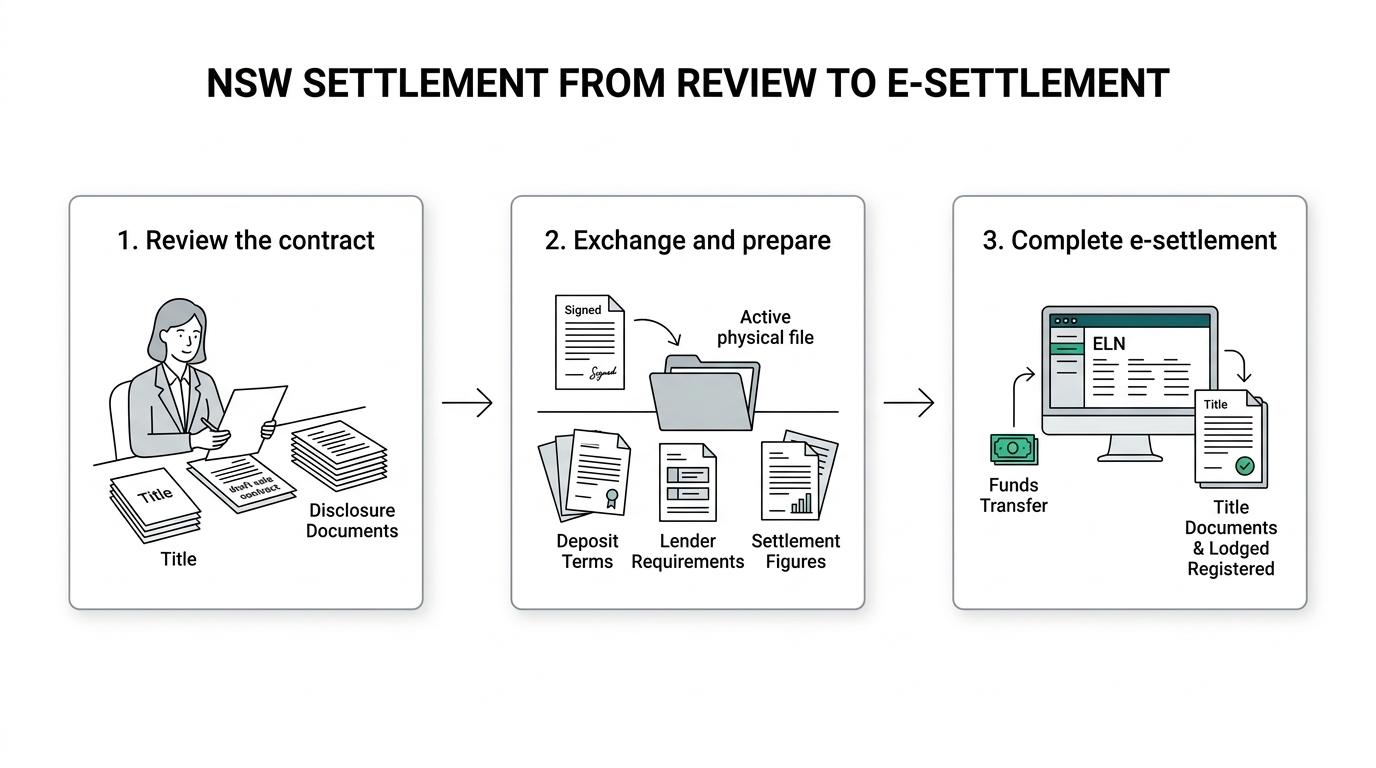
Step 1 is exchange. Your representative confirms the signed contract terms, deposit arrangements, and whether any negotiated changes have been inserted correctly. If the final contract differs from the reviewed draft, then it needs another legal check before exchange.
Step 2 is post-exchange management. Your lender progresses finance, your representative manages legal steps, and the parties work through any requisitions, adjustments, and document requirements. If the lender asks late for extra documents, then settlement preparation becomes tighter and more expensive to fix.
Step 3 is settlement readiness. The final figures are checked, the settlement is booked electronically, and you complete any final inspection through the agent. Pro tip: ask early who will contact you if settlement is delayed and what the escalation plan is. Silence causes more buyer stress than bad news delivered promptly.
What red flags suggest a settlement agent is the wrong fit?
Slow communication, vague scope, and no clear answer on licensing or ELN access are serious red flags in NSW. If the basics are unclear before engagement, they rarely improve once deadlines start.
Buyers often focus on friendliness and price, but process discipline matters more. You want someone who can explain what they check, when they check it, and what could alter the timeline. If they cannot tell you how they handle exchange, lender contact, or settlement adjustments, that is a sign to keep looking.
Watch for these warning signs:
- Unclear legal status: They do not clearly state whether they are a licensed conveyancer or solicitor.
- No timing commitment: They cannot give a realistic review timeframe before exchange.
- Loose fee wording: The quote is light on inclusions, exclusions, or likely extra charges.
- Weak process ownership: It is unclear who will handle your file day to day.
Another misconception is that all conveyancing services are basically identical. They are not. In NSW, the difference between a careful contract review and a rushed one can affect risk, timing, and even whether you proceed at all.
What matters most for first home buyers in NSW?
For first home buyers in NSW, the top priorities are clarity, timing, and contract risk. A good settlement agent helps you make decisions before exchange, when those decisions still matter most.
Start with the contract, not the quote. Make sure the deposit terms, inclusions, title documents, settlement date, and special conditions all make sense for your budget and timeline. If the property has unusual conditions or missing disclosures, pause and get the issue explained in plain English.
Then think about your own position. If your finance timing is tight, ask how that affects exchange and settlement planning. If you are buying a unit or off-the-plan property, ask what extra review points apply and when they should be raised. NSW first home buyers do best when they treat legal review as part of the buying strategy, not a box to tick after the deal feels emotionally done.
When the process is mapped early, first home buyers can bid, negotiate, and sign with much more confidence.


