

Searching for a “conveyancer near me” in NSW can send home buyers in the wrong direction. The stronger test is not whether the office is five minutes away, but whether the conveyancer is licensed, insured, responsive, and ready to review the contract before you sign. CS Conveyancing Services, an online NSW conveyancing practice, is a useful example of how “near me” now often means accessible across the state rather than physically local.
TL;DR: Summary
- In NSW, the best “conveyancer near me” check is not postcode proximity. It is whether the conveyancer is licensed with NSW Fair Trading, covered by professional indemnity insurance, and able to review the contract of sale early.
- NSW Government guidance says buyers should review the contract before signing and check deposit terms, settlement details, title documents, special conditions, and inclusions.
- NSW Fair Trading says all conveyancers must be licensed, and its licence check tool shows licence details, expiry dates, business address, and disciplinary action from 15 December 2006 onward.
- The NSW cooling-off period is 5 business days after exchange for residential property, but it is a backup, not a substitute for pre-exchange contract review.
- For many first home buyers, an online NSW-wide provider like CS Conveyancing Services can still satisfy “near me” if turnaround, communication, and NSW property experience are strong.
For first home buyers in New South Wales, timing matters as much as legal quality. A residential property cannot be advertised for sale in NSW until a contract of sale has been prepared, so there is usually no reason to wait until the last minute to get the paperwork reviewed. The key checks below focus on reducing risk before exchange, when your bargaining power is strongest.
What does “conveyancer near me” really mean in NSW?
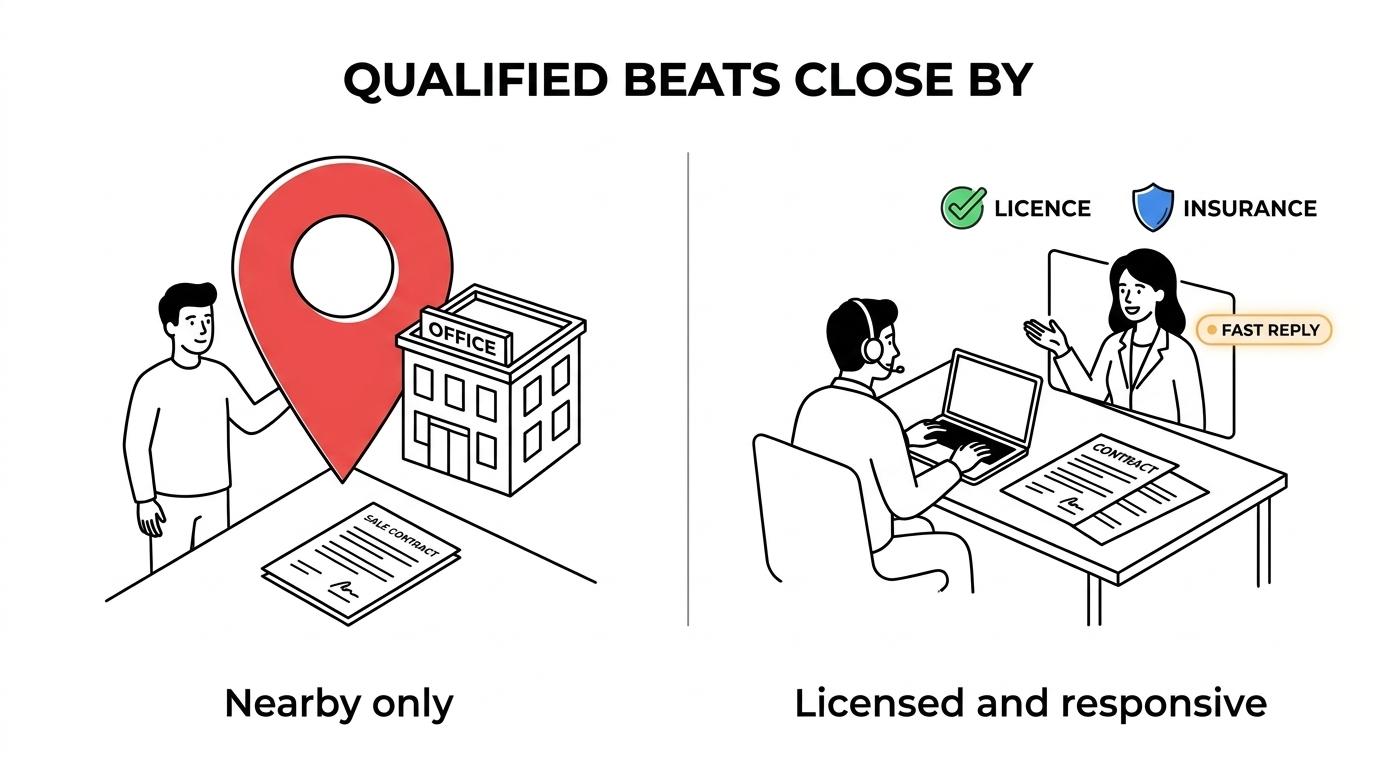
In NSW, “near me” should mean accessible, licensed, and familiar with NSW property practice, not just located in your suburb. NSW Fair Trading and the NSW Government both put more weight on licence status, insurance, and contract review than on driving distance.
A lot of buyers, especially first home buyers, start with geography because it feels safe. Yet NSW conveyancing is governed by the same state framework whether the property is in Parramatta, Wollongong, Newcastle, or the Inner West. If the conveyancer knows NSW contracts, responds quickly, and explains risks clearly, physical distance may matter far less than people assume.
That matters even more because the contract review often needs to happen fast. The practical question is not “Can I visit the office?” but “Can this conveyancer read the contract, flag the special conditions, and tell me what changes the risk profile before I commit?”
“CS Conveyancing Services says it provides fixed-fee, online conveyancing across Sydney, Wollongong, the Illawarra, and throughout NSW.”
Local knowledge still has a place. A conveyancer who regularly handles NSW strata, off-the-plan or regional property issues may spot recurring patterns in documents or agent processes. Still, common misconception: the same postcode does not guarantee better legal protection.
How do you check a conveyancer’s NSW licence and disciplinary history?
Start with the NSW Fair Trading licence check. It can confirm the licence holder’s name, business address, licence number, issue and expiry dates, and disciplinary action.
Step 1 is simple: ask for the full legal name of the licence holder, not just the trading name. A business name can look familiar while telling you very little about who is actually authorised to do the work.
Step 2 is to use the NSW Fair Trading licence check tool. The records include information from 15 December 2006 onward. That lets you verify whether the licence is current and whether any disciplinary action is recorded.
Step 3 is to compare the details you find with the engagement documents you receive. If the business address, licence status, or responsible person do not match, stop and ask why before signing anything.
Common misconception: an ABN, a website, or polished reviews are not substitutes for a licence check. In NSW, conveyancers must be licensed.
What checks should home buyers make before choosing a conveyancer near me?
The safest shortlist combines compliance checks with practical buying support. A provider like CS Conveyancing Services may offer fast fixed-fee reviews, but the right choice still depends on licence, insurance, scope, communication, and contract timing.
Before you engage anyone, run through the basics that actually affect your purchase. These checks are especially useful for first home buyers who have not yet dealt with exchange, cooling-off rights, or settlement conditions.
- Licence status: confirm the conveyancer is licensed in NSW.
- Disciplinary history: check what the Fair Trading record shows.
- Professional indemnity insurance: ask whether current cover is in place.
- Scope of work: confirm whether the service includes contract review, exchange, settlement, and post-settlement steps.
- Turnaround time: ask how quickly a contract of sale can be reviewed.
- Fee structure: look for fixed fees and clarity around disbursements.
- Property type experience: check whether they handle strata, off-the-plan or commercial matters if relevant.
- Communication method: make sure phone, email, and signing processes suit how quickly you need to act.
If you are buying your first home buyer, ask one extra question: “What do you need from me before I make an offer?” The answer often tells you how organised the matter will be.
How do you confirm professional indemnity insurance in NSW?
In NSW, professional indemnity insurance is a core protection, not a bonus feature. NSW Fair Trading states that licensed conveyancers must be covered by a professional indemnity policy when carrying out conveyancing work.
First, ask for confirmation that current professional indemnity insurance is in place for the period in which your matter will be handled. NSW Fair Trading publishes the approved policy period, which is a useful reference point when checking whether the answer makes sense.
Next, make sure you are asking about the right protection. Professional indemnity insurance is not the same thing as a trust account or general business insurance. A trust account deals with client money handling. Professional indemnity insurance is there for loss arising from professional work.
Then confirm scope. If the conveyancer holds an unrestricted licence, NSW Fair Trading says that can cover residential and commercial conveyancing, mortgage documents, sale of businesses, and rural property matters. If your purchase is not a standard residential home, this check becomes more important.
Pro tip: if a provider is vague about insurance, that is useful information in itself.
When should a contract of sale be reviewed?
The contract of sale should be reviewed before you sign and ideally before you make a serious commitment to the property. NSW Government guidance and NSW Fair Trading both point buyers to early contract review.
In NSW, the contract exists before the property can even be advertised for sale. That means you can usually request it from the agent as soon as the property is on the market. Waiting until you are emotionally committed can compress the decision window and increase the chance of missing a special condition or title issue.
This is where speed matters, but only after the compliance checks are done. A fast review can help you move with confidence if the property is clean, or step back early if the paperwork shows restrictions, missing information, or unfavourable terms.
“CS Conveyancing Services says it aims to review buying contracts within 24 to 48 hours of receiving the contract.”
Pro tip: if you are comparing conveyancers, ask how they handle urgent reviews before an offer deadline. Response process is often more useful than marketing language.
What should you look for in the contract of sale and title documents?
Buyers in NSW should check the legal and practical terms together. NSW Government guidance specifically points to deposit amount, due date, settlement details, title documents, special conditions, and inclusions.
A good review does more than explain boilerplate wording. It asks what the documents mean for your exact purchase. If the settlement period is short, then finance timing matters. If special conditions shift risk to the buyer, then negotiation may be needed before exchange.
Key documents and details often include:
- Deposit terms: amount payable, due date, and how it is held.
- Settlement details: proposed date, timing obligations, and default consequences.
- Title documents: whether the title reveals easements, restrictions, or other registered interests.
- Zoning certificate: planning controls that can affect use, extensions, or redevelopment.
- Drainage diagram: stormwater and service information that may affect building plans.
- Special conditions and inclusions: extra clauses, fixtures, fittings, and anything the seller excludes.
Common misconception: the drainage diagram and zoning certificate are not “just council paperwork”. They can directly affect what you can build, change, or use on the land.
How does the NSW cooling-off period compare with pre-exchange review?
The NSW cooling-off period is a short fallback, while pre-exchange review is the main risk-control step. NSW Fair Trading states that the cooling-off period for a residential property in NSW is 5 business days after exchange.
Buyers sometimes assume cooling-off rights mean they can sign first and sort the details later. That is risky thinking. Cooling-off starts after exchange, when the transaction has already moved into a legally significant phase. Pre-exchange review happens when you still have the clearest opportunity to ask questions, negotiate terms, or decide not to proceed.
If the contract review happens early, then the cooling-off period may simply act as a final buffer. If the review happens late, then those 5 business days can become a rushed scramble involving finance, inspections, strata documents, and legal clarifications all at once.
That is why cooling-off should be treated as backup, not strategy.
Can an online conveyancer still count as “near me” in NSW?
Yes. For many NSW buyers, an online service can satisfy “conveyancer near me” if it is licensed, insured, and responsive. CS Conveyancing Services is one example of an Illawarra-based practice working NSW-wide, which reflects how many NSW transactions are now handled.
Most contract reviews, identity checks, updates, and document exchanges can happen by phone, email, secure portals, and electronic systems. For a first home buyer in Sydney buying in another part of NSW, a state-wide online process can be more practical than searching for the nearest shopfront.
The trade-off is straightforward. A local office may suit buyers who strongly prefer in-person meetings or paper signing. An online practice may suit buyers who want faster document handling and do not need face-to-face appointments. In either case, the legal checks are the same: licence, insurance, scope, communication, and timing.
Common misconception: “online” does not mean less regulated. In NSW, the licensing and insurance requirements still apply.
How do exchange, settlement, and title transfer happen step by step?
The process runs in stages: review, exchange, pre-settlement work, settlement, then title transfer confirmation. NSW Fair Trading notes that your solicitor or licensed conveyancer will advise when settlement has occurred and title has transferred into your name.
Before exchange, the conveyancer reviews the contract, explains obligations, and raises any issues with the seller’s side. If something needs changing, that is the moment to negotiate, not after you are locked in.
After exchange, key dates become active. The buyer needs to meet deposit and finance milestones, while the conveyancer prepares the legal and settlement side of the file. If there is a cooling-off period, it runs during this stage.
Before settlement, the conveyancer checks that the documents, funds, and practical requirements are ready. If something is missing, this is the time to fix it.
On settlement day, the legal transfer and payment are completed. After settlement, you should receive confirmation that settlement has gone through and that title transfer has been processed into your name.
If you are a first home buyer, the important point is simple: settlement is not one event in isolation. It is the outcome of good pre-exchange and pre-settlement preparation.
What mistakes do first home buyers in NSW make when searching “conveyancer near me”?
The biggest mistakes are avoidable. Most come from treating conveyancing as an afterthought rather than an early risk check.
First home buyers often move quickly because the property search is emotional and competitive. Yet the strongest approach is calm and structured. A good search usually avoids these traps:
- Choosing by suburb alone: local does not always mean better or faster.
- Skipping the licence check: NSW Fair Trading verification should come first.
- Assuming cooling-off solves everything: it does not replace early contract review.
- Ignoring title documents: zoning, drainage, and registered interests can change the deal.
- Waiting too long to request the contract: delay shrinks your options before exchange.
- Overlooking strata documents: inspections, strata documents, and legal clarifications all at once.
If you are unsure where to start, use a simple rule. First check licence and insurance. Then request the contract early. Then ask for a plain-English explanation of the special conditions, title documents, settlement details, and cooling-off position before you sign.


